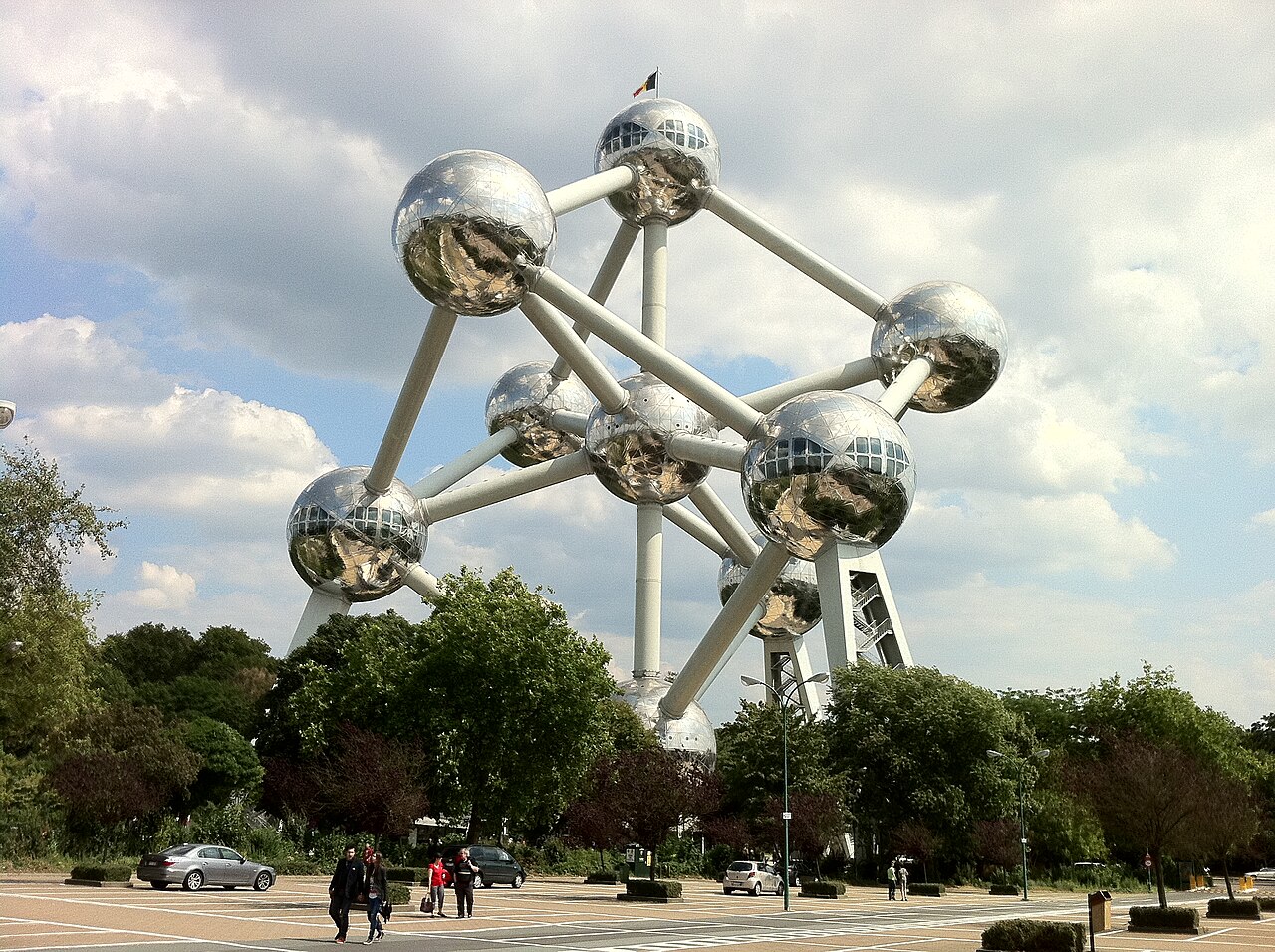
From the ground, the Atomium’s connecting tubes look like lines holding a sculpture together. Inside, those lines acquire a floor, an escalator and a destination. You travel through the silhouette you were just trying to fit into a photograph. The spherical rooms, their exposed framework and the narrow passages between them give this Brussels landmark a pleasure that a skyline view cannot quite explain.[1]
That movement was designed into the building from the beginning. During construction for Expo 58, its makers deliberately limited windows in several spheres so that visitors would keep circulating. The famous shape had to accommodate crowds as well as express an idea of the future. Even a pause to look outside was something the engineers needed to think through.[2]
Its brightness has a history, too. The original aluminium covering deteriorated; during the 2004–2006 restoration, stainless steel replaced it. Some 1,000 original triangular plates were auctioned to help pay for the new skin. The object that seems so complete from a distance has survived through disassembly, repair and reinvention.[3]
Decide what you want to enter
An r/BelgiumTravel discussion captures a disagreement. Several contributors prefer seeing the Atomium from outside; another praises the interior’s light-and-sound show. A commenter identifying Brussels as their birthplace recommends the exterior after sunset. These are individual preferences. They suggest a useful question: do you want the outline, or the experience of moving through it?[4]
That distinction has an immediate practical consequence. As checked on 12 November 2026, the upper sphere’s Panorama is temporarily inaccessible, and tickets are being sold on site only. The official notice gives no reopening date. Read it before travelling: general descriptions farther down the website still describe the normal panorama visit and online sales.[5]
Paying automatically because the building is famous is an avoidable mistake. The community’s exterior-only option is especially reasonable if the high view is your main interest. If the architecture and installations appeal, ask at the ticket office which parts are operating before paying. An old photograph of someone looking out from the top cannot tell you what your ticket buys today.[4][5]
The published standard rates are €17 for adults aged 18–64, €15 for seniors, and €9 for students: allow €9–17 for these admission categories, before transport. These are the listed rates, not a promise of a closure discount. The ticket also includes Design Museum Brussels, about 150 metres away; know that inclusion before buying another museum ticket.[7]
Give the journey some room
For a straightforward approach from Brussels-Midi, take metro line 6 towards Roi Baudouin / Koning Boudewijn and leave at Heysel / Heizel. The paired names matter: they identify the same destination in French and Dutch. Aim for Place de l’Atomium / Atomiumplein 1, rather than treating “Brussels Expo” as a precise entrance instruction.[8]
For an interior visit, I would aim for the 10:00 opening. The operator identifies 11:00–15:00 as the busiest period. Normal hours are 10:00–18:00, with last admission at 17:30, but a late arrival leaves little room for both waiting and looking. Opening time is a better starting plan than assuming the final half-hour is a quiet substitute.[5]
At the site, the ticket pavilion and the Atomium have separate entrances and separate queues. Under the current arrangements, buy at the pavilion first. The operator warns of unpredictable waits of 45 minutes to two hours; that range is a planning warning, not a forecast for your arrival.[6]
The second mistake is scheduling tightly afterward. In the April 2026 community discussion, a visitor describes a long lift wait that disrupted subsequent plans. That was an earlier visit under different access conditions, but the lesson still holds. My planning allowance would be three to four hours for the whole outing from central Brussels, including travel and possible waiting, with the option to shorten it to an exterior visit.[4]
Follow the tubes, then let the room change
The normal exhibition circuit passes through four spheres, using four escalators, with 80 steps up and 167 down spread across the route. The panorama lift is a separate journey; its existence does not make the exhibition circuit step-free. If stairs are a constraint, check access with the venue before committing to the trip.[6]
Once inside, notice the shift between passage and room. The tubes give you a direction; the spherical interiors give your eyes somewhere to wander. Look at the framework as well as the exhibition. It is an unusually physical way to understand a building: the connection that seemed slender from outside becomes a space around your body.[1]
Recent local reporting gives another reason to slow down. Writing in The Bulletin on 14 February 2026, Magdalena Bissels describes installations made specifically for these spaces. In Visual System’s Nimbus, moving light and Thomas Vaquié’s music alter the experience of the room. In Romain Tardy’s Supply Chain, mirrors, LED elements and industrial structures make the technology behind the spectacle part of what you see.[9]
Treating the interior as a quick viewing platform would miss that relationship. Give an installation time to change before moving on; this is my suggestion for looking, prompted by Bissels’s account. The building is both the container and part of the work. The current official listing schedules Nimbus through 7 March 2027, subject to the venue’s opening calendar.[9][10]
Pause where others can pass, keeping stairs and exits clear. The venue also flags disorienting visual effects, so visitors sensitive to flashing or moving light should check the installation guidance beforehand. These details matter in an interior whose appeal depends on movement through enclosed spaces.[6][10]
Outside again, step far enough back to see how the tubes join the spheres. The photograph returns, but it has gained depth: those bright lines now contain the memory of a passage, a staircase, a room opening around you. The Atomium’s continuing life is visible in that change of scale—from an object Brussels displays to a building people still find ways to use.
Sources
- Atomium, “Interior architecture” — spherical interiors, structural framework and connecting escalator tubes.
- Atomium, “The construction of the Atomium” — Expo 58 construction and the relationship between windows and visitor circulation.
- Atomium, “The renovation of the Atomium” — the 2004–2006 restoration, replacement steel skin and auction of original plates.
- Reddit r/BelgiumTravel, “Atomium or Comic Strip Museum,” April 2026 — differing visitor preferences, a Brussels-born contributor’s exterior recommendation and an account of queues disrupting plans; individual experiences, not representative statistics.
- Atomium, “Opening hours” — current panorama closure, on-site-only sales, opening times and crowd guidance; checked 12 November 2026.
- Atomium, “Tour and rules” — current queue warning, separate ticket pavilion, stairs and escalators, circulation rules and sensory considerations; checked 12 November 2026.
- Atomium, “Prices & reductions” — published individual admission categories and included Design Museum Brussels entry; checked 12 November 2026.
- Atomium, “Access” — official metro directions, bilingual station names and street address; checked 12 November 2026.
- Magdalena Bissels, “Light, sound and suspension: The Atomium kicks off anniversary with dazzling digital art,” The Bulletin, 14 February 2026 — local reporting on installations made for the building.
- Atomium, “Nimbus” — current exhibition dates, artistic context and visual-effects notice; checked 12 November 2026.
- Tisloafp, “Atomium Brussel.jpg,” Wikimedia Commons, photographed 15 July 2011 — exterior photograph, shared under CC BY-SA 3.0.