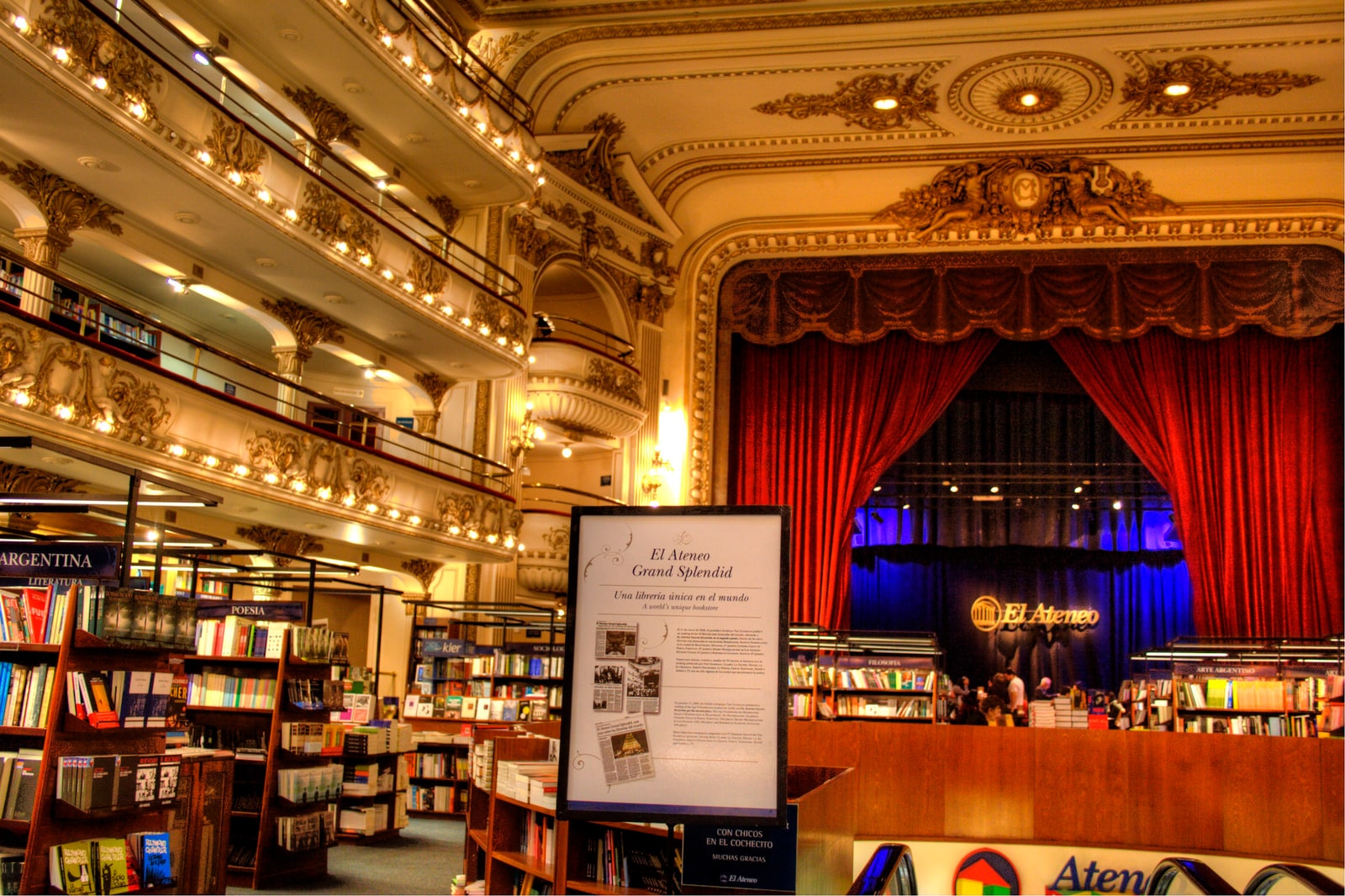
El Ateneo Grand Splendid still tells your eyes where to look. The balconies turn towards the stage, the curtain frames it, and the painted dome draws attention above the shelves. In this Buenos Aires bookshop, the architecture retains the confidence of a room built to gather an audience. Only the audience’s behaviour has changed: people can wander through the former stalls, stop over a book and turn their backs on the stage.[1]
That freedom is the pleasure of the place. You can enter an extravagant theatre on Avenida Santa Fe without waiting for a performance. You can also make the visit unnecessarily complicated by assuming that every part of the building belongs to the same attraction. The bookshop remains free to enter; the third-floor Experiencia Grand Splendid has a separate ticket. Start with the room itself before deciding whether you want the additional visit.[4][6]
A theatre with several afterlives
The Grand Splendid opened in 1919. Its cultural life extended beyond what happened in front of the curtain: the Odeon recording label operated here, Carlos Gardel recorded on the premises, and Radio Splendid began broadcasting from the building in 1923. The city’s tourism account places all these activities inside the same address. This was a building that sent entertainment out into Buenos Aires as well as bringing people in.[1]
The bookshop opened on 4 December 2000. Writing for Meteored Argentina on its twenty-fifth anniversary in December 2025, Agustina Fontirroig describes a conversion that kept the theatre legible: shelves occupy the auditorium, while the stage became a café and the balconies survived. Nazareno Orlandi’s painted dome remains overhead. The most rewarding thing to notice is the mismatch of scales: a room designed for a collective spectacle now accommodates the private decision of which book to pick up.[2]
Give yourself a moment on the main floor before looking for a higher viewpoint. Follow the curve of a balcony towards the curtain; then look down at the tables beneath it. My suggestion is to make that comparison from a side aisle, leaving the entrance and the route through the shelves clear. The photograph comes easily here. Understanding why the room works takes a little longer.
Arrive as a browser
Buenos Aires Free Walks, a local walking-tour operator, recommends mornings or weekdays for a calmer visit. Its guide was updated in August 2026. I would choose 09:00–11:00 on a weekday for the bookshop and allow 45–60 minutes before adding anything else. Those are planning suggestions, not measured queue times or a promise of empty aisles. Ordinary browsing requires no attraction ticket.[3][4]
For a straightforward arrival, the local guide BuenosAires123 directs visitors to Callao on Subte line D, followed by roughly four blocks on foot. Keep Avenida Santa Fe 1860 as the destination; “El Ateneo” alone names a chain. Once inside, move beyond the first view before stopping to photograph it.[4]
The quieter-morning advice matters because this is a working shop with a sightseeing public. In an r/argentina discussion, contributors disagree sharply about the selection: some describe unsuccessful searches, while others question those reports and suggest asking an employee. Several mention the tourist crowds. These are individual accounts, not a stock audit, but they expose a useful visitor mistake: treating the spectacular size of the room as a guarantee that a particular book will be available.[5]
If you have a title in mind, ask a bookseller for the edition and language early in the visit. Keep that errand separate from the pleasure of looking around. The local discussion includes disagreement about the café’s piano, too, so an old account of live music should not become the condition on which the outing depends. Let the shop you encounter be more interesting than a photograph’s promise.[5]
For families, the city’s guide locates children’s books in the basement. That is a useful reason to change floors after taking in the auditorium. For everyone else, a chair is an invitation to pause when available, not a seat reservation. Ask staff about current browsing and reading arrangements before settling in with unpaid books; keep your voice and belongings within the small space you actually occupy.[1]
The upper floor is a separate decision
The newer experience adds interactive scenes, an immersive room, access to former backstage areas and a café with a closer view of the dome. The organiser’s Passline listing places it on the third floor and gives a duration of about one hour. As checked on 12 November 2026, entry windows are 11:00–19:00 Monday–Saturday and 13:00–19:00 Sunday. A ticket is for a chosen day, with entry during that day’s published window.[6]
The same listing shows adult-category face prices of ARS 17,391 for Argentine residents and ARS 26,087 for foreign visitors. For the building alone, the admission budget is therefore ARS 0; adding the experience brings the published general ticket cost into the ARS 17,391–26,087 range, before books, refreshments or any checkout charges. Choose the correct category and bring the required identification for resident or concession tickets. Confirm the final price before paying.[6]
BuenosAires123 says tickets are also available at Informes on the ground floor. Its access notes distinguish lift-served areas from the immersive room and former upper galleries, which require stairs. If that affects your visit, ask at Informes what you can reach before buying. The expensive mistake would be paying merely because you think a ticket is necessary to see the bookshop’s famous interior.[4]
The bookshop and experience also have different closing times. Published guides disagree about the shop’s evening hours, so confirm with the venue before planning a late visit. The morning window avoids that uncertainty; an upstairs visit needs its own time allowance.[1][3][4][6]
On the way out, take one last look across the shelves towards the curtain. The theatre’s geometry is still doing its old work, gathering attention and directing it through the room. Yet no bell tells this audience when to sit down. Someone can stay with a page while someone else looks up at the dome, and the building has room for both.
Sources
- Buenos Aires City Tourism, “El Ateneo Grand Splendid” — theatre, recording and radio history; preserved interior and children’s section.
- Agustina Fontirroig, “De teatro de lujo a ícono cultural y postal turística: El Ateneo Grand Splendid cumple 25 años como librería,” Meteored Argentina, 4 December 2025 — recent anniversary reporting on the conversion and surviving architecture.
- Buenos Aires Free Walks, “Librería El Ateneo,” 18 August 2026 — local operator’s weekday and morning advice; guidance to verify current hours.
- BuenosAires123, “El Ateneo Grand Splendid: horarios y cómo visitar la librería” — local guide to arrival, free bookshop access, ticket desk and stairs within the paid experience; checked 12 November 2026.
- Reddit r/argentina, “The Bookstore Awarded as the Most Beautiful in the World — El Ateneo, Buenos Aires, Argentina” — community discussion of crowds, book availability and changing café experiences; anecdotal and sometimes contradictory.
- Passline, “Experiencia Grand Splendid” — organiser-supplied ticket categories, prices, entry windows and duration; checked 12 November 2026.
- Herbert Brant / HalloweenHJB, “Ateneo Grand Splendid-interior 02-TM.jpg,” Wikimedia Commons, May 2010 — photograph of the auditorium and stage, CC BY-SA 3.0.