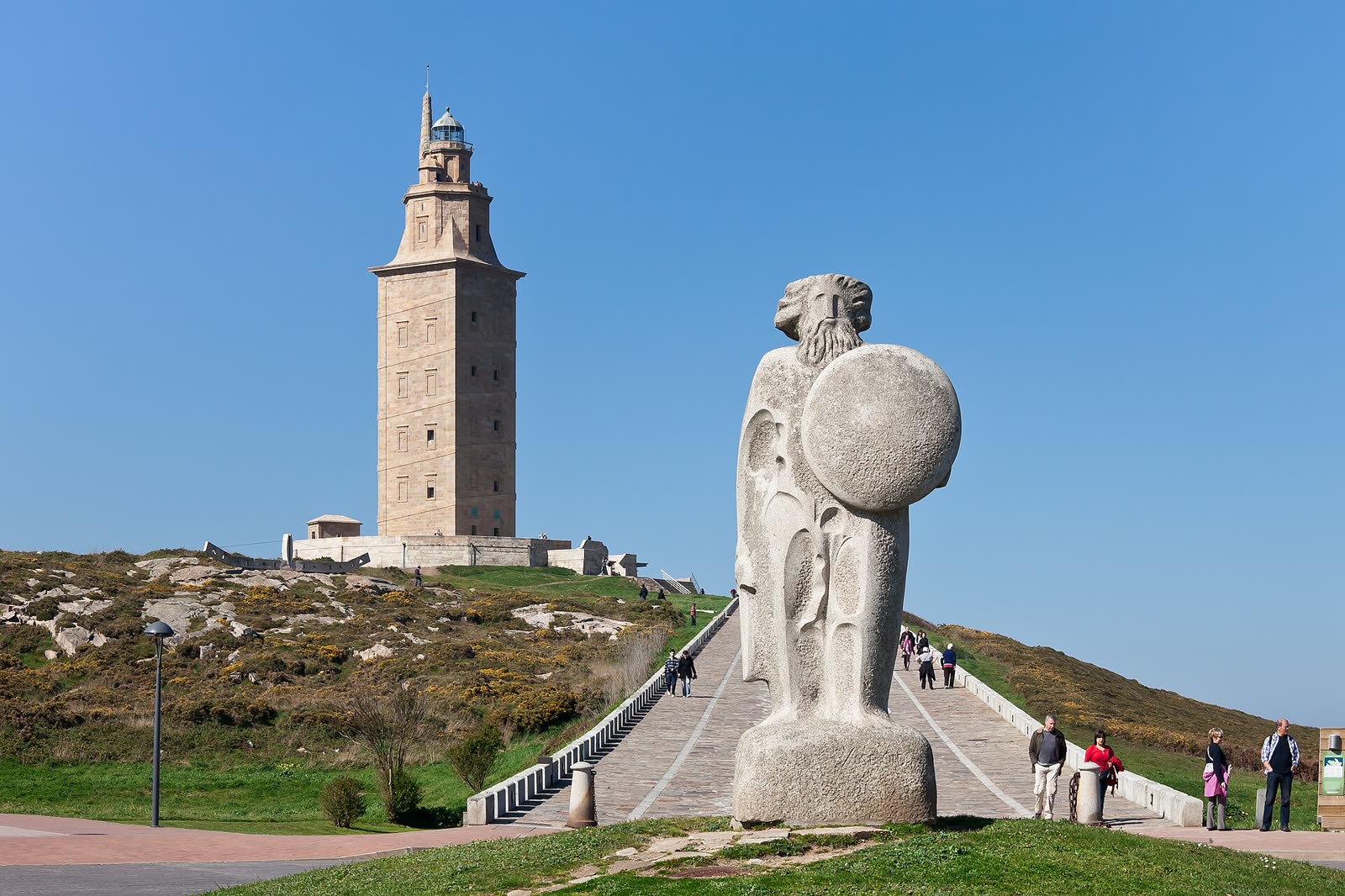
A Coruna's Tower of Hercules is easy to visit in the wrong order. The obvious move is to buy a ticket, climb the Roman lighthouse, take the bay photograph, and leave. The better local rhythm starts outside. Let the headland do the first work: wind, gulls, grass, sculpture, low paths, Atlantic light, and the tower standing slightly apart from the city. Only after that does the climb make sense.
Keep the scope tight. This is not a whole A Coruna itinerary, and it is not a museum-first monument visit. The anchor is the Tower of Hercules plus the surrounding Punta Herminia sculpture-and-coast walk. The useful version takes 75 to 110 minutes: 25 to 40 minutes around the paths and sculptures, a timed interior slot if the weather and capacity allow, then a short second look from outside after you come down. UNESCO's description explains why the tower deserves the attention: it has served as a lighthouse and landmark at La Coruna harbour since the late 1st century A.D., with a 57-meter rock base and a further 55-meter tower, including Roman masonry and an 18th-century restoration layer.[3]
Local move one: arrive before your ticket time, not at it. The city page says visits are limited to 20 people every half hour, starting at 10:15, and warns that same-day capacity can fill before closing.[1] That changes the whole visit. If you arrive exactly when you hope to climb, the tower owns your attention and the headland becomes dead time. Better: get the ticket first, then use the waiting interval for the sculpture park and the Atlantic edge.
Local move two: check the wind as seriously as the hour. The official rules say the monument closes at wind force 7 or higher, and the balcony closes when winds exceed force 5.[1] In a city where sea weather is part of the place, that is not a minor operational note. It is the difference between a summit visit and a ground-level ritual. If the balcony is closed, do not treat the outing as failed. Walk the ring paths, use the sculptures as foregrounds, and let the lighthouse stay exterior.
Local move three: use the seasonal clock cleanly. From 16 September to 15 June, the tower is listed as open 10:00-17:00, with last admission at 15:45. From 16 June to 15 September, the window expands to 10:00-21:00, with last admission at 19:45.[1] Since this post is being created on June 11, 2026, the short-season clock is still in force until June 15, 2026. Do not build a golden-hour climb around summer hours four days early. For the headland walk, late light is excellent; for the interior, the ticket clock is stricter.
Local move four: take bus access seriously enough that you do not waste the approach. The CIAV page gives the tower address on Avenida Doctor Jose L. Vazquez Iglesias and lists bus lines 3, 3A, and 5 for the site.[2] A Coruna's own tourism page points visitors to the Tranvias website and iTranvias app for route planning and real-time bus information.[6] That is the practical cue: use the bus for the approach if you are coming from the old town, cruise side, or station side, then spend your walking energy on the headland rather than on a traffic-edged trudge.
Local move five: start with the open-air museum, not the stairs. The city describes the Sculpture Park as a 47-hectare open-air museum spread across the Tower peninsula, Punta Herminia, O Acoroado, and Cabal de Pradeira, with works arranged in dialogue with the monument.[4] That phrase matters. The sculptures are not decoration around a famous object. They are the way the tower's mythology, navigation story, and Atlantic setting become walkable. Use Breogan, the Compass Rose, the Menhirs, the Stone Ship, and the lower paths as a slow approach rather than a checklist.
Local move six: choose a side path before choosing a photograph. The headland is a Natural Area of Local Interest, and the city notes more than 500 native species around the tower area, plus cliffs, coves, coastal rocks, and habitats shaped by Atlantic exposure.[5] If you go straight to the tower base, every photograph starts looking like everyone else's. Instead, step outward first. Put grass, sculpture, or cliff line between you and the tower. The place gets better when the lighthouse is seen as an active marker in a working coastal landscape.
Local move seven: treat the price as permission to be selective. General admission is 3 euros, reduced admission is 1.50 euros, and Mondays are free, though a CIAV ticket still has to be collected.[1] Those numbers are low enough that the trap is psychological: visitors feel they must climb because it is cheap and famous. Better: climb if the slot, wind, knees, and time all fit. Skip the interior if the day is crowded or the weather has closed the balcony. The headland is still the main room.
Local move eight: leave through a different visual corridor than the one you used to enter. If you came up by bus and began near CIAV, exit by swinging toward the sculpture park and back toward the waterfront instead of walking straight back to the stop. If you entered from the promenade side, do the reverse. The Reddit local/community advice is consistent with this broader reading: recent Galicia travel discussion pairs A Coruna's Old Town, Paseo Maritimo, Monte de San Pedro, and Tower of Hercules as linked city walks rather than isolated attractions.[7] A separate A Coruna community thread calls the tower environment pretty and easy to reach by public transport, while pointing sunset seekers toward the wider coastal parks rather than only the tower itself.[8]
The visitor mistakes are predictable. Mistake one is showing up at 16:10 in the short-season months and expecting an interior visit; the official last-admission time before mid-June is already 15:45.[1] Better: get the climb settled first, then wander. Mistake two is fighting the wind for a summit experience when the balcony is closed. Better: use the ground paths, where the weather becomes part of the city rather than an obstacle. Mistake three is taking one front-facing photo at the tower base and leaving. Better: walk at least one sculpture loop so the monument stops looking isolated.
Mistake four is treating the sculptures as a children's detour or a filler walk. Better: use them as the interpretive layer the city built into the headland. UNESCO's listing explicitly names the nearby sculpture park, Iron Age rock carvings at Monte dos Bicos, and the Muslim cemetery as part of the site's surrounding story.[3] The municipality's park page makes the same point in civic language: the sculpture themes relate to history, mythology, legends, and navigation.[4] Those details keep the visit from flattening into "old lighthouse, nice view."
The best compact route is simple. Arrive around 10:00-10:30 if you want a calmer morning climb, or around 14:15-15:15 in the short-season months if you want afternoon light without risking the last-admission cutoff. Collect or confirm your ticket. Walk outward through the sculpture park for 25 minutes. Climb only if the slot and wind make it worthwhile. After descending, take five minutes to look back at the tower from a lower angle, with Breogan or the grass line in view. Expected spend is 0 to 3 euros unless you add transport or a guide; expected effort is moderate because the exposure and stairs matter more than distance.
A Coruna is a port city, but this headland is where the city becomes legible without a map. The tower is Roman infrastructure, neoclassical restoration, local emblem, navigational tool, UNESCO object, walking target, and weather instrument at once. If you start with the climb, you see a monument. If you start with Punta Herminia, you see why the monument had to be there.
Sources
- A Coruna City Council, "Prices and Opening Times" - official ticket prices, free-entry days, seasonal opening hours, last-admission times, wind-closure rules, and 20-person half-hour capacity.
- Tower of Hercules Visitor Services and Interpretive Center, "Information about the Tower / CIAV" - official address, June-September and October-May hours, CIAV hours, bus lines 3, 3A, and 5, and visitor contact details.
- UNESCO World Heritage Centre, "Tower of Hercules" - World Heritage description covering the late-1st-century Roman lighthouse, 57-meter rock base, 55-meter tower, Roman masonry, 18th-century restoration, adjacent Roman building, sculpture park, Monte dos Bicos, and Muslim cemetery.
- A Coruna City Council, "Sculpture Park" - official description of the 47-hectare open-air museum across the Tower peninsula, Punta Herminia, O Acoroado, and Cabal de Pradeira, with sculpture themes tied to history, mythology, legends, and navigation.
- A Coruna City Council, "Trails and Surrounding Area" - official Natural Area of Local Interest page covering the 47-hectare walking landscape, cliffs, coves, Atlantic habitats, and more than 500 native species around the tower.
- A Coruna Tourism, "Getting around" - official visitor transport page recommending the city bus system, iTranvias app, and Tranvias website for route planning and real-time arrivals.
- Reddit r/Galicia, "Traveling around Vigo and A Coruna. Looking for local..." - recent local/community travel thread recommending the Old Town, Paseo Maritimo, Monte de San Pedro, and Tower of Hercules as linked A Coruna moves.
- Reddit r/ACoruna, "Trip to A Coruna" - local/community advice noting that the Tower of Hercules environment is pretty, reachable by public transport, and best read alongside the wider sunset/coastal-park context.
- Luis Miguel Bugallo Sanchez, "Torre de Hercules - DivesGallaecia2012-62.jpg," Wikimedia Commons - real photographic source used for the article image, showing Breogan and the Tower of Hercules on the A Coruna headland.