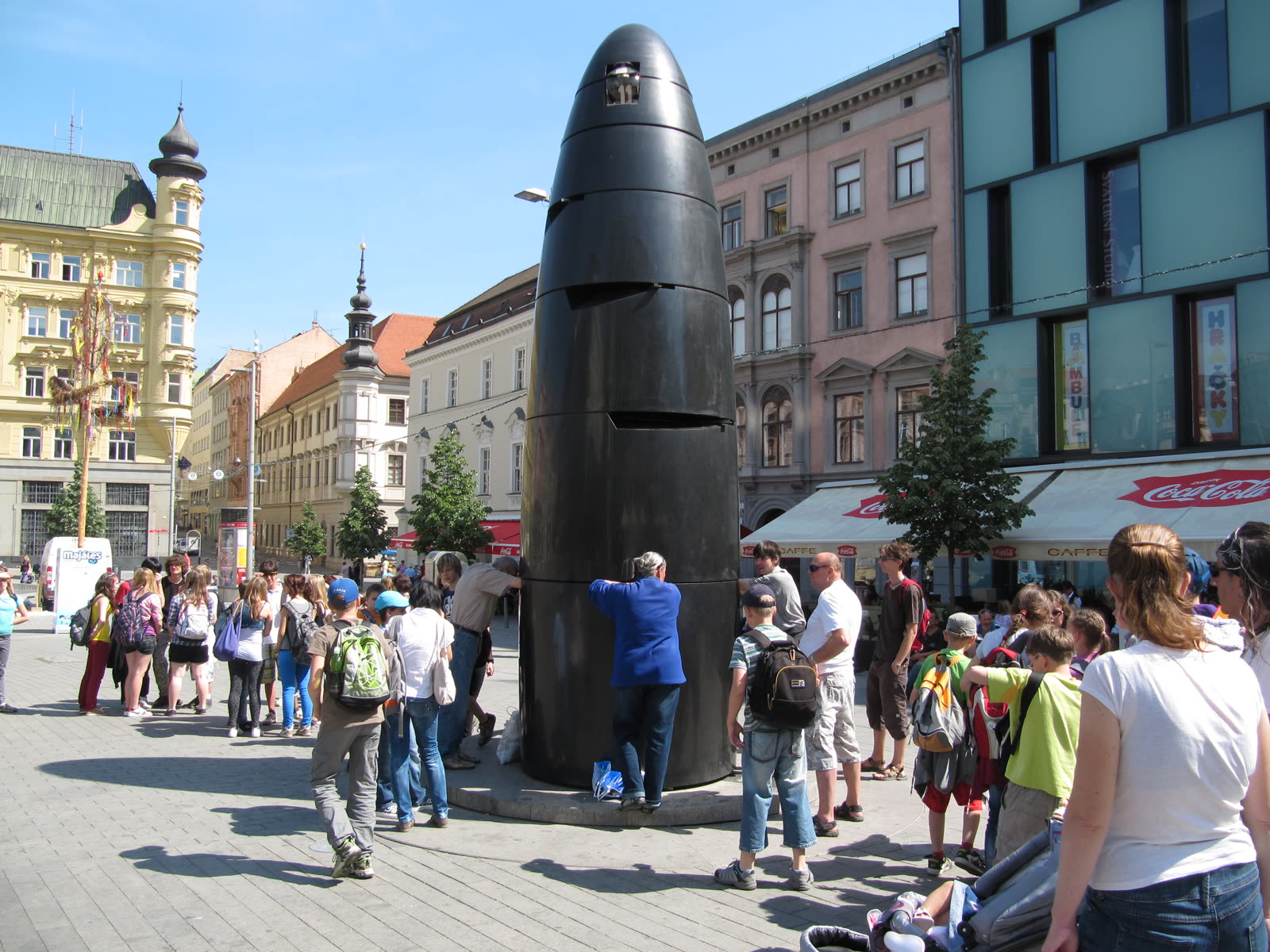
Brno’s black time machine offers a compact lesson in public scarcity. Every day at 11:00, one handmade glass marble travels through the mechanism and chooses one of four openings near the base. Whoever catches it may keep it. A sculpture weighing 24 tonnes becomes, for a few seconds, a game with one prize and no reliable strategy [1][2].
Winning is the least useful way to plan the encounter. The better visit begins with the 10:15 prelude rather than a 10:59 dash: hear the mechanism build through three quarter-hour sequences, decide whether an unoccupied opening genuinely invites a try, and stay a few minutes after the release. If all four positions are already held, the day has answered the question for you. Step back and watch. The ritual is free; possession is not an entitlement.
That boundary matters especially this month. A local Brno publication has confirmed two one-off designs tied to an exhibition on the city’s public lighting: the flame-patterned Oheň marble is scheduled for September 18, 2026, and the starry Noc marble for September 28, each at 11:00 [3]. A Brno-desk report found that collector pressure, now much quieter on ordinary days, can return for limited editions [8]. On those dates, arrive materially earlier or choose an ordinary day if what you want is the mechanism rather than a contest.
The marble changes how the square behaves
The useful recognition cue is almost comically easy: look for a roughly six-metre projectile of polished black granite on the eastern side of Freedom Square [1]. Save the Czech name, Brněnský orloj, rather than searching only for “astronomical clock.” Its official description is closer to a multifunctional clock machine, and it does not perform like Prague’s dial-and-figures spectacle.
Do not go straight to the holes. Stand a couple of paces back for the first sequence. At 10:15, 10:30, 10:45, and 11:00, the carillon plays while balls move through visible slots and strike names connected with the seventeenth-century conflict. The upper stone and glass elements also rotate to indicate seconds, minutes, and hours, though reading them takes more attention than glancing at a face [1]. It does tell the time; it simply refuses to do so at a glance.
Those quarter-hour passages are not dead waiting. They reveal the object in layers: first sound, then internal motion, then the subtle turning of stone, and finally the crowd tightening around the base. Circle it once from the outside. Read the explanatory panel. Keep the square’s through-route clear even when the broad paving makes the space feel entirely pedestrian. Then return to a position from which you can see both the upper rings and the hands below. There is no good reason to spend 45 minutes with an arm inside polished granite.
This is also where the object becomes specifically Brno rather than merely eccentric street furniture. For its fifteenth anniversary, the city noted that “meet at the orloj” had become a local rendezvous formula [2]. That is a deeper success than legibility. A monument initially argued over is now precise enough to organize two people in a large square, yet strange enough that they still have something to say when they arrive.
Chance needs an etiquette
The four openings look like a queueing system, but they are not one. A March 2025 r/Brno account said that, on the writer’s most recent visit, positions filled between roughly 10:00 and 10:20 and were gone by 10:30 [7]. A September 2025 Brno-desk report supplies the longer view: collectors had once arrived up to three hours early; ordinary days had since become calmer; limited editions could still draw them back [8]. One is an anecdote and the other a reported pattern. Neither is a dependable crowd forecast or a license to stereotype whoever is standing there.
If one opening remains plainly free near 11:00 and you want to try, choose one. Do not recruit companions to cover the other three—a temptation documented with unusual candor in the community account [7]. Do not displace a hand, argue about who arrived first, or treat physical persistence as local knowledge. If every aperture is taken, stand far enough back to see the whole release. You will understand more of the square than four people staring into four holes.
Use only a hand, and only if doing so feels comfortable. The clock’s keeper has described removing coins, car keys, and even a wedding ring that visitors inserted as if the machine were a wishing well; local reporting also records improvised traps [4][8]. None improves the ritual. Foreign objects create maintenance work, and a trap turns a chance gift into an attempt to defeat the mechanism.
At the chime, let the outcome be clean. If the marble arrives in your opening, take it and move away from the base so the small crowd can loosen. If it goes elsewhere—or, as one community account observed, bounces off its rail and out of reach—do not reach farther, chase the winner, or demand another release [7]. The operator publishes the ordinary schedule, not a personal guarantee [1].
A legend, a projectile, and a piece of glass
The machine was unveiled on September 18, 2010, on the 365th anniversary of Brno’s defense against a Swedish siege. Oldřich Rujbr and Petr Kameník designed the seven-part column in South African black granite; the projectile form makes the military reference physical before any plaque explains it [2].
The timing comes from a story Brno tells about 1645. In the legend, the besieging commander would abandon the assault if the city had not fallen by noon, so Brno rang noon an hour early. Another strand gives the enemy commander a vulnerability to a glass projectile formed through a magical ritual and fired at midnight. The city labels both strands as legend; local reporting supplies these more specific versions [2][8]. Treating them as folklore preserves what matters—the way a community folds cunning, bells, ammunition, and survival into one tale—without presenting a neat civic myth as a verified battle transcript.
The glass is not generic vending-machine stock. The ordinary marbles are handmade at the Karlov glassworks in the Vysočina region [1]. In January 2026, Czech Radio reported that energy costs were forcing changes at the workshop, while the maker and the clock’s operator still expected production to continue and said reserves covered 2026 and 2027 [5]. That supply story gives the tiny object unexpected weight: the daily giveaway depends on skilled labor, a working furnace, an operator’s stockroom, and continued public appetite.
It also clarifies the choice after a loss. TIC Brno’s official shop currently lists a locally made orloj marble for CZK 470 and marks it in stock [6]. It is not the same experience as catching the day’s random release, but it is the honest route if the object matters more than the uncertainty. The expected spend at the square is therefore CZK 0; the 470-crown alternative buys certainty without turning shared space into a confrontation.
The visitor trapline
Mistake one: arriving at 10:59 because the event happens at 11:00. A community account found all four positions gone by 10:30 on one visit, while local reporting shows that special releases can revive much earlier waits [7][8]. Better: on an ordinary day, arrive for the 10:15 prelude and let the release finish the object rather than replace it [1].
Mistake two: optimizing the odds. The r/Brno visitor openly described holding two holes with a friend and planning to bring more people next time [7]. Better: try one genuinely free aperture or watch from outside the ring; four openings do not make four places for one party.
Mistake three: treating the aperture as something to outsmart. Visitors have inserted everyday objects, while collectors have used purpose-made traps [4][8]. Better: use one bare hand at a free opening or do not enter the catch at all.
Mistake four: believing the public drop is the only honest way to own the object. Local commenters point disappointed visitors toward the tourist shop, whose current listing makes the alternative explicit [6][7]. Better: watch without escalating the catch, then buy one only if the glass itself still matters.
The clean go plan
- Anchor: the glass-marble ritual at Brněnský orloj; do not add a second attraction just to fill the wait.
- Best window: 10:15–11:05 on an ordinary, non-special-release day. Check the operator and local announcements that morning [1][3].
- Expected spend: CZK 0 to watch or attempt the public catch; CZK 470 for the currently listed official-shop alternative [6].
- Queue and reservation reality: no reservation protects a position. Four openings create four informal places, and community reports show that their occupancy varies [7][8].
- Where to stand: begin two paces outside the base so the whole machine remains visible. Near 11:00, use at most one clearly unoccupied opening; otherwise remain outside the ring.
- Navigation cue: find the east side of náměstí Svobody and the six-metre black-granite projectile. Use the Czech pin
Brněnský orloj[1]. - Etiquette: keep the circulation path clear, use only one free opening and a bare hand, do not challenge an occupant, and clear the base once the release ends [4][7][8].
- Special-edition warning: September 18 and 28, 2026 are announced one-off designs, not good baselines for an ordinary visit [3].
Brno’s marble is valuable because it is unnecessary. One person leaves with glass; everyone else can leave with the more revealing object—the memory of a whole square leaning toward chance, then returning to its day. The local move is not to beat that arrangement. It is to let the marble stay small.
Sources
- Technické sítě Brno, “Brněnský orloj” — current operator page for location, daily release, four openings, quarter-hour sequence, time display, designers, material, and handmade marbles.
- City of Brno, “Brněnský orloj slaví patnáctiny jubilejní edicí kuliček” (September 18, 2025) — official anniversary account of the monument’s dimensions, construction, civic afterlife, 1645 legends, and meeting-place role.
- iBrno, “Orloj vydá kuličky k výstavě 245 let veřejného osvětlení v Brně” (August 6, 2026) — recent local confirmation of the September 18 and September 28 special releases.
- Tomáš Kremr, “Už 15 let se na náměstí Svobody v Brně tyčí černý obelisk.” iROZHLAS, September 18, 2025 — keeper interview on the mechanism, catch openings, improvised traps, and objects removed from the clock.
- Andrea Poláková, “Sklárna v Karlově kvůli cenám energií omezí provoz. Kuličky do brněnského orloje chce ale vyrábět dál.” iROZHLAS, January 8, 2026 — recent reporting on the craft workshop and marble reserves through 2027.
- TIC Brno, “Kulička z orloje” — current official shop listing for the locally made 470-crown alternative, checked in stock at publication.
- r/Brno, “How to get the glass marble?” (March 2025) — local community discussion used as anecdotal evidence about variable position-filling, attempts to cover multiple apertures, an out-of-reach bounce, and the shop alternative.
- Tereza Hrabinová, “Jak se na orloji v Brně čte čas a kdy vypadává kulička.” iDNES Brno, September 18, 2025 — local reporting on earlier three-hour waits, limited-edition collector pressure, traps, the free catch, and the legends behind the 11:00 release.
- Palickap, “Brno, orloj, 11 hodin.jpg.” Wikimedia Commons — documentary photograph made at 11:02 on May 10, 2012, showing the clock and marble ritual in Freedom Square.