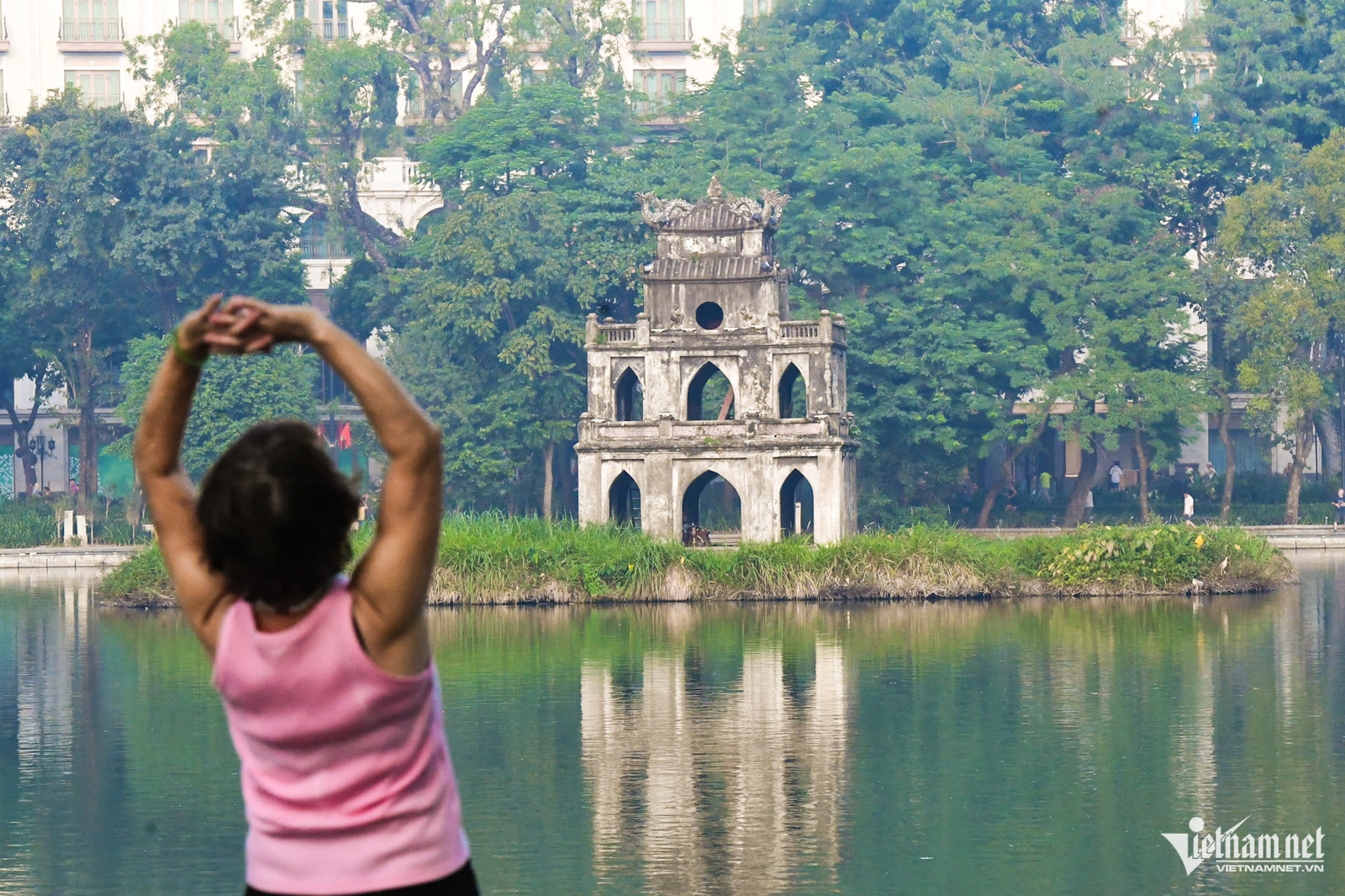
At 05:30, Hoàn Kiếm Lake is not waiting to be discovered. The walkers have already chosen a pace. Runners slip around them. Small exercise groups borrow rectangles of pavement without fencing them off. On September 12, 2026, a local photo report found the same mix—walking, running, cycling and group movement—under the first light of a 26°C morning [2]. The useful fact is not that one dawn happened to be photogenic. It is that the lake was already functioning before most visitor itineraries had begun.
Give that function one complete lap. Start at Hòa Phong Tower at 05:25, walk the lake-side edge in whichever direction is already flowing cleanly, and return roughly 1.8 kilometres later. Allow 45–60 minutes, not because the circuit is long but because a good lap includes waiting, yielding and looking. The lake and path cost VND 0; set an optional VND 0–30,000 ceiling for water bought before or after, not as an excuse to turn the route into breakfast research.
This is a weekday ritual lens. Tuesday through Thursday, 05:25–06:25, gives the clearest view of an ordinary working morning. At weekends the roads around the lake become pedestrian space, which can make running easier but changes the social geometry: the carriageway joins the park, events accumulate and the edge no longer shows quite the same negotiation with live traffic [1][4]. Both versions are real. For a first close reading, choose the narrower one and stay on the pavement.
Move one: begin beside the fragment, not the postcard
Hòa Phong Tower stands on the southeastern shore, beside Đinh Tiên Hoàng Street. It is small enough to miss and specific enough to make a dependable meeting point. Save its pin before leaving your room; at this hour, “by the lake” is not a useful rendezvous.
The tower is also the right historical threshold. It is the surviving trace of Báo Ân Pagoda, a large nineteenth-century complex built in 1842 and largely cleared in the colonial remaking of the eastern shore around 1889 [7]. Morning exercise now passes a fragment left by an urban replacement. That is more revealing than beginning with Turtle Tower as a free-floating emblem: Hanoi's daily circuit runs through a landscape repeatedly rebuilt, not around scenery sealed outside history.
Arrive five minutes before the intended start and stand on the building side of the path while orienting yourself. The lake should remain on one side for the whole circuit. The roadway stays on the other. If you cannot make those two edges agree with the map, you have probably stopped at the wrong tower or allowed a vehicle drop-off to choose your position.
Move two: check the air before choosing the effort
Dawn is cooler; it is not automatically cleaner. A recent r/Hanoi discussion about running near the Old Quarter reaches no comforting consensus: residents and repeat visitors recommend the lake, especially when weekend roads are closed, while several contributors warn that early-hour air can still be poor [4]. Treat that disagreement as a prompt to measure, not as a reason to accept whichever anecdote suits the plan.
Before leaving, open the official VN Air app and select the nearest useful station. It publishes current hourly and daily VN_AQI readings plus health guidance tied to the index [5]. Check rain and heat at the same time. If the live category, visibility or your own health makes exertion a bad bargain, convert the run to an easy walk, shorten it, or skip it. A ritual worth understanding is not improved by pretending conditions are harmless.
Once outside, put the phone away again. This lap asks for less data after the go/no-go decision, not more.
Move three: choose one direction and become predictable
There is no ceremonial direction around Hoàn Kiếm. The local move is simpler: read the flow nearest Hòa Phong Tower, choose a direction, and hold a steady line. Do not weave between a pair walking abreast merely to preserve a training pace. Do not stop at the inside edge of the path, where the water pulls cameras and the narrowest passing line forms behind them. When you need to pause, move fully to the outer edge first.
The official monument authority measures the lake at about 12 hectares and the surrounding line at approximately 1,800 metres [6]. A current community estimate calls a lap about 1.7 kilometres, which is a useful reminder that GPS totals change with pavement choice and small detours [4]. Nothing meaningful depends on resolving the last hundred metres. Commit to one visible circuit rather than chasing a watch reading through other people's space.
For a walker, 30–35 minutes of motion plus 15–25 minutes of observation is about right. For a runner, one easy lap is enough for this exercise in attention. Repetition turns the place into a workout route; that may be valuable on another morning, but it blunts the one-lap argument here.
Move four: leave the borrowed rooms intact
Vietnam's national tourism site describes the hours before sunrise as a time when joggers, tai chi practitioners and games gather around the lake. It also records a favorite Hanoi invitation—đi một vòng hồ, to go once around the lake [1]. A late-August 2026 Vietnam News Agency photo essay finds walkers, runners, tai chi, yoga and ballroom dance already active around the lake at about 05:00 [3]. Together, those accounts explain what the first lap should feel like: public, permeable and already owned by use.
When a group occupies part of the path, pass around its edge without cutting through its formation. If movement is being led, do not mirror it from the front as though the group were a free class. If someone waves you in, follow the invitation and leave when the sequence naturally breaks; otherwise observation is enough. Keep voices low, headphones quiet enough to hear bicycles and feet, and any stretching gear out of the shared line.
The same boundary applies to photography. Wide atmosphere is safer than a close portrait. A phone pointed at an individual doing tai chi turns a daily practice into somebody else's content. Frame water, trees, moving silhouettes and the route's architecture; ask before making any person identifiable. The cover photograph above offers the right model: morning movement and Turtle Tower share the frame, so neither person nor monument becomes a detached specimen [2].
Move five: let the east and west banks disagree
Do not flatten the circuit into “lake views.” Its banks do different work. The eastern side runs beside Đinh Tiên Hoàng Street and the civic buildings that replaced or absorbed earlier fabric. The western edge follows Lê Thái Tổ Street, where the tree line feels more enclosed and the Old Quarter presses closer. Hàng Khay closes the short southern seam. At the north, the red Thê Húc Bridge and Ngọc Sơn entrance create the obvious visual stop [6].
Use those changes to pace the lap. Walk the east without stopping for every open water view. At the north, take one photograph only after stepping out of circulation. Let the west side carry the quieter middle. On the south, find Hòa Phong again before checking the time. This sequence keeps the circuit legible without promoting four new attractions into the itinerary.
The lake's names deepen that unevenness. Official Hanoi sources record earlier names including Lục Thủy and Tả Vọng before Hoàn Kiếm—“Returned Sword”—attached the water to the story of King Lê Lợi returning a heaven-sent sword to the turtle deity after victory over Ming rule [6]. The legend makes the lake a national symbol. The dawn lap makes it ordinary again without making it less important. People use the symbolic centre to maintain bodies, friendships and schedules before work.
Move six: cross with the calendar you actually chose
On a weekday, the roadway is live. Remain on the lake-side pavement, use marked crossings if you must approach from the Old Quarter, and never assume a runner in front of you has made a safe traffic decision on your behalf. The recent local report shows bicycles joining the morning rhythm [2]; it does not turn the footpath into a predictable cycle lane. Listen before changing position.
On a weekend, official tourism guidance says the lake roads close to vehicles and become a broad public gathering space [1]. That does not make every approach street car-free, nor does it guarantee the same closure during a special event or holiday adjustment. Check current barriers and municipal notices when you arrive. A map describes a road; the cones in front of you describe this morning.
The distinction matters because visitors often copy the weekend image on a weekday. Standing in an empty-looking traffic lane for a photograph at 05:40 is still standing in a traffic lane. The better picture is made from the edge that remains public every day.
Move seven: do not buy your way out of the quiet
Hoàn Kiếm sits inside one of Hanoi's densest fields of coffee, breakfast and sightseeing suggestions. Ignore them for one hour. Bring water. The anchor is the circuit itself, and expected spend at the lake is VND 0. The optional VND 30,000 ceiling is a planning boundary for a simple bottle, not a claim about a universal vendor price.
This refusal has a practical benefit. Stopping halfway for coffee means occupying a seat while the morning changes outside; adding Ngọc Sơn Temple means waiting for a separate institution and its opening rules. Both can be worthwhile later. Neither improves the dawn ritual. Finish the loop first and decide afterward whether the day needs another anchor.
The lake is central enough that Hanoi's tourism writing calls it a favorite place to gather throughout the day, but it singles out early morning for precisely this mix of movement and social use [1]. Do not confuse convenience with permission to stack everything nearby. One lap is already a complete city experience.
Move eight: finish while the first hour is still visible
Aim to be back at Hòa Phong Tower by 06:20–06:25. Do not treat that as an official closing time; it is an editorial edge. By then, the exercise groups are thinning or changing, vehicles and deliveries are more insistent, and a visitor with a full day ahead can leave without forcing the ritual to become an attraction.
Before walking away, look once at the tower rather than across the water. In under 60 minutes, the circuit has joined three versions of Hanoi: the remnant of a demolished pagoda, the national story held in the lake's name, and the present-tense social room made by repeated bodies. None needs a ticket. All depend on beginning early enough to see daily use before the centre becomes a destination again.
The visitor trapline
Mistake one: arriving for sunrise rather than for the ritual. Waiting until the sky is fully bright often means meeting more cameras and traffic than exercise. Better: reach Hòa Phong at 05:25 and let sunrise happen during the lap [1][2].
Mistake two: assuming “early” means clean air. Temperature, light and pollution do not run on one clock. Better: use the official live VN_AQI reading before choosing a run, walk or cancellation [4][5].
Mistake three: borrowing the weekend roadway on a weekday. Online photographs often show the expanded pedestrian space, but vehicle closure is a weekend condition [1]. Better: keep the everyday lap on the lake-side pavement and believe live barriers over memory.
Mistake four: treating a documented exercise group as an open class or a photo set [2][3]. Public visibility is not blanket consent. Better: preserve the group's shape, join only when invited, and ask before making an identifiable portrait.
A compact go plan
- Anchor: one complete lap of Hoàn Kiếm Lake, beginning and ending at Hòa Phong Tower. No temple, café or Old Quarter add-on is required.
- Best window: Tuesday–Thursday, 05:25–06:25. This is an editorial recommendation for ordinary weekday rhythm, not an official operating period.
- Distance and time: approximately 1.7–1.8 kilometres; budget 45–60 minutes including two deliberate pauses [4][6].
- Expected spend: VND 0–30,000 at the anchor. The path is free; the upper bound is a self-set allowance for water. Transport and anything after the lap are separate.
- Queue and reservation reality: none. The friction is shared space, live traffic, weather and air—not admission.
- Navigation cue:
Hòa Phong Tower -> keep the lake continuously on one side -> Thê Húc / Ngọc Sơn entrance at the north -> return to Hòa Phong. If the lake disappears behind blocks, correct the route instead of turning the lap into an Old Quarter walk [6][7]. - Same-day checks: the official VN Air reading, rain and heat, any special event, and whether weekend vehicle barriers are actually in place [1][5].
- Etiquette: hold one predictable line, pass around groups, step fully aside before stopping, and ask before photographing a recognizable person.
At 05:30, Hanoi's centre does not feel empty. It feels allocated differently. Pavement becomes an exercise room; a national symbol becomes a neighborhood circuit; a tower left by demolition becomes the mark that sends you out and receives you back. One lap is enough to understand the bargain: arrive before the horns, take only the space you need, and leave the morning usable for the people who will repeat it tomorrow.
Sources
- Vietnam National Authority of Tourism, “Explore the Old Quarter your way” — official tourism account of the đi một vòng hồ invitation, pre-sunrise exercise and weekend vehicle closure around Hoàn Kiếm Lake.
- Thạch Thảo, “Sáng chớm thu ở Hà Nội, người dân chạy bộ, thưởng cà phê.” VietNamNet, September 12, 2026 — recent local photo report confirming walkers, runners, cyclists and group exercise around Hồ Gươm at 05:30.
- Vietnam News Agency, “L'aube à Hanoï : une ville en mouvement, entre énergie et douceur.” Vietnam Pictorial, August 28, 2026 — recent local photo essay documenting walkers, runners, tai chi, yoga and ballroom dance around Hoàn Kiếm at about 05:00.
- r/Hanoi, “Running routes near old quarter” (2026) — recent community discussion of the Hoàn Kiếm circuit, weekend road closure and the need to treat air quality as a live constraint; used as anecdotal local evidence.
- Northern Center for Environmental Monitoring, VN Air — official nationwide hourly and daily AQI readings, station selection and health guidance.
- Hanoi Monuments and Landmarks Management Board, “Cụm di tích quốc gia đặc biệt Hồ Hoàn Kiếm và đền Ngọc Sơn – Di tích đền Bà Kiệu” — official dimensions, 1,800-metre perimeter, bordering streets, lake-name history and monument descriptions.
- MyHanoi, “Tháp Hòa Phong” — local city platform on the tower's southeastern location and its survival from the former Báo Ân Pagoda complex.