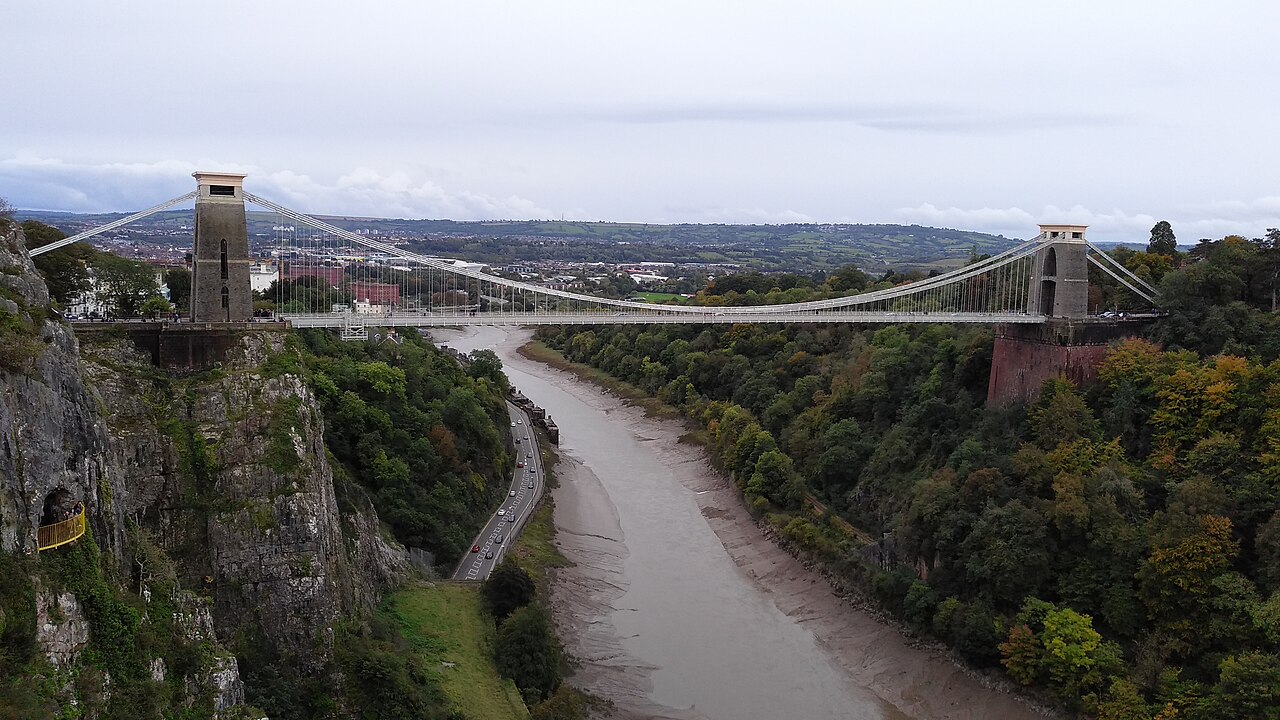
From Observatory Hill, Clifton Suspension Bridge has room around it. The towers stand apart, the chains dip across the gap, and the gorge makes the whole arrangement legible. Step onto the bridge and that picture breaks into close details: ironwork, pavement, passing traffic, the view between the railings. Both positions are worth keeping. Bristol walking guide Mike’s Bristol Walks pairs the hilltop outlook with a crossing to see Clifton from the opposite bank.[1]
The hill also offers somewhere to stay. In a July 2026 discussion on r/bristol, contributors recommend the Observatory grounds for sunset; one specifically suggests the grass outside.[2] That modest distinction is useful. You can give the bridge an hour of attention without buying an experience around it. The pleasure comes from moving close, moving away, and noticing what each position reveals.
Arrive at the height of the bridge
For a first visit that includes the bridge’s museum, I would choose 10:00–11:30, leaving 60–90 minutes once in Clifton. This is a suggested pace, not a prediction of empty footpaths. The museum’s normal hours are 10:00–17:00 daily; the bridge normally remains open around the clock. An ordinary pedestrian crossing needs no reservation and costs nothing.[3] Check the Trust’s current notices before travelling, since maintenance can affect access.[6]
The approach deserves its own allowance. The Trust suggests approximately 45 minutes on foot from the city centre.[3] A flat map can make that look like an effortless add-on; Mike’s local guide describes steep terrain, and the Trust warns that walking routes from the centre involve a climb.[1][4] If the gorge is the part you want your energy for, take the number 8 bus to Clifton Village or Christ Church and walk from there. The official directions describe these final approaches as short and level. Check the current journey planner: the Trust flags city-centre bus-route changes from August 2026.[4]
Keep £0–5 per person as an optional on-site budget: admission to the bridge and museum is free, and five pounds is a suggested donation allowance, not an entrance charge. Transport, refreshments and any separately booked tour are outside that figure. There is no timed-admission queue for the ordinary crossing; this remains a route people use to get somewhere.[3][6]
Give the bridge some distance
Going directly to the tower can leave you with photographs of details and little sense of the span. Make the short uphill detour to Observatory Hill first. Mike’s route identifies the stone Observatory tower above the gorge and the outlook towards the bridge, with the Cumberland Basin’s warehouses beyond.[1] The public grass outside is the place recommended in the recent local discussion; entering the Observatory’s attractions is a separate choice.[2]
Stand back enough to let both towers enter the view. Their separation is the subject. Look at how the chains curve towards the middle, then compare that curve with the straighter line of the road. The gorge supplies the scale that disappears when the ironwork is within touching distance.
Follow the established path down towards Suspension Bridge Road, where the bridge approach becomes the obvious navigation cue.[1] Keep the hill and the crossing as two distinct pauses. There is no need to keep a phone raised between them.
Cross, then turn towards Clifton
On the footway, leave room for people coming the other way and step aside where space permits before stopping. Anyone bringing a bicycle onto the pedestrian footway must dismount; the Trust provides a separate signed route for cyclists riding on the road.[6] The architecture has an everyday job, and watching that job continue is part of the visit.
The Trust’s self-guided walk points out an especially good moment at the Leigh Woods end: turn and look back towards the gorge and Clifton. The Georgian houses of Sion Hill slope towards the large cream-coloured Avon Gorge Hotel.[5] From this side, the bridge belongs to a neighbourhood. Windows, terraces and the cliff come into the picture together.
Turning back as soon as you clear the span would miss that view. Mike’s guide specifically recommends crossing for the outlook towards Clifton; give the far bank a pause before beginning the return.[1] You have changed more than your position on a map. The place you approached through has become something you can see.
The iron has been somewhere else
Look again at the chains before leaving. Much of their iron began its working life in London: the Trust records that many links were manufactured for Brunel’s Hungerford Footbridge, opened in 1845. When that bridge was removed to make way for the Charing Cross Railway Bridge, engineer John Hawkshaw reused components at Clifton.[7]
That history gives the familiar outline a different texture. These are parts with a previous address, kept in service through inspection, painting and repair. The Trust’s account of the refurbishment begun in 2024 describes protecting the wrought iron and replacing the lighting.[7] Looking at the chain links becomes a way to notice the maintenance behind a view that photographs can make seem permanent.
Stay on the pavement beyond the Leigh Woods end and look for the museum opposite the zebra crossing.[5] Its free displays explain the bridge’s construction and continuing care.[3] Leave roughly 20–30 minutes within your visit for that indoor pause; this is an itinerary allowance, not a prescribed tour duration. The return walk then gives you another chance to look at the material you have just read about.
If you prefer the evening gathering on Observatory Hill, borrow the local suggestion and settle on the grass before sunset.[2] Treat that as a different visit from the morning museum stop. Either way, let the final view last longer than the photograph: the small movement of people across the deck is part of what holds the scene together.
Sources
- Mike’s Bristol Walks, “Walk Five: Introduction to Clifton,” June 2020, especially pages 1 and 9 — local walking guide to the hills, Observatory viewpoint, bridge approach and view back towards Clifton.
- r/bristol, “Things to see in Bristol for two days,” 22–23 July 2026 — local community recommendations for sunset from the Observatory grounds and grass; individual suggestions, not a crowd forecast.
- Clifton Suspension Bridge Trust, official visitor information — free pedestrian access, no crossing reservation, museum hours and approximate walk from the city centre; checked 14 October 2026.
- Clifton Suspension Bridge Trust, “How to Find Us” — uphill approaches, number 8 bus stops, level final approaches and the August 2026 route-change notice.
- Annabel Storrar for Clifton Suspension Bridge Trust, “Over and Under the Clifton Suspension Bridge: A Self-Guided Walk” — Leigh Woods outlook, Sion Hill and museum navigation.
- Clifton Suspension Bridge Trust, “Crossing the Bridge” — pedestrian access, cycling and dismounting rules, with links to maintenance and planned closures.
- Clifton Suspension Bridge Trust, “Refurbishment Works” — the reused Hungerford chain links, John Hawkshaw and the refurbishment project begun in April 2024.
- WFan, “20191012 Clifton suspension bridge 1.jpg,” Wikimedia Commons — photograph dated 12 October 2019, CC BY-SA 4.0.