Utrecht’s former main post office gives its visitors an unusual privilege: time beneath a ceiling designed for people with an errand. In the central hall at Bibliotheek Neude, brick arches rise above reading tables, stone figures stand against the walls, and the old machinery of public grandeur survives around ordinary library life. The building opened as a post office in 1924; its library conversion opened in 2020. Once, customers could enter the hall while the rooms beyond belonged to staff. Now those rooms are part of the visit.[1]
That change is the reason to come inside. The hall supplies the first astonishment, but the more revealing moment comes when you follow a doorway that would once have stopped you. Zecc Architecten and Rijnboutt’s conversion added six openings above the historic doors, drawing light and sightlines towards the side wings.[2] A room built to receive the public has become a starting point for exploring.
Aim for Neude 11, on the square, and find the two stone lions beside the entrance. They have their own small Utrecht story. When the post office opened, the intended sculptures were still blocks of stone; contributions from local businesses and residents helped turn them into lions in 1926.[3] Before you meet the imposing interior, the doorway already records a piece of civic participation.
The first mistake would be to admire the façade and keep walking because you have no books to borrow. The Dutch visitor account Reis ernaartoe recommends an extended look precisely for people without a borrowing errand, and Utrecht’s tourism organisation includes the library among its free outings.[4][6] Walk into the public hall. You do not need to buy a sightseeing ticket or a drink to justify looking around.
For a first architectural visit, Thursday, 12:30–14:00, is a useful suggested window: it falls within the library’s fully staffed period and leaves the option of joining a booked afternoon tour. This is a planning choice, not a promise of low crowds. Published opening hours, checked on 15 October 2026, are 09:00–21:00 Monday–Saturday and 10:00–18:00 Sunday. Staff are available across the departments daily from 12:00 to 18:00; outside those hours, assistance is concentrated at the second-floor customer-service desk.[5]
Allow 45–60 minutes for an independent look. A reasonable personal allowance is €0–8, excluding transport: the visit costs nothing, while the upper figure is an optional refreshment budget, not a quoted café price. The café is a separate choice. The main expenditure here can simply be time.[6]
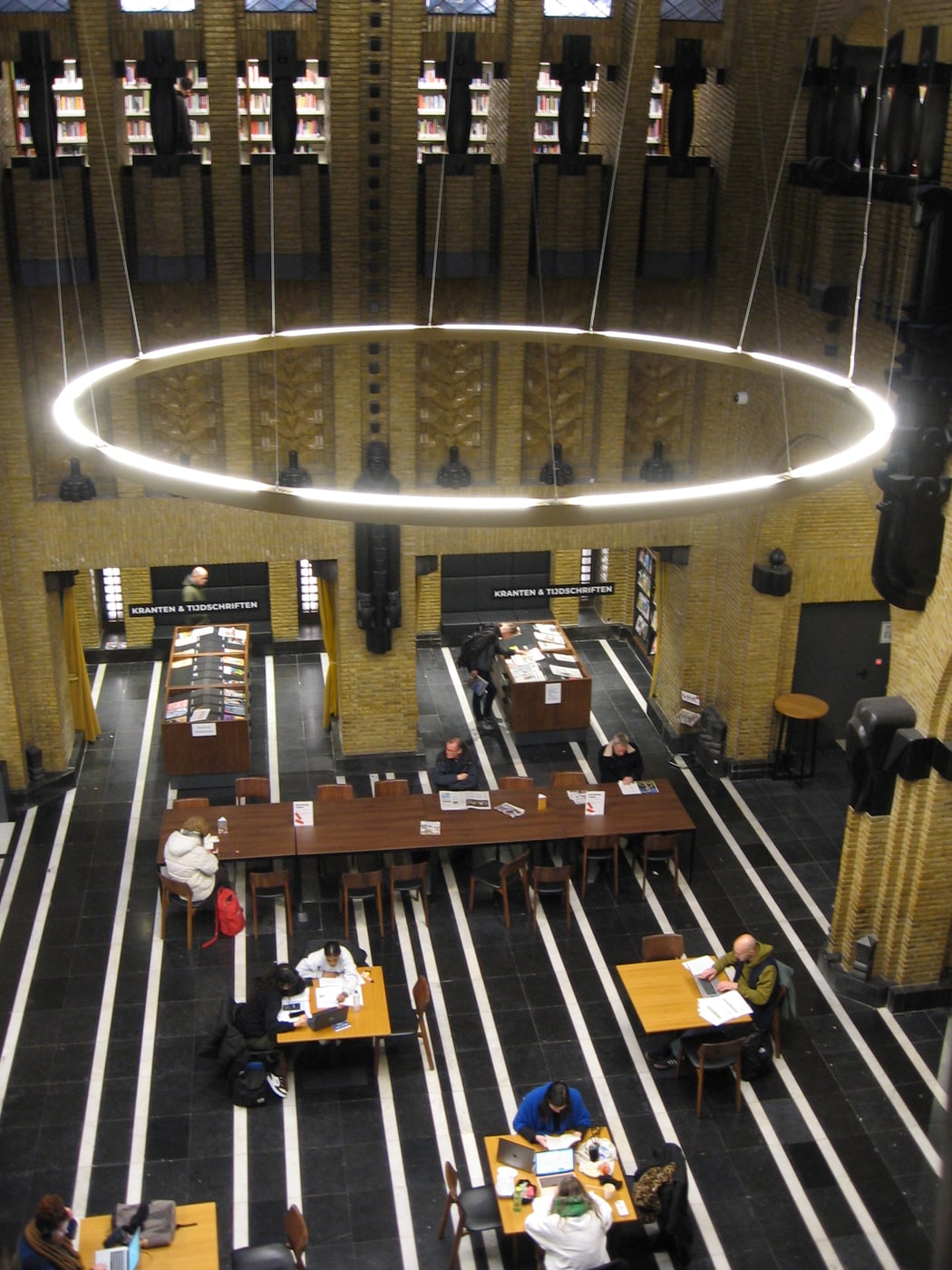
Begin with a slow circuit of the hall, keeping clear of people passing through. Joseph Crouwel designed the building in the Amsterdam School style. Look for Hendrik van den Eijnde’s tall figures representing continents and his glazed-brick carrier pigeons: postal communication has been worked into the decoration. Crouwel also designed the great clock and national coat of arms, made by Royal Delft.[1] These details make the room legible as a post office even after the counters’ original purpose has disappeared.
Then take the first-floor circulation route for a view back into the hall. The Dutch visit account photographs this upper outlook, and the library’s conversion architects describe how new passages connect rooms while preserving changes between low and high spaces.[4][2] From above, the tables bring the monument down to human scale. Someone reading beneath those arches is using the room at a different pace from a customer waiting to post a parcel.
Keep that ordinary use in mind when taking photographs: frame the architecture without making a reader’s face or laptop the subject, and leave the passage clear. The most satisfying view includes the possibility that people can carry on with their day while you look.
A second mistake is to equate a beautiful library with a guaranteed cosy seat. In a May 2026 r/Utrecht discussion about quiet places to read, one contributor recommends Neude’s comfortable corners; another finds too few appealing seats.[7] Those are individual experiences, but the disagreement is useful. Come for the building without making your afternoon depend on an empty armchair.
If you actually need a reserved work session, arrange it separately. The library’s booking system offers places for today or tomorrow, with blocks of up to three hours; members can book free, and non-members can try once free. Check in using the desk’s QR code: a reservation lapses after 15 minutes of lateness.[8] An architectural wander and a dependable study place require different preparation.
For more of the building’s stories, reserve the guided visit. The regular schedule lists 14:00–15:00 Thursday–Saturday, plus 11:00–12:00 Friday, with just eight participants per tour.[3] The tours are free, but Utrecht’s visitor guide explicitly advises booking.[6] Do not treat free admission as a guarantee of a spare guided-tour place. If language is a concern, use the English information booklet linked from the tour page; it also works as a companion for independent looking. Before a booked tour, lockers are available to the right of the second-floor service desk.[3]
Finally, check the day’s programme if you want a contemplative visit. Local newspaper DUIC’s 6 September 2026 report previewed a free Rechtsstaat Parade across the library’s rooms, mixing talks, theatre and public discussion.[9] That event has passed; the useful lesson remains that this is an active civic building with changing uses. The hall’s grandeur does not oblige the whole place to behave like a silent monument.
Return to the entrance before leaving. The clock, the pigeons and the stone figures still belong to a building made to connect Utrecht with elsewhere. The library has added another kind of connection: open doors into rooms the old customer never saw. Give yourself enough time to follow one.
Sources
- Bibliotheek Utrecht, Neude Library, English information booklet, 2024 — building history, former public access, architect, continental figures, carrier pigeons, clock and coat of arms.
- Zecc Architecten, “Bibliotheek Neude,” Architectenweb, 29 June 2020 — project-team account of the conversion with Rijnboutt, new openings and connected rooms.
- Bibliotheek Utrecht, “Rondleidingen Neude” — regular guided-tour times, capacity, lockers, English booklet and the entrance lions’ history; checked 15 October 2026.
- Reis ernaartoe, “Bibliotheek Neude in het oude hoofdpostkantoor Utrecht,” 16 August 2020, updated 27 January 2026 — Dutch visitor account recommending the building without a borrowing errand and documenting the first-floor outlook; the visit itself dates to 2020.
- Bibliotheek Utrecht, “Bibliotheek Neude: Openingstijden” — Neude 11 address, weekly opening hours and departmental staffing hours; checked 15 October 2026.
- Ontdek Utrecht, “8x de leukste gratis uitjes in Utrecht” — free architectural visit and free tours requiring reservations.
- r/Utrecht, “Rustig leescafé gezocht,” 17 May 2026 — recent local community recommendations and disagreement about Neude’s comfortable reading places; anecdotal evidence, not a crowd forecast.
- Bibliotheek Utrecht, “Werken of studeren in de Bieb” — reservation eligibility, booking horizon, time blocks and check-in rules; checked 15 October 2026.
- Sofie Jansen, “De Rechtsstaat Parade: feest én wake-upcall,” DUIC, 6 September 2026 — recent local reporting on a library-wide public programme scheduled for 10 September.
- Hansmuller, “Grote Hal, Openbare Bibliotheek Neude, Utrecht. Noordoostkant, januari 2023,” Wikimedia Commons — photograph taken 21 January 2023, CC BY-SA 4.0.