Autumn on the Petite Ceinture comes with a small administrative surprise. On October 24, 2026, the public railway walk in Paris’s 14th arrondissement closes at 18:30. The following day, it closes at 17:00. The trees will change at their own pace; the gate loses ninety minutes overnight.[1][2]
That makes this a particularly good place to give an autumn afternoon a modest ambition: descend below the streets, follow the old track, and take an hour to notice what grows around it. The section known as PC14 runs for 750 metres between rue Didot and avenue du Général-Leclerc, in a cutting whose vegetated banks put the city above your head.[3] You can walk through quickly. The pleasure is allowing a short distance to occupy more time than it needs.
Give the afternoon an earlier start
For an October visit, choose 15:00–16:00 as a comfortable walking window. This suggested plan fits on either side of the clock change and leaves room to find the entrance without making closing time the destination.
The first trap is carrying a summer evening habit into autumn. Petite Ceinture Info, the specialist local guide, makes the seasonal change explicit; use its entrance advice alongside the city’s dated timetable.[1] Looking up “Petite Ceinture hours” without specifying the arrondissement is less useful: these promenades are separate public spaces, and an hour attached to another section need not be yours.
An independent walk is free, with no timed admission to reserve. Budget €0–10 beyond transport: zero for the promenade itself, with the upper end simply an optional allowance for something bought before or after, not a ticket price. Sortiraparis’s locally reported walk lists free access and recommends breaking the railway into manageable sections.[6] This is one such section, with no obligation to add another.
Find the staircase, then follow the rails
Come by Métro line 4 to Porte d’Orléans. The community walking platform Visorando places the station immediately beside avenue du Général-Leclerc near rue de Coulmiers.[4] Turn onto Coulmiers and find the number 4 entrance recorded by Petite Ceinture Info; the other end is at 123ter rue Didot.[1] The second trap is arriving at street level and assuming that the track beneath you must be accessible from exactly where the map pin lands. Save the entrance address, not just the railway’s name.
From Coulmiers, descend to the former platform and railway level, then follow the public path toward Didot. You are taking the reverse of Visorando’s documented route: the short passage beneath rue Friant comes before the bridges carrying avenue Jean-Moulin and rue des Plantes.[4] Those overhead crossings give the walk its scale. Streets that normally send you toward the next junction become brief roofs over your head.
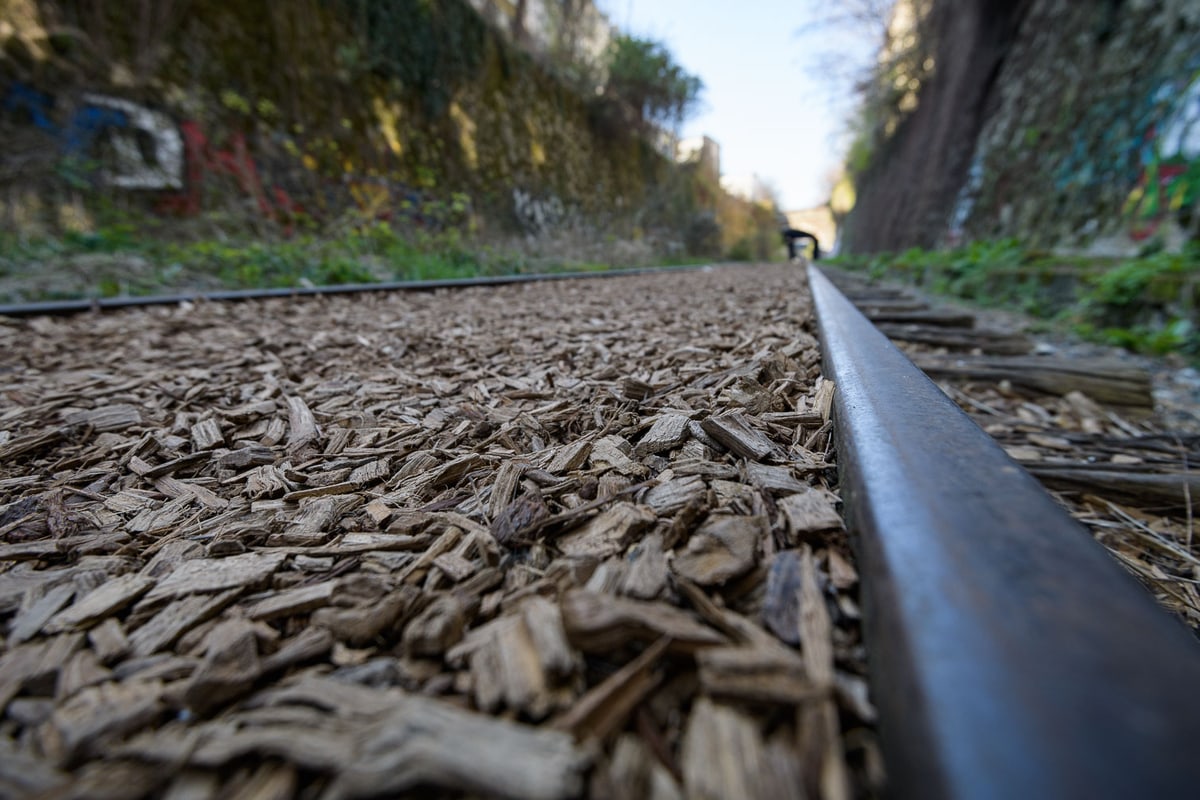
Wear shoes suited to a path rather than polished pavement. The city describes chipped wood laid among the surviving rails to make a walking surface; the retained track also accommodates the maintenance association’s rail trolley.[3] That detail is worth looking down for. What resembles a railway being swallowed by vegetation is also a place whose upkeep still makes practical use of the track.
At Didot, either leave by the public exit or turn back. Returning to Coulmiers makes approximately 1.5 kilometres along the promenade; allow 45–60 minutes for the out-and-back with pauses, an editorial estimate rather than a measured tour duration. For a photograph, stop where the path gives others room to pass and let a bridge frame the view. There is no need to climb a bank to make the railway recognizable.
Leave the untidy edges alone
The third trap is reading the name “Little Belt” as a promise of an uninterrupted circuit. The Association des Promeneurs de la Petite Ceinture explains that open walks remain separated by closed railway sections. Where access ends, return to the street; a line continuing behind a gate is not a continuation of the public footpath.[5] A satisfying PC14 visit can end after these few bridges.
Before descending, deal with water and a toilet stop: the city lists neither toilets nor a drinks dispenser on this section. Dogs are not admitted.[2] The stairs also matter when choosing the outing. Visorando describes stair access at both ends, while the city’s PC14 listing does not confirm step-free accessibility; anyone who needs it should verify the entrance arrangement before setting out.[2][4]
There is a reason the place feels less composed than a formal Paris garden. Vegetation established itself on the railway banks, and the promenade’s design preserves that character.[3] Public access here also reflects a neighborhood choice: the city traces the opening in summer 2019 to the participatory-budget project to reclaim the Petite Ceinture.[7] The short walk is a piece of infrastructure that residents helped make available for ordinary afternoons.
Autumn gives that ordinary afternoon an edge: the time available contracts while the banks keep changing. Look along the rails once more on the return, then climb back to Coulmiers. At street level, the bridges become junctions again. The satisfying part of this little excursion is how much Paris can change without your travelling very far.
Sources
- Petite Ceinture Info, “Promenade du 14e arrondissement (PC14)” — local specialist guide to the Coulmiers and Didot entrances, seasonal hours and railway status; checked October 14, 2026.
- Ville de Paris, “Petite Ceinture du 14e (PC 14)” — current hours, facilities, accessibility and photograph; checked October 14, 2026.
- Ville de Paris, “La petite ceinture et ses promenades écologiques,” updated August 19, 2026 — PC14 length, cutting, vegetation, mulch surface and maintenance trolley.
- Visorando, “La Petite Ceinture du 15e, Georges Brassens et la Petite Ceinture du 14e,” updated September 2, 2026 — community route, PC14 directions, stairs and Porte d’Orléans connection; latest displayed walker review May 4, 2026. Its combined opening-hours summary is superseded here by the city’s section-specific timetable.
- Association des Promeneurs de la Petite Ceinture, “Se promener sur la Petite Ceinture aujourd’hui” — independent local association’s guide to open promenades, discontinuities and respecting closed sections.
- Graziella, Sortiraparis, “Balade sur la Petite Ceinture du 14 au 16e arrondissement : un sentier nature dépaysant,” August 29, 2022 — locally reported walk, free access and advice to divide the disconnected sections; used for context, not current hours.
- Ville de Paris, “10 ans de Budget Participatif… dans le 14e” — the resident-backed project and summer 2019 opening between rue de Coulmiers and rue Didot.