At the far end of Marsh’s Library, three little enclosures give the beautiful room an unexpected edge. Their wired doors once closed around readers to keep them from stealing books. A library opened to the public had made a practical calculation: knowledge could circulate while the person consulting it stayed put. The cages turn the oak shelves around them into something more interesting than an attractive background.[1][5]
This is a particularly rewarding Dublin room to give an unhurried hour. In an April 4, 2026 discussion of overlooked places, a self-described Dubliner said they returned about once a year, drawn partly by the smell of old books.[2] That is one resident’s affection, rather than a verdict from the whole city. It does suggest the right scale of attention: a familiar interior can repay another visit without acquiring a new spectacle.
Find the library’s own door
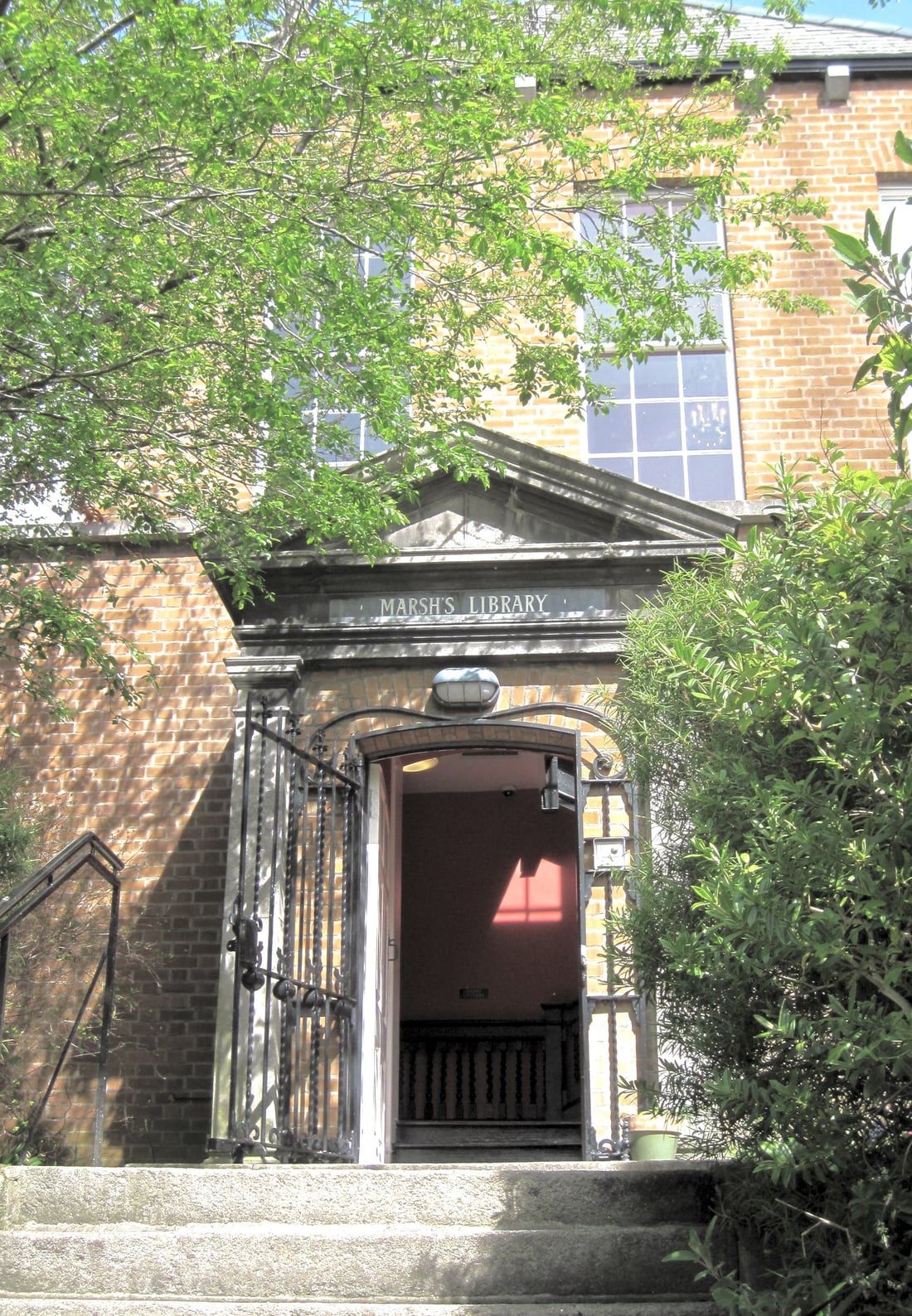
Use St Patrick’s Close, D08 FK79 as the destination. The library sits behind St Patrick’s Cathedral; look for the library’s own entrance and the name above its door before following the larger monument’s visitor flow.[1][3][7] The cathedral is a useful landmark, but this visit has its own door, stairs and admission.
For a first visit, I would choose 09:30–10:30, Tuesday to Friday, and allow 45–60 minutes including the garden. That is a suggested pace, not a timed tour. One Tripadvisor visitor reported a few quiet minutes after arriving at opening; another found the narrow passages harder to negotiate when a tour was present.[4] Early arrival offers a sensible chance of breathing room, without promising an empty gallery.
Visiting details checked September 29, 2026: the advertised public hours are 09:30–17:00 Tuesday–Friday and 10:00–17:00 Saturday. Keep ordinary sightseeing to those listed days; Sundays and bank holidays are closed. Check the library’s notices before setting out. Budget €8 per adult, or €6 for students and seniors; individual under-18s enter free. You can book online or pay at the door.[3]
The admission charge has surprised visitors: a Tripadvisor review describes an unexpected expense, and the library’s reply explains its conservation costs.[4] Knowing the price beforehand makes this a deliberate small visit. There is no compulsory advance reservation for an ordinary individual visit, but the pay-at-door option says nothing about how long any queue will be.[3]
The stairs also deserve attention before arrival. The historic galleries are not wheelchair accessible. Staff can arrange access to the ground-floor facilities, shop and garden on request; contact the library first if that changes whether the visit will work for you.[6]
Let the shelves slow the walk
At the top, pause for the staff introduction and take the self-guiding leaflet. Ask what to look for in the current exhibition before moving into the first gallery.[5] Visitors repeatedly single out the staff’s explanations.[4] A question about one displayed page gives the room a focus that a sweep of photographs cannot supply.
The building’s sequence is compact: two long galleries connected by an old reading room, with books arranged in bays of dark oak.[1] The library dates its public opening to 1707 and says the first gallery’s books retain their places on the original shelves.[5] Look along a bay as well as down the central aisle. The repeated divisions make the collection feel both extensive and domestic: knowledge has been fitted into furniture.
In the Old Reading Room, take the invitation to sit at the original table.[5] A seated view changes the proportions. Shelves become the boundaries of a place where someone might spend an afternoon, and the distant end of the gallery ceases to be the only destination. When a group passes, leave the narrow route clear and resume looking afterward. The visitor reports about congestion are a useful correction to the assumption that a quiet attraction always offers unrestricted space.[4]
A door around the reader
Continue to the three cages at the end of the second gallery.[5] Dublin.ie’s local account places them within the older problem of protecting valuable books from theft.[1] They deserve a pause because their purpose changes how the whole room reads. Public access required a way to keep a collection available for the next reader. Here that negotiation left visible doors.
Today, the boundary is gentler but still real. Leave shelved books untouched and read the open examples in the exhibition instead. The library’s FAQ permits personal photography without flash, while research access requires supervised handling. An admission ticket also does not provide a general study desk: study places are for people consulting the collection.[6] These rules explain how the room can remain both visitable and useful.
Finish through the downstairs shop and give the little garden a few minutes before returning to the street.[5] There is no need to extract a grand literary revelation from the visit. The cages, the table and the staff’s careful permission to look have already made a modest argument: a public library lasts through repeated acts of attention, including restraint.
Sources
- Genevieve Fitzgerald, Dublin.ie, “Supernatural Dublin — Marsh’s Library” — local account of the building’s setting, gallery arrangement and reading cages.
- r/irishtourism, “Overlooked places in Dublin,” April 4, 2026 — recent community recommendation from a self-described Dublin resident who revisits Marsh’s Library.
- Marsh’s Library, official homepage — current admission, public opening hours, address and online or door-payment options; checked September 29, 2026.
- Tripadvisor, Marsh’s Library visitor reviews — individual reports on opening-time quiet, narrow passages during tours, staff explanations and admission expectations; historical prices in reviews are superseded by the official site.
- Marsh’s Library, “Plan Your Visit” — staff introduction, leaflet, original shelves, Old Reading Room table, cages and garden sequence; checked September 29, 2026.
- Marsh’s Library, “Library FAQ” — accessibility, personal photography, book handling and restrictions on general study; checked September 29, 2026.
- Leslie Noelle Sullivan, “The doorway to Marsh’s Library, beckoning” — original photograph and CC BY-SA 4.0 attribution record, Wikimedia Commons; resized for this article.