Salzburg gets overbooked by first impressions. Visitors stack Getreidegasse, Mozartplatz, the fortress, and a pastry stop into one old-town sweep, then treat any hill view as a bonus if there is time left. The cleaner seasonal version is narrower and much more local in its mechanics. Take the Mönchsberg lift up in the evening shoulder, keep moving past the museum terrace, and let Richterhöhe be the real destination.[1][2][3]
That sequence matters because the lift is not only a convenience. Salzburg's official page frames it as the fastest route onto the Mönchsberg: a 60-metre rise in 30 seconds to an elevation of 485 metres, with the valley station on Anton-Neumayr-Platz and 2026 hours that currently run Monday 8 a.m.-7 p.m. and Tuesday-Sunday 8 a.m.-9 p.m., stretching to 11 p.m. daily from July 18.[1] Those numbers are not trivia. They explain why this works specifically as a warm-season evening move. The ascent is so short that you do not spend your energy on access, and the longer seasonal light lets the ridge itself become the event.
The second anchor is what most first-timers miss. Salzburg's own Mönchsberg magazine piece treats Richterhöhe as an insider tip and names it the Mönchsberg's 508-metre high point, a slightly hidden perch that feels more secluded than the first obvious museum-edge platform.[2] The city's "Instagrammable Salzburg" walk makes the same directional point in a more tourist-facing voice: once you are up on the Mönchsberg, the route keeps leading toward Richterhöhe because the broader hill sequence matters more than the lift arrival alone.[3]
There is also a city-specific texture here that improves the walk. The Mönchsberg gets its name from the monks of St Peter's Abbey.[2] Even now, one of Salzburg's most useful urban facts is that a hill, old defensive edges, museum access, parking exits, quiet paths, and skyline views all sit on top of one another instead of being zoned into separate attractions. The result is a city that rewards one well-timed elevation change more than a marathon checklist.
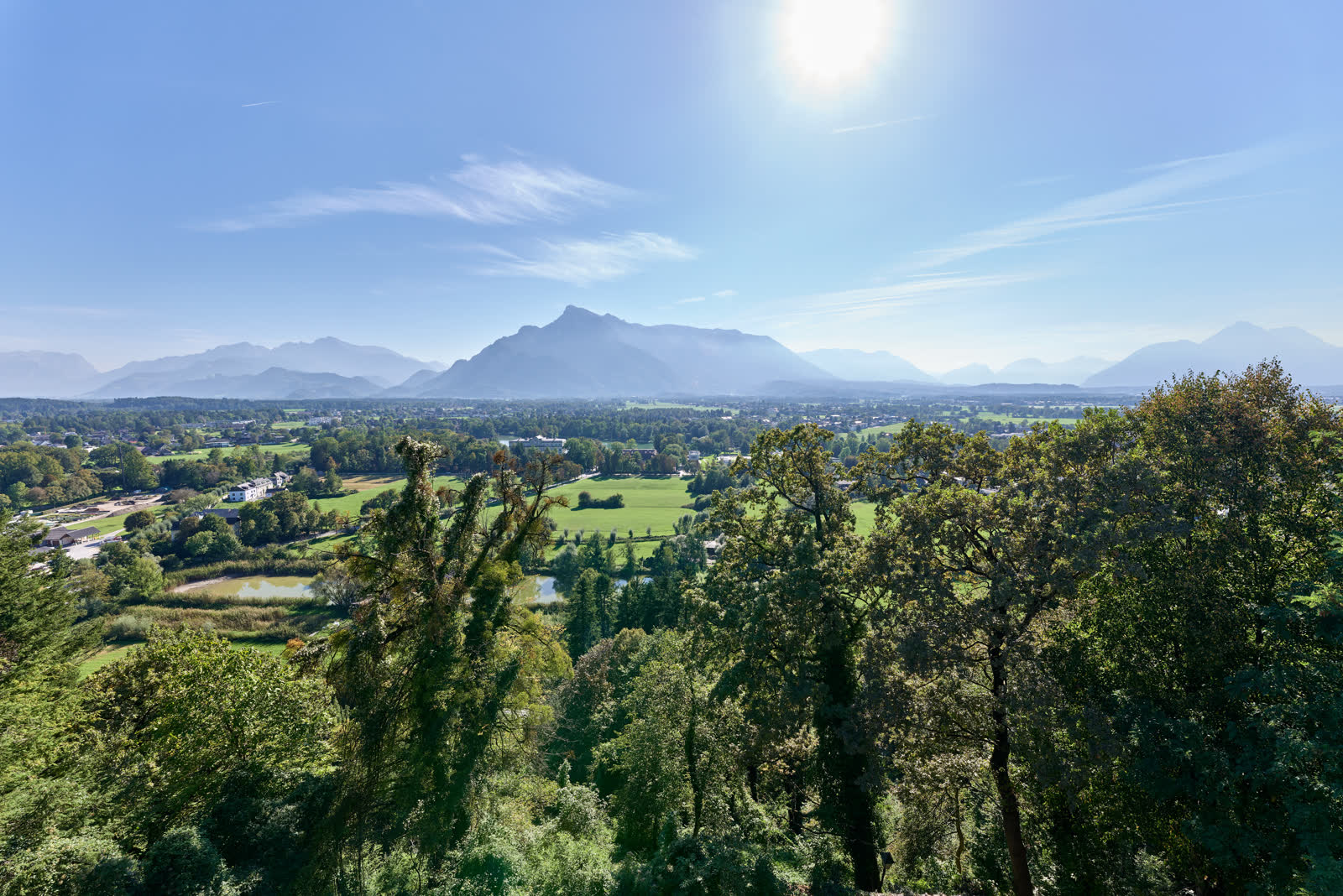
Image context: the cover uses a real documentary photograph taken from Richterhöhe on the Mönchsberg. That is the right recognition cue because this article depends on a specific visual payoff: fortress, Old Town roofs, and mountain edge held together from a quieter perch than the lift terrace.[10]
Why the evening gap is better than a midday look-and-leave
This route works best when Salzburg is changing registers but has not yet gone theatrical. In early evening, the Old Town below still reads as roofs, church towers, and stone volume; a little later, it begins to glow; later still, the hill can flatten into darkness and restaurant gravity. The seasonal sweet spot is the overlap, especially from late spring through early autumn, when the lift remains useful after dinner and the ridge paths still hold enough light to feel spatial rather than merely scenic.[1][2]
The operational details support that reading. Salzburg's official lift page makes clear that the machine is generous but not all-night infrastructure: on most of the calendar, Monday closes two hours earlier than the rest of the week, while the late-festival extension to 11 p.m. only begins on July 18.[1] That means the route is not infinitely flexible. If you drift onto the hill too late on a Monday, or treat the lift like a midnight bailout outside festival season, the outing gets smaller fast.
The hill path beyond the lift is what turns access into atmosphere. Salzburg's own water-reservoir tour page places the meeting point near Richterhöhe and notes that it is about 12 minutes' walk from the lift.[4] That is the useful distance. It is long enough to shake off the lift crowd, short enough to stay low-friction, and exact enough to keep the outing from becoming a hike.
Recent Salzburg community chatter points the same way. In recent local Reddit threads, people looking for one good city overlook keep getting pushed beyond the most obvious first platform toward the Mönchsberg ridge and Richterhöhe itself.[6][7] Google Maps place surfaces around both the lift and Richterhöhe also still behave like active evening-use spots rather than dead postcard markers, which matters because this route only works if locals and repeat visitors are still actually using it.[8][9]
Anchor 1: use the lift as a timing tool, not as the attraction
The Mönchsberg lift is strongest when you treat it like a precise shortcut. Buy the ride, go up, step out, orient yourself, and keep walking. The official fare is currently EUR3.40 one way or EUR4.80 round-trip for adults, with a one-time free ride included on the SalzburgCard.[1] That pricing is another clue about how to use the route. The one-way ticket makes sense if you plan to exit elsewhere. The round trip makes sense only if you know you want the same vertical return.
The first trap is the museum terrace directly at the top. It is attractive, obvious, and immediately legible, which is exactly why it can flatten the evening if you stop there too long. The better move is to give yourself only a short orientation pause. Look once over the roofs, confirm the weather is worth the ridge, and keep moving southward. Salzburg's "Instagrammable" walk is useful here not because you need a social-media checklist, but because it quietly confirms the hill is meant to be sequenced, not consumed at the first overlook.[3]
There is also a practical exit logic built into the mountain. Salzburg's official Old Town garages page notes that the Mönchsberg garage system is cut directly into the mountain and lists multiple exits, including Mönchsberg lift, Bürgerspitalplatz, Pferdeschwemme/Herbert-von-Karajan-Platz, and Toscaninihof.[5] For a walking route, that matters because it tells you the hill is stitched into the city at several release points. You do not need to backtrack mechanically unless the time window or weather forces it.
Anchor 2: Richterhöhe is where Salzburg stops performing and starts settling
Richterhöhe gives this route its shape because it is not trying so hard to announce itself. Salzburg's own magazine calls it a beautiful southern-facing point and emphasizes both its slightly hidden feel and its altitude at 508 metres.[2] That combination is exactly what changes the mood. You are still close to the city, but the noise floor drops. The fortress is still present, yet no longer the only thing to look at. The Old Town turns back into an urban fabric instead of a souvenir image.
This is where the evening shoulder matters most. Arrive too early and Salzburg below can still feel like a sunstruck historical set. Arrive too late and the mountain edge loses detail. The good version is the band when the lower city has begun to warm and dim at once, while the ridge path and mountain silhouettes are still readable. On dry days from roughly May through early October, that often means aiming to step onto the hill about 45-75 minutes before sunset and reaching Richterhöhe after the first terrace crowds have thinned.[1][2][3]
The exit should stay simple. If the light is still holding and you want the cleanest descent into the old-festival quarter, Toscaninihof is the elegant release because it lands you on the old-town side without wasting the hill's final minutes.[5] If weather turns, or if Monday's earlier closing window is forcing the route tighter than expected, the same lift remains the low-drama way out.[1]
8 local moves that materially improve this Salzburg stop
- Run this in the evening shoulder, not at noon. The route is built for lingering light, not maximum visibility.[1][2]
- Remember the Monday penalty. The lift currently stops at 7 p.m. on Monday but 9 p.m. on most other days outside the July-18 festival extension.[1]
- Use the lift to save time, not to replace the walk. The whole point is the ridge after the ascent.
- Give the museum terrace five minutes, not fifty. It is orientation, not the article's real anchor.[1][3]
- Budget about 12 minutes from the lift toward Richterhöhe. That short walk is the price of quieter air and a better skyline hold.[4]
- If you want the strongest mountain-and-city balance, keep going until the crowd thins. Richterhöhe is quieter precisely because not everyone stops there first.[2][6]
- Treat the one-way ticket seriously. At EUR3.40, it is a cheap way to buy elevation and free yourself to descend elsewhere; round-trip only if you know you want the same return.[1]
- Use Toscaninihof as the cultured exit when conditions are good. The official garage-exit geometry makes that descent feel built into the city rather than improvised.[5]
Non-local trapline: 4 common mistakes and the better move
Mistake 1: stopping at the first terrace and assuming you have already done the route
Better move: keep walking to Richterhöhe. The first platform is the teaser; the quieter high-edge pause is farther on.[2][3]
Mistake 2: treating Monday like every other evening
Better move: respect the current 7 p.m. Monday closing and tighten the route accordingly.[1]
Mistake 3: arriving so late that the ridge path has already lost depth
Better move: aim for the 45-75 minute pre-sunset band and let the city start glowing while the hill still has contour.[1][2]
Mistake 4: buying the round trip automatically
Better move: decide whether you really want the same vertical return. Salzburg gives you several lower-city releases, and that flexibility is part of the pleasure.[1][5]
Concrete go details
- Best window: dry evenings from roughly May to early October, especially 45-75 minutes before sunset until about 20 minutes after.
- Expected spend: EUR3.40 one way or EUR4.80 round trip for adults; effectively EUR0 at the point of use if you already have a SalzburgCard ride left.[1]
- Queue / reservation reality: no reservations; the real constraint is the operating clock, especially Monday 8 a.m.-7 p.m., versus Tuesday-Sunday 8 a.m.-9 p.m., with the late summer-festival extension to 11 p.m. from July 18.[1]
- Where to stand: take your first short pause by the museum edge, then do the real standing still at Richterhöhe once the immediate lift crowd has fallen away.
- Navigation cue:
Anton-Neumayr-Platz valley station -> Mönchsberg lift -> short museum-terrace orientation -> ridge walk about 12 minutes -> Richterhöhe -> optional Toscaninihof release.[1][4][5] - Numeric anchors worth keeping: 60 m, 30 seconds, 485 m, 508 m, 12 minutes, 8/7, 8/9, 8/11, EUR3.40, EUR4.80, July 18.[1][2][4]
Salzburg does not need another frantic old-town lap. One quick lift, one short ridge walk, one quiet overlook, and one good descent are enough. The city below is famous either way. The point of this route is to let it settle before you go back down into it.
Sources
- salzburg.info, "Mönchsberg Lift" - official page with valley-station location, 60-metre rise, 30-second ascent, 485-metre elevation, 2026 opening hours, and current one-way / round-trip fares.
- salzburg.info Magazine, "A mountain escape close at the Mönchsberg" - local guide describing Richterhöhe as an insider tip, naming the Mönchsberg's 508-metre high point, and explaining the mountain's name from St Peter's monks.
- salzburg.info, "City Walk: Instagrammable Salzburg" - official walking route that continues from the Mönchsberg toward Richterhöhe rather than treating the lift terrace as the finish.
- salzburg.info, "Company tour - Elevated tank Mönchsberg & WasserSpiegel" - official page placing the meeting point near Richterhöhe and noting access via the Mönchsberg lift followed by about 12 minutes on foot.
- salzburg.info, "Underground car park Altstadtgaragen" - official page listing the Mönchsberg garage exits including the lift, Pferdeschwemme/Herbert-von-Karajan-Platz, and Toscaninihof.
- Reddit r/Salzburg, "Aussichtspunkt über die Stadt" - recent local-community thread steering viewpoint seekers beyond the obvious first platform toward the Mönchsberg and Richterhöhe.
- Reddit r/Salzburg, "Local Experience?" - recent local-community thread that explicitly recommends adding a Richterhöhe stop when planning a Salzburg day.
- Google Maps search, "Mönchsberg Lift Salzburg" - current community-review surface for access, crowd feel, and live place status.
- Google Maps search, "Richterhöhe Salzburg" - current community-review surface for the overlook itself and live visitor timing cues.
- Wikimedia Commons, "File:View from Richterhöhe Mönchsberg Salzburg 2023-09-27 06.jpg" - documentary photograph source for the cover image.