Belfast often gets split into two visitor scripts that should never have been separated. One script says go to St George's Market. The other says walk out toward the docks and Titanic Quarter. The cleaner local version is to hold those two motions together: start inside the market while the city centre is still barely awake, then leave through the river side and let the walk east explain what the market has been doing there all along.[1][2][6][7]
That sequence works especially well on Sunday morning because the timings line up in Belfast's favor. Visit Belfast's current essential-information page says most city-centre shops on Sunday open only from 1 p.m. to 6 p.m., while St George's Market is already open from 10 a.m. to 3 p.m..[3] Belfast City Council's market page adds the useful nuance: Sunday has a quiet hour from 10 a.m. to 11 a.m., then the room shifts back into its normal weekend sound with live music, trader banter, and a steadier public flow.[1] That makes the market more than a place to buy breakfast or souvenirs. In this time window it becomes the first civic room that is fully switched on.
The market earns that role historically as well as physically. Belfast City Council states that the current building was constructed between 1890 and 1896, while the Friday market tradition reaches back to 1604; the same page says there are around 200 market stalls and that the site remains a weekend destination with live music and a recognisable local hum.[1] A Belfast-based local guide fills in the city-centre scale: St George's is about a 10-minute walk from City Hall, which helps explain why it keeps attracting both locals and visitors instead of drifting into edge-of-town novelty.[4] This is still Belfast's trading hall, only now it sits beside a regenerated waterfront rather than beside the older commercial city it once served.
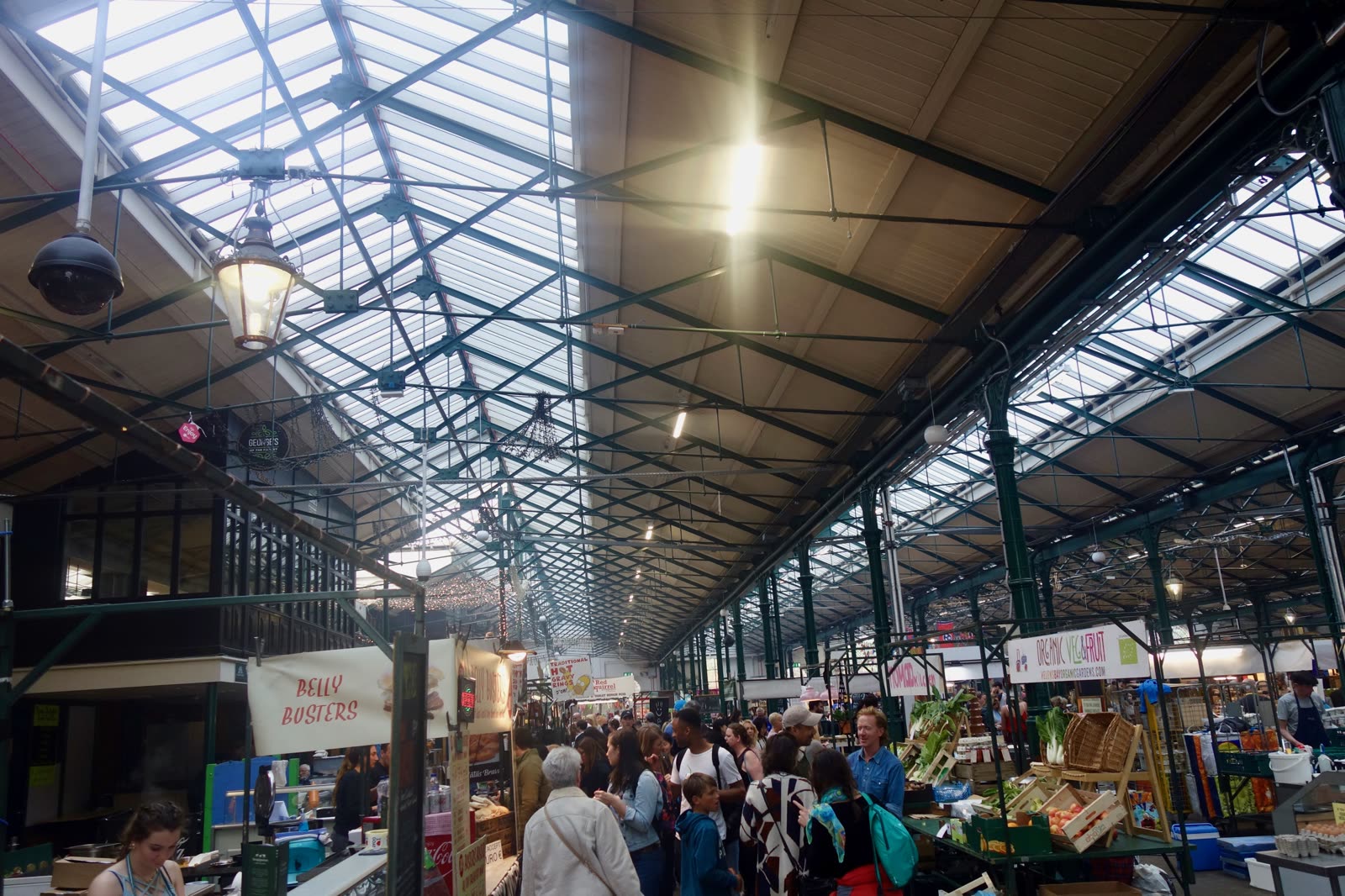
Image context: the cover uses a real documentary photograph of St George's Market from Wikimedia Commons. That is the right recognition cue because the route begins with architecture before it becomes a walk: red brick, ironwork, and one long hall set against the river edge of the centre.[9]
Why the river half matters as much as the market half
The market alone gives you an interior Belfast: iron columns, voices bouncing off the roof, a mix of craft, produce, old objects, and people who are actually there to browse rather than merely complete a checklist.[1][4][8] But the short walk east tells you why this building still feels rooted. Belfast City Council notes that the market sits opposite Waterfront Hall and can be entered from Oxford Street, May Street, and East Bridge Street.[1] In practice that means your best exit is already pointing toward the river.
Visit Belfast's Maritime Mile page gives the next set of cues. Walk to Donegall Quay and you hit the 10-metre-long Big Fish, then the route continues over the Lagan Weir footbridge and along the dockside trail toward SS Nomadic and the Titanic Slipways.[2] The point is not to turn this article into a full Titanic day. The point is to let Belfast widen. The market shows the old commercial density; the bridge and dockside show how the city turns outward toward shipyard memory, cranes, and water.
Recent local/community advice lines up with that reading almost too neatly. In a March 2026 r/Belfast thread, one local suggested exactly this small-window sequence: City Hall -> St George's Market -> Waterfront -> across the bridge toward the SSE and Titanic area, adding that the route packs in the city's best quick photographs and riverside air without demanding a museum booking.[6] In another thread focused on a walk near the city centre, a local mapped the longer extension more precisely: Lagan Weir bridge -> marina edge -> Titanic slipway -> HMS Caroline -> back, estimating 60 to 70 minutes depending on pace.[7] That is enough to show why the bridge should not be treated as optional scenery. It completes the market.
Why Sunday before lunch is the sharpest version
Friday and Saturday both work, and Belfast City Council lists the full weekend spread clearly: Friday 8 a.m.-2 p.m., Saturday 9 a.m.-3 p.m., Sunday 10 a.m.-3 p.m..[1] Friday carries the oldest market lineage and the broadest variety mix. Saturday is busier and more obviously visitor-facing. Sunday, though, has a special city-logic advantage. Because the rest of central retail stays largely shut until 1 p.m., the market becomes the morning's main public room rather than one stop among many.[3]
That affects how the walk feels. If you arrive during the Sunday quiet hour, you get the structure of the hall without the full soundtrack.[1] If you arrive just after 11 a.m., you get the same architecture plus the market mood people actually remember. The better move depends on your tolerance for noise, but the route itself stays the same: one pass through the building, one decisive exit toward the river, one crossing that turns Belfast from an indoor market city into a dock city.
This is also where the route becomes more local than touristic. A fresh r/Belfast itinerary thread from two days ago calls St George's "one place that I always bring visitors to."[8] That line matters because locals in Belfast do not mean "must-see" in the flattened, brochure sense. They usually mean something closer to: this place still works, and it still says something true about the city.
8 local moves that make this seam land
- Use Sunday morning if you want the route at its clearest. The city centre is still slow, while the market is already fully operational from 10 a.m..[1][3]
- Choose your sound level deliberately. The Sunday quiet hour runs 10-11 a.m.; after that, the market shifts back toward music and a denser public rhythm.[1]
- Enter from East Bridge Street or Oxford Street if you already know the river walk is coming. Those approaches reduce pointless backtracking once you finish the market loop.[1]
- Keep the market visit to one intentional lap. This article is about a seam, not about converting the outing into a half-day indoor browse.
- Use Waterfront Hall and the Big Fish as your transition markers. Once the hall is behind you and the 10-metre fish appears, the city is already changing register.[2]
- Cross the Lagan Weir footbridge instead of calling a taxi to Titanic Quarter. The bridge is the mechanism that lets the market and the dockside speak to each other.[2][6][7]
- Decide in advance whether your outer limit is SS Nomadic / the slipways or the longer HMS Caroline loop. The second version pushes the walk toward the 60-70 minute range and changes the energy of the outing.[2][7]
- If you drive, use the route as if you had arrived on foot. Belfast City Council's current customer offer gives parking for up to four hours at £5 in Lanyon Place car park, but the walk still works best when you think in entrances and exits rather than in parked-car loyalty.[1]
Non-local trapline
Mistake 1: treating St George's as a food stop and then retreating back toward City Hall
Better move: leave through the river side and keep the city's old market logic connected to the newer dockside edge.[1][2][6]
Mistake 2: arriving on Sunday after lunch and wondering why the room feels more tourist-balanced than city-defining
Better move: use the 10 a.m.-1 p.m. window, when the market is active and the rest of the centre has not yet spread your attention across standard retail.[1][3]
Mistake 3: crossing to Titanic Quarter by vehicle and losing the spatial handoff
Better move: walk the footbridge. The route needs that gradual change from hall to river to dockside.[2][7]
Mistake 4: trying to see every dockside landmark on the same pass
Better move: stop cleanly at the slipways or Nomadic unless you truly want the longer 60-70 minute extension to HMS Caroline and back.[2][7]
Concrete go details
- Best window: Sunday 10:15 a.m.-12:45 p.m. if you want the market-to-river handoff at its strongest; Friday and Saturday remain good alternates, but Sunday gives the cleanest contrast with the still-sleeping city-centre retail grid.[1][3]
- Expected spend: market entry is free; if you are driving, the current St George's customer parking offer is up to four hours for £5 at Lanyon Place with the stated app / promo-code conditions.[1]
- Queue and reservation reality: no booking layer for the market; the main tactical choice is whether you want the 10-11 a.m. quiet hour or the louder post-11 rhythm.[1]
- Where to stand or pause: take your longer pause outside, not at the first stall that looks photogenic; the strongest short halt is usually after the market, near the river markers before you step onto the bridge.
- Navigation cue:
East Bridge Street or Oxford Street entrance -> one deliberate market lap -> Waterfront Hall edge -> Big Fish -> Lagan Weir footbridge -> SS Nomadic / Titanic Slipways -> return or longer HMS Caroline loop.[1][2][7] - Numeric anchors worth keeping: 1604, 1890-1896, 200 stalls, Friday 8-2, Saturday 9-3, Sunday 10-3, Sunday quiet hour 10-11, 10-minute City Hall walk, 10-metre Big Fish, up to four hours for £5 parking, and the 60-70 minute longer bridge-and-docks loop.[1][2][3][4][7]
Belfast has grander history trails than this one and bigger-ticket attractions farther east. Very few of them explain the city as efficiently. One Victorian hall, one river crossing, one dockside continuation: that is enough to show how trade, music, and shipyard memory still meet in the same short piece of ground.
Sources
- Belfast City Council, "About St George's Market" (official market page covering the 1890-1896 building dates, 1604 Friday-market roots, around 200 stalls, Sunday quiet hour, weekend opening hours, entrances, and current Lanyon Place parking offer).
- Visit Belfast, "Belfast's Maritime Mile" (official city guide page used here for the Big Fish, Lagan Weir footbridge, SS Nomadic, and Titanic Slipways sequence).
- Visit Belfast, "Essential Information" (official current visitor-information page used here for Sunday city-centre shopping hours and St George's Market weekend opening times).
- City Tours Belfast, "St George's Market Belfast" (local guide used here for the market's short walking distance from City Hall and its continued local-favourite framing).
- Google Maps search, "St George's Market Belfast" (current local/community place layer useful for same-day crowd feel, entrance checks, and recent visitor photos).
- Reddit / r/Belfast, "In Belfast for 24 hours for business, have a specifically small window to relax and see something nice... Any ideas?" (March 2026 local/community thread recommending the market-to-waterfront-to-bridge sequence for a short city read).
- Reddit / r/Belfast, "Walking path near city centre?" (local/community thread used here for the Lagan Weir -> marina -> Titanic slipway -> HMS Caroline loop and its roughly 60-70 minute time budget).
- Reddit / r/Belfast, "2 Day Visit Itinerary" (published 2026-05-04; recent local/community thread treating St George's Market as a default place to bring visitors on a weekend).
- Wikimedia Commons, "File:St George's Market, Belfast (28238854498).jpg" (documentary photographic source for the cover image used in this article).