Gothenburg is easy to misread if you stay loyal to one bank of the river. Visitors linger around the south-side centre, look across the water at cranes and glass, and treat Hisingen as a separate excursion for later. The cleaner local move is much shorter: board line 286 at Stenpiren, cross to Lindholmspiren for free, walk just far enough to let the north bank explain itself, then decide whether to turn back or continue west along the quay.[1][3][4][5][6]
That sequence works because line 286 is not a sightseeing cruise with commuter utility added on top. It is utility first. Västtrafik's current boat page says the central river system has three routes: 285, 286, and 287. Of those, 286 runs Monday to Friday only, travels only between Stenpiren and Lindholmspiren, and is explicitly a free trip; a green flag marked Gratisresa is the operator's own visual cue that the crossing costs nothing.[1] The same page adds that the boats on this route have plenty of room for bicycles, which matters because Gothenburg expects you to treat the crossing as transport, not as a sealed experience.[1]
The official city guide makes the choice even cleaner. Gothenburg's transport page says there are three ferry routes on the Göta älv, but only one of them is the short cross-river correction: line 286 goes directly between Stenpiren and Lindholmspiren and needs no ticket, while line 285 runs farther along the river and uses the regular public-transport fare.[3] If what you want is the city seam rather than a longer boat outing, 286 is the right object because it cuts away every unnecessary decision.
That is also why Lindholmspiren is the correct landing point. Gothenburg's current north-bank guide describes Lindholmen and Eriksberg as former shipyard districts transformed into quays, housing, research, and mobility-related workplaces.[4] It adds two specific layers that make the crossing legible in a way a tram ride does not. Around 1890, Lindholmen's shipyard was the largest employer in Gothenburg; between 1850 and 1900, workers built houses on Slottsberget above the river; and when you step off the ferry today, you meet historic shipyard structures alongside Kuggen and Karlatornet, which the guide describes as the Nordic region's tallest building at 246 metres.[4] The north bank is not an afterthought. It is one of the places where old industrial Gothenburg and present-tense Gothenburg remain visible in the same frame.
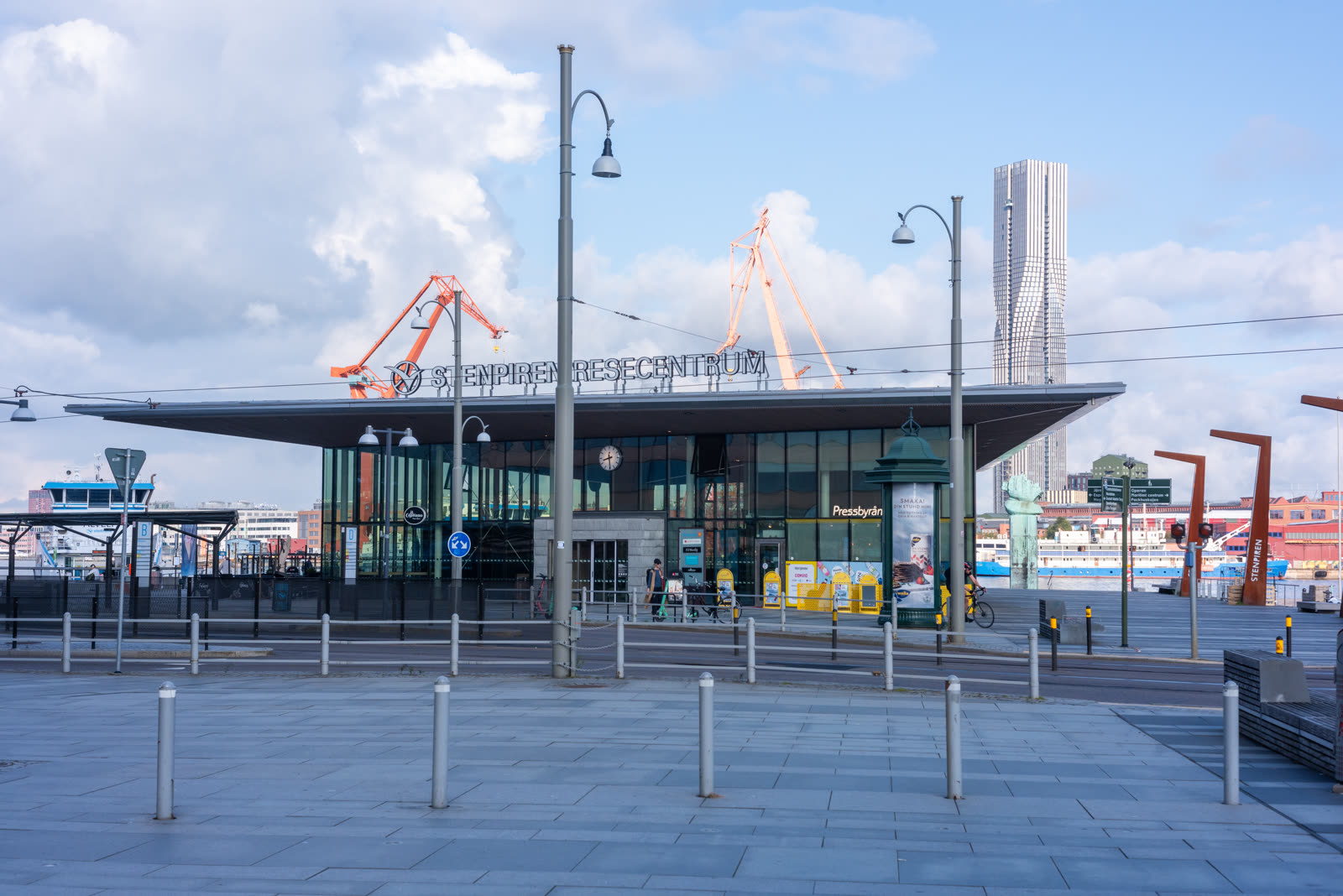
Image context: the lead photo uses a real 2024 Wikimedia Commons photograph of Stenpiren. That is the right recognition cue for this article because the route begins with finding the correct ferry-terminal logic, not with chasing a postcard skyline.[9]
Why this free crossing tells you more than a longer river wander alone
If you only walk the south bank, Lindholmen stays a backdrop. If you only ride a longer boat, the river can flatten into scenery. Line 286 solves both problems by being brief enough that you keep your sense of orientation and specific enough that the opposite shore changes status the moment you step off. Local community advice in r/Gothenburg treats this almost as an insider obviousness: in a "Gothenburg hacks" thread from November 2025, one commenter answers the ferry question plainly, saying that the one crossing between Stenpiren and Lindholmen is free.[5] In a second local thread from March 2026, a resident recommending a late-May visit gives essentially the same move in broader form: take the ferry to Lindholmen or Eriksberg and go for a stroll along the river.[6]
That is the important distinction. The crossing is not the whole outing. It is the device that corrects the map in your head. Stenpiren is a transport hinge in the centre; Lindholmspiren is the moment when Hisingen stops feeling peripheral and starts reading as a lived extension of the city. Gothenburg's own guide says exactly what should happen next: when you disembark, you are already in a district where old shipyard buildings, research campuses, hotels, and new towers coexist, and the waterfront can be walked westward toward Eriksberg in one continuous sequence.[4]
Why weekday late afternoon is the clearest version
Because line 286 is a Monday-Friday object, the article should not pretend it works equally well on a Saturday.[1] The best use is to lean into the weekday fact instead of fighting it. Late afternoon, roughly 16:30-18:30, is the sharpest window if you want the crossing to feel like Gothenburg rather than like a neutral ride. Stenpiren is still functioning as a city-centre interchange, Lindholmen is still visibly a work district rather than a weekend set, and the river light usually falls low enough to separate the slopes, quays, and new towers cleanly.
That does not mean midday is wrong. Midday is simply flatter. The stronger local read comes when the ferry still belongs to everyday circulation. Gothenburg's official route pages keep insisting on the same basic truth from different directions: these boats are part of the urban transport system, not a decorative supplement to it.[1][3] The more you meet line 286 on those terms, the more useful the crossing becomes.
8 local moves that make line 286 land properly
- Use line 286 only when you want the shortest cross-river correction. If you want a longer waterfront ride, line 285 is the other object; if you want the free snap across, 286 is the one.[1][3]
- Check the line number and the green
Gratisresaflag before boarding. Gothenburg has multiple central river boats, and the whole point of this move is to choose the free weekday crossing rather than drift onto the wrong one.[1] - Do not save Hisingen for "another day." The value of 286 is that it makes the north bank small enough to read inside the same outing.[4][5]
- If you have a bike, bring it. Västtrafik says the boats on line 286 have plenty of space for bicycles, and there is no extra charge.[1]
- Once you land at Lindholmspiren, walk at least one quay segment before deciding what the district is. The shipyard-to-innovation handoff only resolves on foot.[4][6]
- If the north bank clicks for you, keep walking west. Gothenburg's own guide says the waterfront continues all the way toward Eriksberg, with preserved industrial traces still visible along the route.[4]
- If you only want a short version, make the outing a clean out-and-back. One crossing, one short Lindholmen walk, one return ferry is enough to correct the city map in your head.
- Do not build a weekend plan around 286. The official rule is plain: this line runs on weekdays, so weekend versions of the route need line 285 or another transport fallback.[1][3]
Non-local trapline: 4 common mistakes and the better alternative
Mistake 1: confusing line 286 with Gothenburg's other river boats
Better alternative: board deliberately. The useful split is simple: 286 is the free weekday crossing; 285 is the longer paid river line; 287 is a different free branch to Lundbystrand.[1][3]
Mistake 2: stepping off at Lindholmspiren and immediately turning back
Better alternative: give the north bank one short walk. The district only becomes intelligible when the ferry landing opens into former shipyard ground, office blocks, and the riverfront promenade.[4][6]
Mistake 3: treating Hisingen as a separate side trip that needs a half day
Better alternative: use line 286 precisely because it keeps the move small. The crossing is short enough to fit inside a normal city-centre wander and strong enough to change how Gothenburg reads.[1][5]
Mistake 4: assuming the free crossing works as a Saturday default
Better alternative: respect the weekday boundary. If your plan is weekend-only, shift to line 285 or another public-transport route instead of arriving at Stenpiren with the wrong expectation.[1][3]
Concrete go details
- Best window: weekday 16:30-18:30 if you want the ferry to feel fully woven into Gothenburg's live city rhythm; late morning works if you want a calmer version.[1][4]
- Expected spend: 0 SEK if you keep the outing to line 286 plus a Lindholmen walk; if you switch to line 285, Västtrafik's current single-fare examples are 37 kr in the app or 44 kr in store / on board.[1]
- Queue and reservation reality: no reservation layer; this is commuter transport, so the main tactical question is whether you are boarding the right line at the right pier.
- Where to stand or sit: start at Stenpiren, stay outside if the weather is decent, and read the landing before you bury your head in the crossing; on the return, board from Lindholmspiren only after you have walked enough to feel the district change.[2][4]
- Navigation cue:
Stenpiren -> line 286 -> Lindholmspiren -> short waterfront walk -> return on 286 or continue west toward Eriksberg. - Numeric anchors worth keeping: 285, 286, 287, Monday-Friday, 37 kr, 44 kr, 1890, 1850-1900, and 246 metres.[1][3][4]
Gothenburg has bigger boat rides than this one and grander viewpoints farther west. Very few of them explain the city more efficiently. One free ferry, one opposite-bank landing, one short quay walk: that is enough to make Gothenburg stop looking like a south-bank centre with some extra scenery attached.
Sources
- Västtrafik, "Åk kollektivt med båt i centrala Göteborg" (official boat-transport page covering lines 285/286/287, the Monday-Friday rule for line 286, the free
Gratisresastatus, bicycle carriage, and current fare examples for line 285). - Västtrafik, "Timetable line 286" (official timetable page confirming the current line identity and the Stenpiren / Lindholmspiren stop names).
- goteborg.com, "Getting around in Gothenburg" (official city guide page covering the three Göta älv ferry routes and the fact that line 286 is the free cross-river link between Stenpiren and Lindholmspiren).
- goteborg.com, "Eriksberg & Lindholmen – riverside innovation and experiences" (official city guide page used here for Lindholmen's shipyard history, the 1890 employer scale, the 1850-1900 workers' houses, the westward waterfront walk, and the 246-metre Karlatornet reference).
- Reddit / r/Gothenburg, "What are your Gothenburg hacks?" (local-community thread used here for the insider shorthand that the Stenpiren-Lindholmen crossing is the free one).
- Reddit / r/Gothenburg, "Trip in late May" (recent local-community thread recommending the ferry to Lindholmen or Eriksberg followed by a riverfront stroll).
- Google Maps search, "Stenpiren, Gothenburg" (live local place layer useful for same-day terminal orientation and recent user photos).
- Google Maps search, "Lindholmspiren, Gothenburg" (live local place layer useful for landing-point orientation and recent user photos).
- Wikimedia Commons, "File:Stenpiren July 2024 01.jpg" (documentary photographic source for the lead image used in this article).