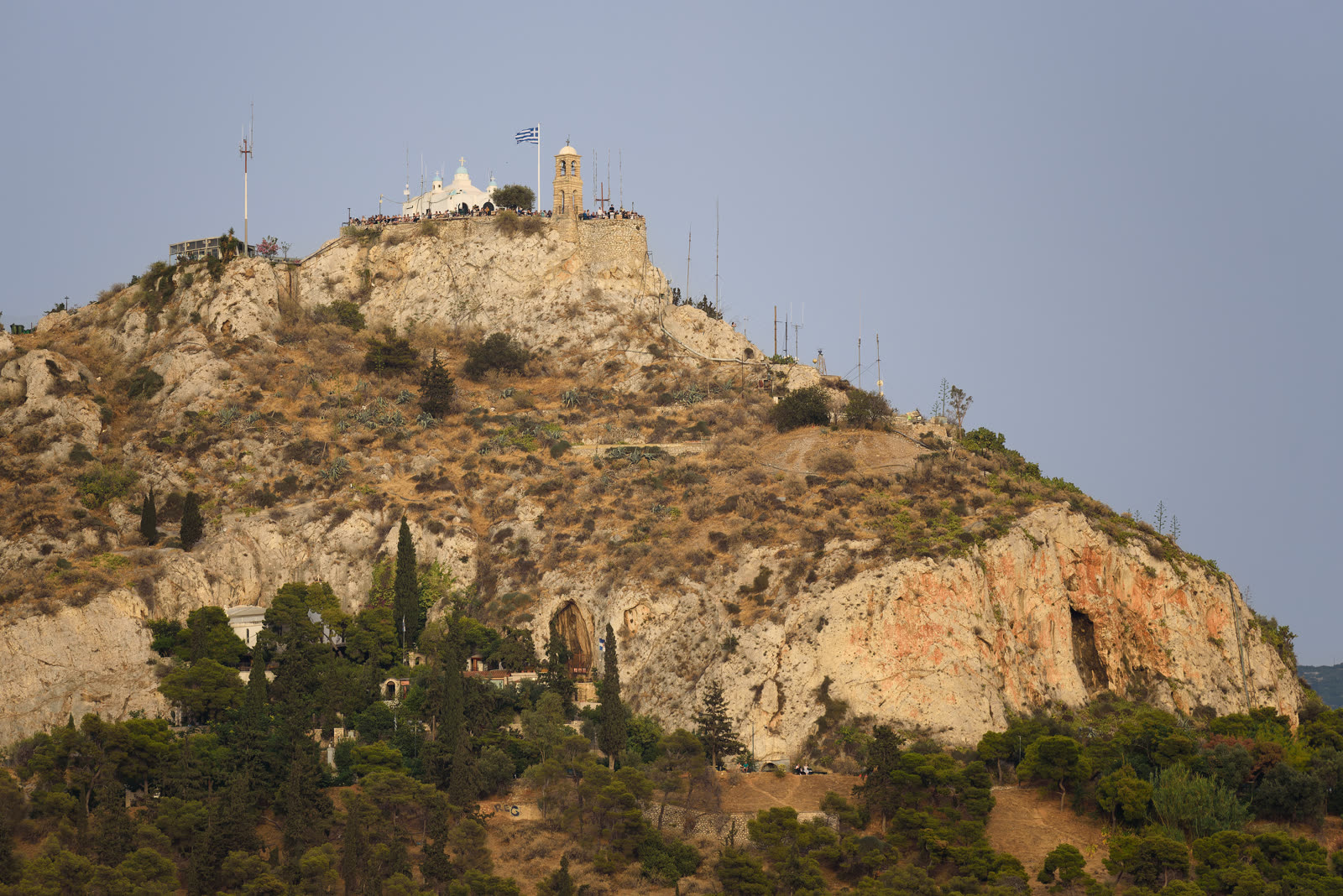
Athens has larger monuments, but Lycabettus is where the city turns legible. Keep the scope tight to two anchors only: the lower cable-car entrance in Kolonaki and the whitewashed St. George courtyard at the summit. Run them as one vertical sequence at dusk and the hill stops feeling like a generic lookout and starts behaving like a piece of Athenian city infrastructure.[1][2][3]
The operational reason is straightforward. The cable car starts at the end of Ploutarchou where it meets Aristippou in Kolonaki, near Evangelismos station; the line is 210 meters long, fully tunneled, and the ride takes about 3 minutes.[1] At the top, you are not arriving at an abstract viewpoint. You step into a summit that This is Athens still frames as one of the city's active cultural rooms: the Chapel of St. George, the reopened Lycabettus Theatre nearby, and a hill that keeps pulling together worship, concerts, and evening circulation in the same compact crown.[2][3][5]
Place-specific texture matters here. Lycabettus stands 277 meters high, the second-highest viewpoint in wider Athens, and its stories fold geology, mythology, and city habit into the same slope: quarry stone from the hill helped build Athenian neoclassical buildings, and Good Friday still sends a candlelit procession down from St. George through the dark hillside.[2] That layered use is why the right visit is not "go up, snap, leave." It is a short, deliberate dusk run with enough time for the city below to change state.
The high-yield dusk sequence
Use a 75- to 110-minute block.
- Reach the lower station 45 to 30 minutes before sunset.
- Decide fare logic before you join the queue: 13 euro round-trip if you want a clean retreat, 10 euro one-way if you already know you want to walk down through the hill paths afterward.[1]
- Ride up immediately when a car opens; each carriage holds 34 people, so hesitation compounds quickly around the sunset band.[1]
- On arrival, walk past the restaurant edge and settle first in or near the St. George courtyard, not at the first railing you see.[3][5]
- Hold the summit through the 15 to 20 minutes after sunset, when the basin of Athens loses glare and gains definition.
- Descend either by cable car or on foot, depending on energy and how crowded the summit has become.
That sequence works because the hill has two clocks, not one. The transport clock is mechanical: standard departures every 30 minutes, tightening to 20, 15, or even 10 minutes at peak times.[1] The visual clock is slower: full daylight flattens the basin, while full darkness erases neighborhood texture. Dusk is the only band that gives you both structure and light.
Image note: The cover photo shows Lycabettus as a real landform rising out of the Athenian basin, with the summit crown visible; it is there to anchor the guide in the hill's actual silhouette rather than a generic skyline image.[6]
8 local moves that materially improve the stop
First, share the lower-station pin before you leave. "Lycabettus Funicular Athens" is easier to hand off than trying to explain the Ploutarchou/Aristippou corner from memory.[1][4]
Second, settle your ticket choice before queueing. Two small carriage cabins and sunset compression make indecision costlier here than the fare difference itself.[1]
Third, if you care about space more than a perfect orange sky, board a little earlier than your instinct says. The view improves after sunset; the queue does not.[1]
Fourth, use the summit like a courtyard, not a railing sprint. The Chapel of St. George and the open space around it give the hill its real rhythm, and This is Athens still treats that crown as part of the site's identity, not a side detail.[2][3]
Fifth, if you see event infrastructure or soundcheck activity, adjust immediately. The hill is still hosting programmed uses; the 2025 This is Athens City Festival staged multiple Lycabettus Sunset Live performances in St. George's Courtyard, which means some evenings inherit a more event-like flow than a quiet lookout flow.[5]
Sixth, treat the restaurant as optional, not as the anchor. The cleanest first read of Athens comes from the open summit edge and chapel zone, before you add tables or waiting time.
Seventh, if you plan to walk down, use the cable car only for the ascent. The tunnel has zero view; the hill paths carry the atmosphere.[1][2]
Eighth, remember that this hill is also a ritual site. Around Easter, and especially on Good Friday, the summit's value is tied to procession and collective movement as much as panorama.[2]
Non-local trapline: 3 mistakes that flatten the visit
Mistake 1: arriving exactly at sunset
Better move: reach the lower station 30 to 45 minutes earlier. The best light window extends beyond sunset, while carriage capacity remains fixed at 34.[1]
Mistake 2: stopping at the first photo rail after the tunnel
Better move: walk through to the St. George courtyard and let the summit open up before you start shooting.[3][5]
Mistake 3: buying a round-trip ticket by reflex
Better move: decide whether this is a pure summit run or an up-by-tunnel, down-by-foot evening. The one-way fare exists for a reason.[1][2]
One-screen logistics card
- Lower station: end of Ploutarchou at Aristippou, Kolonaki; nearest metro Evangelismos.[1]
- Height: 277 meters above the city basin.[1][2]
- Cable-car line length: 210 meters.
- Ride time: about 3 minutes.[1]
- Cabin capacity: 34 passengers per carriage.[1]
- Posted service rhythm: every 30 minutes, tightening to 20/15/10 minutes at peak.[1]
- Posted late-hours window: public listing shows 09:00 to 02:30, with a winter warning that operations can end earlier.[1]
- Fare: 13 euro round-trip, 10 euro one-way.[1]
- Best working window: arrive 45 to 30 minutes before sunset; hold 15 to 20 minutes after.
- Recognition cue at the top: Chapel of St. George, with the theatre zone nearby.[3]
Athens has many places that impress from a distance. Lycabettus is better when used at human speed. You enter by tunnel, surface into white stone and chapel walls, and watch the basin below reorder itself from glare into neighborhoods.
Sources
- Lycabettus Hill, "Cable Car" (operating hours, ride time, capacity, fares, service rhythm, Kolonaki entrance).
- This is Athens, "Lycabettus Hill" (official city guide on height, history, Good Friday procession, and hill context).
- This is Athens, "City of Athens Lycabettus Theatre" (official summit context, St. George chapel, and theatre reopening history).
- Google Maps, "Lycabettus Funicular Athens" (local wayfinding and live community listing surface).
- This is Athens, "This is Athens City Festival 2025: Live Music Concerts" (recent confirmation of St. George's Courtyard programming on the hill).
- Wikimedia Commons, "File:Lycabettus Hill, Athens, 2024.jpg" (photographic image source used for the cover).