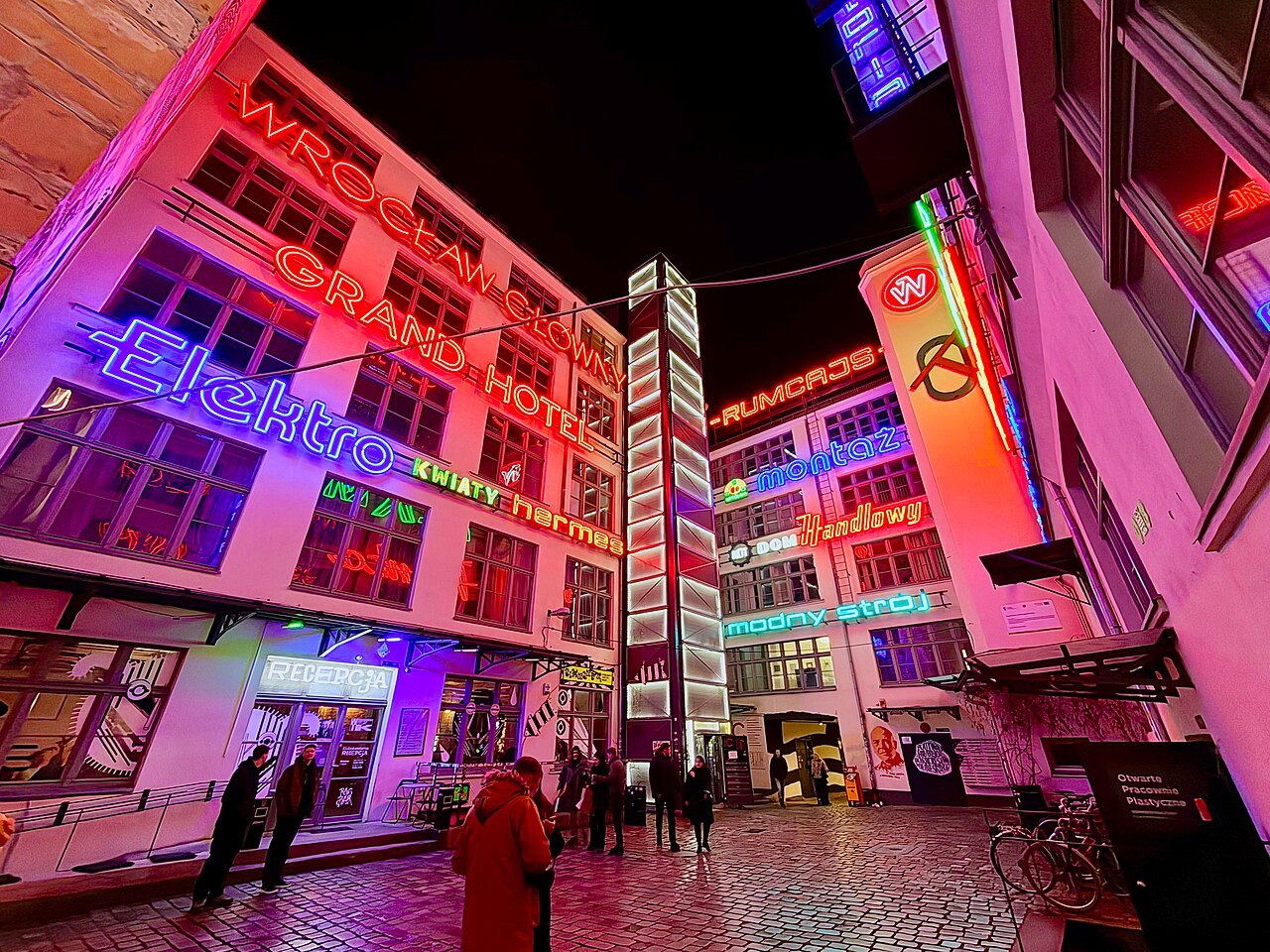
Most night sights punish lateness. Ruska 46 punishes earliness. One visitor reached Wrocław's neon courtyard at 20:00 in May 2026 and found the signs dark [7]. A current local guide explains why that can happen: the collection has been turning on at a set evening time, not automatically at sunset, and a proposed weekday/weekend adjustment had not become a published operating promise [5]. “After dark” is therefore atmosphere, not a timetable.
That uncertainty should make the visit smaller, not harder. Give the courtyard a flexible 25–40-minute slot inside an evening you are already spending near the Old Town. For a September weeknight, hold 20:45–21:30, but check the host or a same-day local post before walking over and do not treat that range as an official switch time. The core visit costs 0 PLN, requires no reservation, and has no exhibition queue: Ruska 46 is an open-air passage with cultural studios and nightlife around it, not a ticketed neon museum [1][5][8].
The useful route is only one courtyard long. Enter under the building at Ruska 46C, let the old commercial words assemble into a room above you, then continue out through the opposite passage to Świętego Antoniego [2][5]. That one-way movement matters. The signs were once scattered across stations, cinemas, hotels and shops. Here they face one another, while people still cross beneath them on ordinary business. Wrocław has not preserved its neon by removing it from city life; it has made city life pass through the archive.
A room made from addresses that disappeared
The collection began in 2005, when Tomasz Kosmalski saved a confectionery-shop sign that was heading for scrap. More shop, cinema, station and industrial signs followed [1]. The city's account credits Daniela Szymczak and Tomek Kosmalski as the gallery's two originators; in 2014, cooperation between the Neon Side foundation and the city established the courtyard display, bringing advertising from the 1960s and 1970s back to public view [1][3]. The official host now lists 30 exhibits alongside roughly 40 organizations, institutions and studios across a 7,000-square-metre cultural complex [1]. Those larger numbers describe the whole address, not a promise of 30 perfectly isolated objects in a museum room.
The location supplies the city-specific twist. The defunct Reklama enterprise once made illuminated signs here and was the largest neon manufacturer in Lower Silesia from the mid-1960s. Retired signs have returned to a former place of production [1]. This is why the courtyard is more than a colorful salvage wall. It joins the labor that bent the glass, the businesses that commissioned it, and the later rescue effort on the same ground.
Read a few names instead of trying to inventory everything. Wrocław Główny once marked the main railway station. Kino Warszawa belonged to the cinema that opened in 1945 as the first in postwar Wrocław. Kwiaty advertised a florist, Spożywczy a grocery, and Cuprum came from a demolished office building [2]. The words are plain because they had jobs to do. At night, their fonts and colors recover fragments of the streets from which redevelopment removed them.
That recovery remains maintenance, not magic. To secure the collection's next decade, the city signed a 10-year rental agreement in June 2024 covering insurance, servicing and upkeep. Specialists then repaired 16 signs before a public relighting on April 5, 2025 [3][5]. The address was still actively programmed in June 2026, when the city previewed a site-specific installation made with more than 20 participants for the courtyard festival [4]; an August local guide records that three-day festival as completed [5]. A July 2026 local account likewise described the restored signs as a living outdoor gallery rather than a closed historical set [8].
Eight moves that keep the room legible
First, save the doorway rather than the attraction name. The host gives the complex's administrative address as Ruska 46A, while the city directs visitors through the covered entrance at 46C [1][2]. Search results also mislabel the courtyard as a museum. Pin the 46C gateway and look for the passage under the building; the display itself sits behind the Ruska Street frontage [5][8].
Second, approach on foot from Rynek. A locally measured route puts the Market Square about 0.56 kilometres, or roughly 7 minutes, away [5]. That is close enough to make the courtyard a hinge in an evening rather than its own expedition. If the signs are still off, you have lost a short walk, not an hour and two transfers.
Third, verify light rather than darkness. The most consequential recent review is the failed 20:00 visit [7]. The local guide's account of a fixed switch time explains why winter sunset or a phone's twilight forecast is insufficient [5]. Check the Ruska 46 host and current local channels the same day. If no confirmation exists, pass the gateway once and continue with the evening if the walls remain dark; do not wait indefinitely for an undocumented timer.
Fourth, favor the event-free shoulder. In a May 2026 r/wroclaw thread about a proposed Sunday visit after 22:00, local commenters characterize the courtyard itself as a lane of bars, outdoor tables, music, smoke and beer, while distinguishing it from the rowdier adjacent Pasaż Niepolda [6]. That is anecdotal local texture, not a universal crowd or safety guarantee. The practical inference is to arrive soon after the lights are confirmed on and avoid a posted event if you want the signs—not nightlife—to lead the visit.
Fifth, walk Ruska to Świętego Antoniego instead of orbiting one camera position. Local reporting confirms the Ruska entrance around number 46 and an opposite passage to Świętego Antoniego [5]. Crossing once reveals the central fact that a static photograph hides: this “gallery” is also a shortcut through the block. Keep the middle line open for residents, workers and other visitors.
Sixth, take the wide view before the close-up. From an edge of the cobbles, let Wrocław Główny, Grand Hotel, Rumcajs, Montaż and Modny Strój share one field. The current cover photograph uses that recognition view [9]. Then choose two or three letterforms to inspect. Trying to photograph every sign turns a compact room into a repetitive phone exercise and makes you more likely to block the passage.
Seventh, read the nouns as former infrastructure. “Flowers,” “shoes,” “grocery,” “cinema,” “hotel” and “main station” once helped people locate ordinary urban services [1][2]. Their afterlife is most interesting when you imagine each word back at street scale, not when you treat the whole wall as generic cyberpunk decoration. The local host's origin story—signs returning to the former Reklama works—provides the interpretive key [1].
Eighth, leave before consumption becomes compulsory. The courtyard's bars and studios are real tenants, not scenery, but the neon display is free and requires no purchase [1][5][8]. A 20–30-minute illuminated pass is enough for the core experience. Stay for a venue because its program interests you; otherwise use the Świętego Antoniego exit and let Ruska 46 remain a public night room rather than an obligation to buy a drink.
Three ways visitors miss Ruska 46
Mistake one: scheduling a museum visit. Current local research is explicit that there is no neon museum here—no ticket desk, cloakroom, curator-led route or indoor display hall [5]. The better alternative is to arrive ready for a courtyard crossing. Your expected spend is 0 PLN, the “queue” is simply however many people occupy the passage, and the entire anchor can fit inside 40 minutes.
Mistake two: equating sunset with switch-on. The city's general page says the signs are most enjoyable at night, but that is not an operating hour [2]. Recent community evidence shows that 20:00 can still be too early [7]. The better alternative is a two-part test: confirm current lighting locally, then build a short flexible window rather than anchoring dinner, transport or a ticketed event to an unpublished minute.
Mistake three: expecting an empty photo set. Commenters in the 2026 local discussion describe tables, music, smoke, beer and circulation in the same lane [6]. Tripadvisor reviewers similarly describe a small, lively courtyard and warn that it may feel underwhelming if approached as a large attraction [7]. The better alternative is an event-free evening, an edge position and an acceptance that other people belong in the frame. If you are with children or dislike bar noise, go soon after the lights appear rather than after 22:00, and leave through Świętego Antoniego instead of drifting into the neighboring nightlife passage [5][6].
The compact go plan
- Anchor: the Neon Side courtyard at Ruska 46 only; the bars, galleries and neighboring passages are context, not a second stop.
- Best window: the first 30–45 minutes after confirmed switch-on. For a September weeknight, hold 20:45–21:30 as a flexible planning range, not official hours [5][7].
- Expected spend: 0 PLN for the courtyard; no drink or venue ticket is required [5][8].
- Queue and reservation reality: no booking, box office or formal line. Crowd density rises with nightlife and programmed events [4][5][6].
- Navigation cue: enter beneath Ruska 46C, about 7 minutes on foot from Rynek, and leave through the opposite passage to Świętego Antoniego [2][5].
- Where to stand: along a courtyard edge for the full wall; keep the central cobbled passage clear.
- Time budget: 25–40 minutes, including one complete crossing and a close read of two or three signs.
Ruska 46 is strongest when it refuses to become a museum. The signs once told Wrocław where to catch a train, see a film, buy flowers or find a hotel. Now they illuminate a shortcut through the place where signs like them were made. Wait until the switch has actually been thrown, walk beneath the old nouns, and keep moving. The room survives because it is still part of the city.
Sources
- Ruska 46, “About space” and “Neon lights gallery” — official English-language host page for the cultural complex, its 30 exhibits, 40 organizations, 7,000-square-metre scale, collection history, former Reklama works and current address.
- City of Wrocław, “Galeria Neonów Neon Side we Wrocławiu” (published October 24, 2024; updated June 18, 2025) — official city guide to the Ruska 46C entrance, transport approach and origins of selected signs.
- City of Wrocław, “Podwórko neonów we Wrocławiu – otwarcie po remoncie w sobotę” (April 2025) — official chronology of the 10-year city agreement, repair campaign and April 5 relighting.
- Błażej Organisty, City of Wrocław, “Plecionka na windę. W piątek na Podwórku Neonów odsłonią instalację artystyczną” (June 19, 2026) — recent official confirmation of active cultural programming in the courtyard.
- Co we Wrocławiu, “Galeria Neonów Neon Side we Wrocławiu – przewodnik po podwórku przy Ruskiej 46” (August 19, 2026) — current local guide to the passage layout, two entrances, measured approach, non-museum status and switch-time uncertainty.
- r/wroclaw, “Galeria Neonów nocą” (May 23–24, 2026) — recent local community discussion of the courtyard after 22:00, its bars and outdoor tables, and the distinction from adjacent Pasaż Niepolda.
- Tripadvisor, “Neon Side Gallery” — community review surface used for the May 2026 report of dark signs at 20:00 and for contrasting accounts of the courtyard's size, nighttime atmosphere and free access.
- Klara Ertav, Wroclaw Magazine, “Step Into Wrocław's Neon Side Gallery Where Vintage Signs Still Shine” (July 22, 2026; updated July 30) — recent local account of the free outdoor gallery, restored signs and after-dark character.
- Olgierd Rudak, “Galeria Neonów ul. Ruska Wrocław (2026-02-21) 2.jpg,” Wikimedia Commons — source page for the documentary night photograph of the illuminated courtyard; CC BY-SA 4.0.