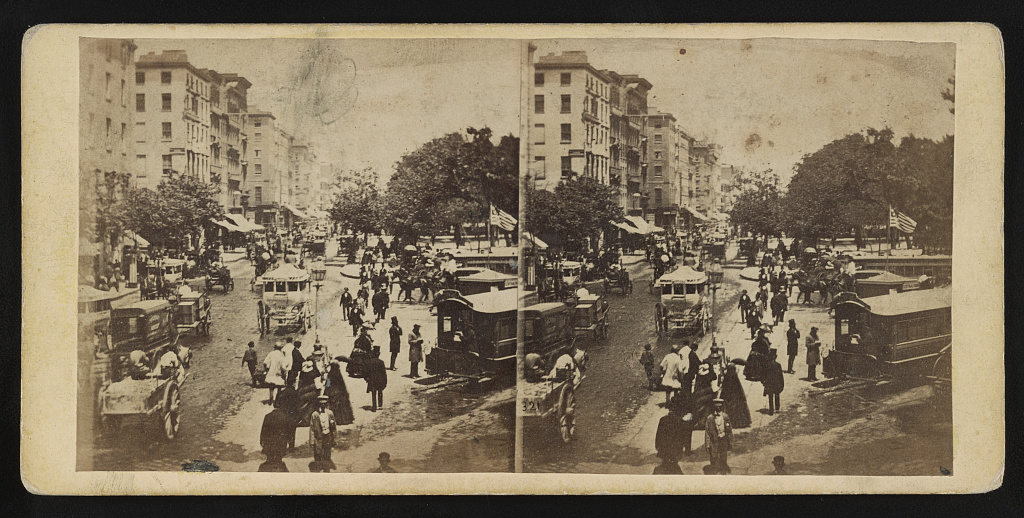
Look for the number 32 on the back of the cart. It sits just inside the lower left edge of the right-hand photograph. Find the same cart in the left-hand photograph and its tailboard has slipped partly out of the frame. Farther up Broadway, a pale omnibus faces the camera in both views. Its rounded roof makes a good landmark while your eye travels back and forth. A customer buying E. Anthony’s Broadway from Barnum’s Museum, Looking North got both pictures on one card. The small disagreements between them were part of the purchase. [1]
You can try the principle at the nearest window. Hold up a thumb against a building across the street, close one eye, then switch eyes without moving your hand. Your thumb jumps sideways against the building. Bring your thumb closer and it jumps farther. The word for that change of alignment with viewpoint is parallax. A stereograph preserves two such viewpoints. Seen through a viewer that delivers one photograph to each eye, the differences help you judge what stands in front of what. Two identical prints would still give you all the ordinary signs of distance on Broadway, down to the windows dwindling along the block. They would lose the extra information you just got from your thumb. [1][2]
The photographer chose a particularly good perch for this. From above the traffic you can see the tops of hats, the roof of the omnibus and the load in the cart. Between them are patches of bare roadway. Try following one of the pedestrians across that open ground with your eye. You can see where a crossing might take them behind a vehicle and where they would come back into view. The pleasure of depth here is quite practical. It lets you size up a way through the crowd while remaining several storeys clear of it. [1]
At home the viewer had a small adjustment to make. Oliver Wendell Holmes built a handheld stereoscope using two lenses and a handle borrowed from an awl. Joseph Bates, the Boston dealer who put the design into production, made the distance between the card and the lenses adjustable. Slide the card until the details sharpen. That movement brings the lettering on the cart into focus. The sideways difference that gives the cart its place in the street was already there when the photographer took the views. [2][3]
Holmes described a habit of looking that suits this card. In an 1859 essay he recalled a stereo view of Table Rock in which two people initially served him as a measure of the scenery’s vastness. With a strong magnifier, he wrote, he could make out their faces. Stereo cards offered their buyers a way to visit distant places from home, a use documented in the American Antiquarian Society’s collection. Yet Holmes could get a second visit out of the same view simply by changing what held his attention. [2][4]
Give Broadway that second look. The publisher’s title sends your gaze north, along a whole avenue. The painted 32 draws it back to a few inches of tailboard. For someone passing on the pavement it would have been the most fleeting of sights. On the card the wagon is still there, half in the picture, waiting for your other eye. [1]
Sources
- E. Anthony, Broadway from Barnum’s Museum, Looking North. Library of Congress scan of the original stereo card.
- Oliver Wendell Holmes, “The Stereoscope and the Stereograph,” The Atlantic Monthly, June 1859.
- David R. Daly, “Stereo Card Viewer,” Longfellow House–Washington’s Headquarters National Historic Site.
- American Antiquarian Society, “Stereographs,” an introduction to the collection and its uses.