Look under the chin. Rachel Gurney has made a shelf of her crossed arms, and Julia Margaret Cameron has given her another shelf to lean on, a box covered with cloth. Take away the wings and the pose would be familiar to anyone who has watched a child settle in for a long wait. Put them back and a practical question arises. How much would a pair of wings weigh on shoulders that small? [1]
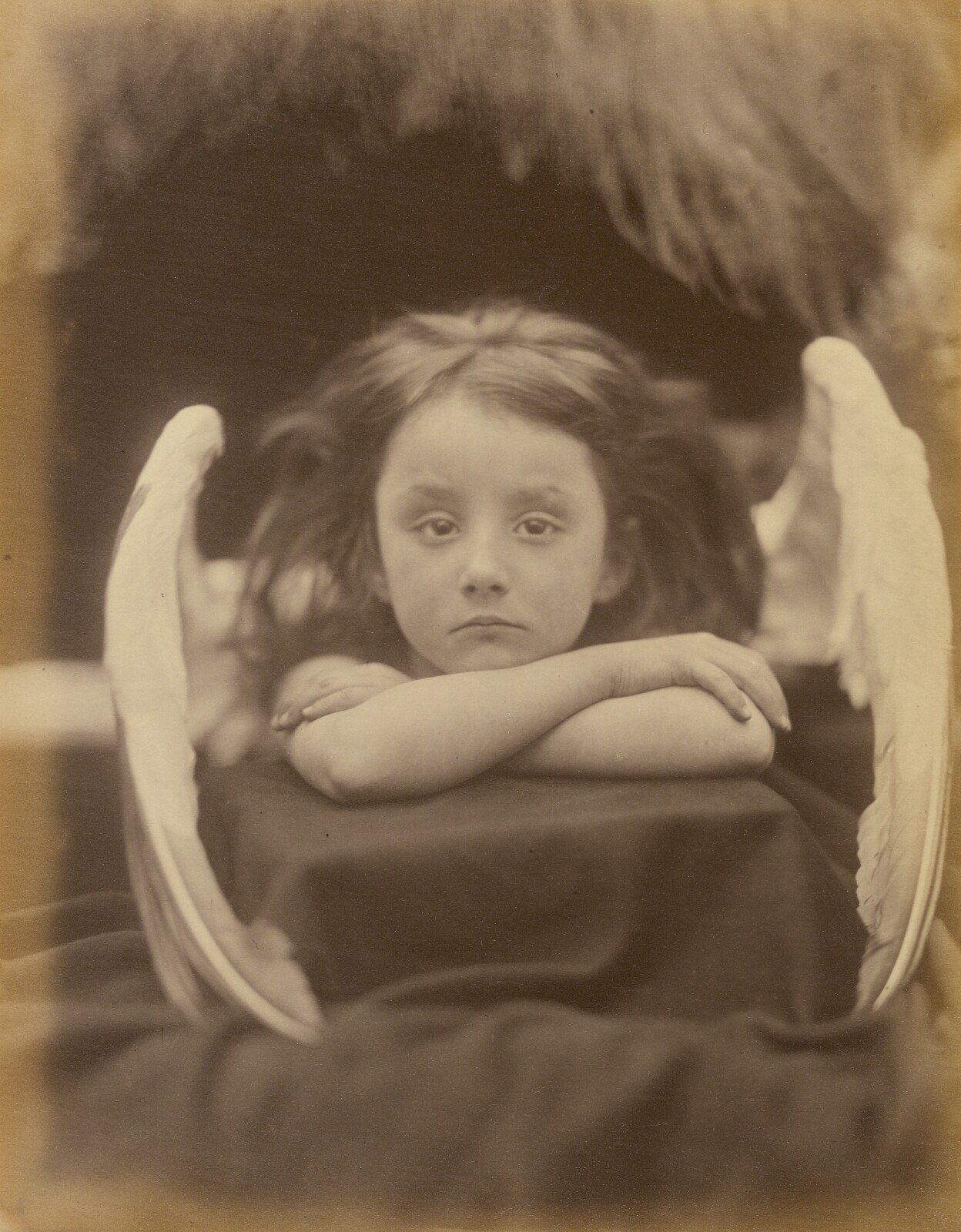
Cameron borrowed the gesture from the bottom edge of Raphael’s Sistine Madonna. Two winged children lean on a parapet there. One has folded his arms and laid his chin on them. His eyes tip up, and if you follow them you have most of an altarpiece still to see. The Virgin comes forward carrying her infant, with a saint kneeling on either side. The cherub can afford to take his ease. The business of the painting goes on overhead. [2][3]
By the time Cameron photographed her great-niece in 1872, it was quite possible to know those two children on their own. The engraver Moritz Steinla had given the pair a sheet to themselves decades earlier. In his print the parapet survives, as do the upturned eyes. You can still deduce the existence of a scene upstairs from the attention paid to it downstairs. Cameron makes a more radical cut. Rachel has lost the other angel. The space overhead has gone dark, and her gaze comes straight out of the picture. Follow it this time and you end up where Cameron stood. [1][2][4]
The box earns its place in this arrangement. Its covering hangs down in folds, giving a humble piece of furniture enough ceremony to stand in for the rim of heaven. Across its top, two bare forearms carry the weight of a head. That much of the staging works in plain sight. The wings make the opposite promise. Their feathers reach up past Rachel’s shoulders, suggesting that she could rise, even as the rest of her has found a tolerable way to stay put. [1]
Rachel’s sister Laura, who also sat for their great-aunt, remembered having heavy swan wings fastened to their shoulders to play angels. What stayed with her was the uncertainty of a sitting. The girls had to keep themselves ready for whatever Cameron might ask them to do next. Laura was recalling their experience years later. Rachel’s expression in this particular exposure remains hers to keep. But her sister supplies a detail even a wonderfully clear print could never give us. A feather looks light from the photographer’s side of the camera. A whole wing feels different from the sitter’s. [1]
Say the title aloud and it comes out in Rachel’s voice. I Wait could belong to an angel keeping watch at the edge of Raphael’s heaven. It could equally be a child’s answer to the question of what she does while her great-aunt makes a photograph. Cameron chose the words and fitted the wings. It takes Rachel, finding somewhere to rest her chin, to make both readings possible. [1][2]
Sources
- J. Paul Getty Museum, I Wait (Rachel Gurney), collection record, photograph and recollection by Laura Troubridge
- Morgan Library & Museum, Julia Margaret Cameron exhibition labels, including “I wait” and its source in Raphael
- Old Masters Picture Gallery, Dresden State Art Museums, Raphael’s The Sistine Madonna
- Royal Collection Trust, Moritz Steinla’s engraving Two winged cherubs, RCIN 851072