Wilson Bentley kept a feather beside his camera. Taking a snow crystal’s portrait on his farm in Jericho, Vermont, he had to persuade a weightless sitter to lie flat. A pointed sliver of wood could lift the crystal from the board on which it landed. The edge of the feather could settle it against the glass. His own breath, at this stage of the proceedings, was a considerable nuisance. [1][2]
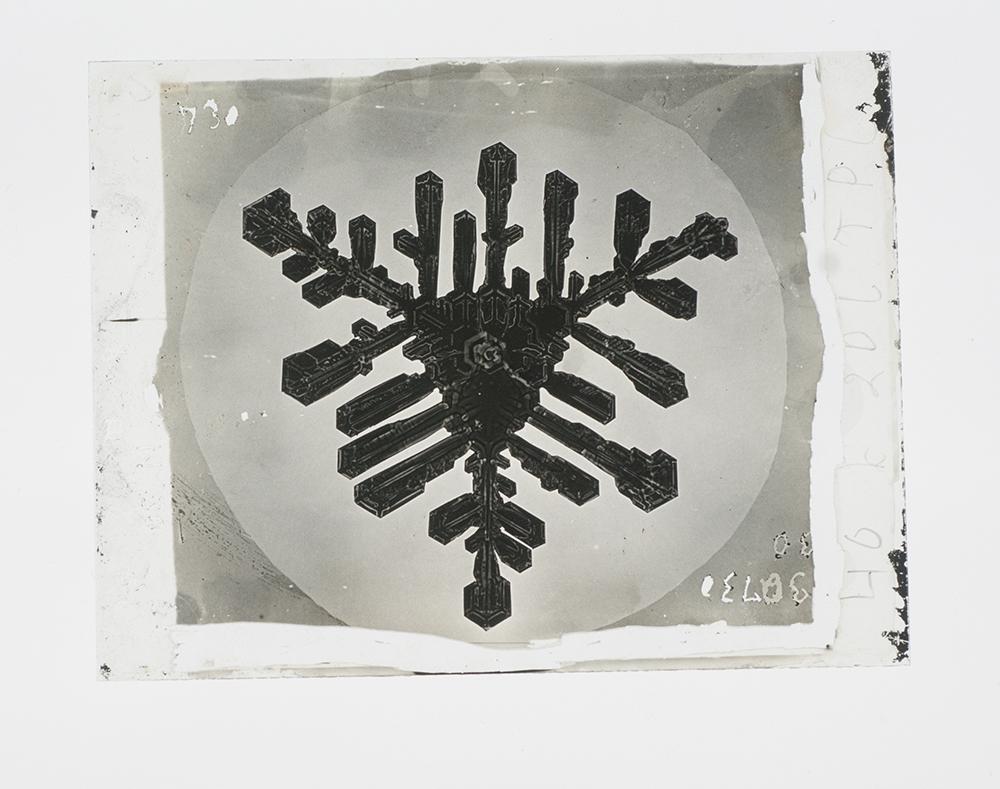
Bentley made his first successful photograph of a snow crystal in 1885. Ten winters later he made the photograph reproduced here. Start at the broad tip of the lowest arm and follow its shaft into the crowded center. Try the upper arm next. A little spur sticks out on the right, partway up, where the lower arm was bare. You have the leisure to go back and check. Bentley had a few minutes at best. Even in a room kept as cold as the air outside, he could watch the fine extremities of a specimen disappear while he worked. [1][2][3]
In 1922 Bentley explained his working habits to readers of Popular Mechanics. The piece has the intimacy of being shown around somebody’s kitchen. The catching board had handles because a warm hand against the board itself could ruin the catch. A card in front of the microscope served as a shutter. For a particularly fragile specimen he recommended arranging several other crystals around it on the slide. In his experience the one at the center lasted longer that way. One of the pleasures of his finished pictures is the air of complete solitude they confer on a subject that could require a small crowd to sit for it. [1]
Daylight came through a window and passed through the ice. Bentley could use a minute pocket of air near the crystal’s center to judge whether the microscope was in focus. That choice of lighting brought out features inside the ice, at the cost of a pale background against which the outline was hard to pick out. Much of what we recognize as a Bentley snowflake took shape afterward, when he sat down with a copy negative and worked his way around the perimeter, removing the photographic emulsion outside the crystal. Light could then pass freely through those cleared areas during printing, turning the paper dark right up to the edge of the ice. [1][2]
There is a peculiar division of labor in that black border. Bentley had to follow every small turn of a contour that the weather had given him. A reader sees the contour in an instant. Look along it again, slowly, and you begin to get some sense of how well this man knew his subjects by the time a print left his hands. The duplicate mattered here. Bentley urged his magazine readers to keep the original negative safe from a slip of the tool. [1]
In 1931 Bentley and W. J. Humphreys published Snow Crystals. Across its plates the dark ground gives the eye a place to rest between specimens. It also makes comparison easy. Carry the shape of one crystal in your mind to the next and a difference in the breadth of an arm can absorb as much attention as the likeness of the whole. A winter’s afternoon offered Bentley one good look at each sitter. The book gave his readers the privilege of turning back a page. [2][4]
Sources
- Wilson A. Bentley, “Photographing Snowflakes,” Popular Mechanics, February 1922. Facsimile in the Smithsonian Institution Archives teaching collection, pp. 16–19.
- University of Alaska Fairbanks Geophysical Institute, “The Man Who Made Portraits of Snowflakes,” on the workshop, transmitted light, and the copy negatives.
- Rochester Institute of Technology, “Snowflakes Up Close,” including Bentley’s 1895 photomicrograph and material from his notebooks.
- W. A. Bentley and W. J. Humphreys, Snow Crystals, Dover reprint of the 1931 collection.