In a photograph from Axel Heiberg Island, paleobotanist James Basinger sits beside a tree stump broad enough to make a seat of its own. The tree grew in the Canadian High Arctic roughly 45 million years ago. Its base still marks the spot it occupied in an Eocene swamp. With a tape measure and a map of the other stumps, one might expect to work out how crowded the woods were. The difficult measurement turns out to be the one beneath Basinger’s feet. [1][2]
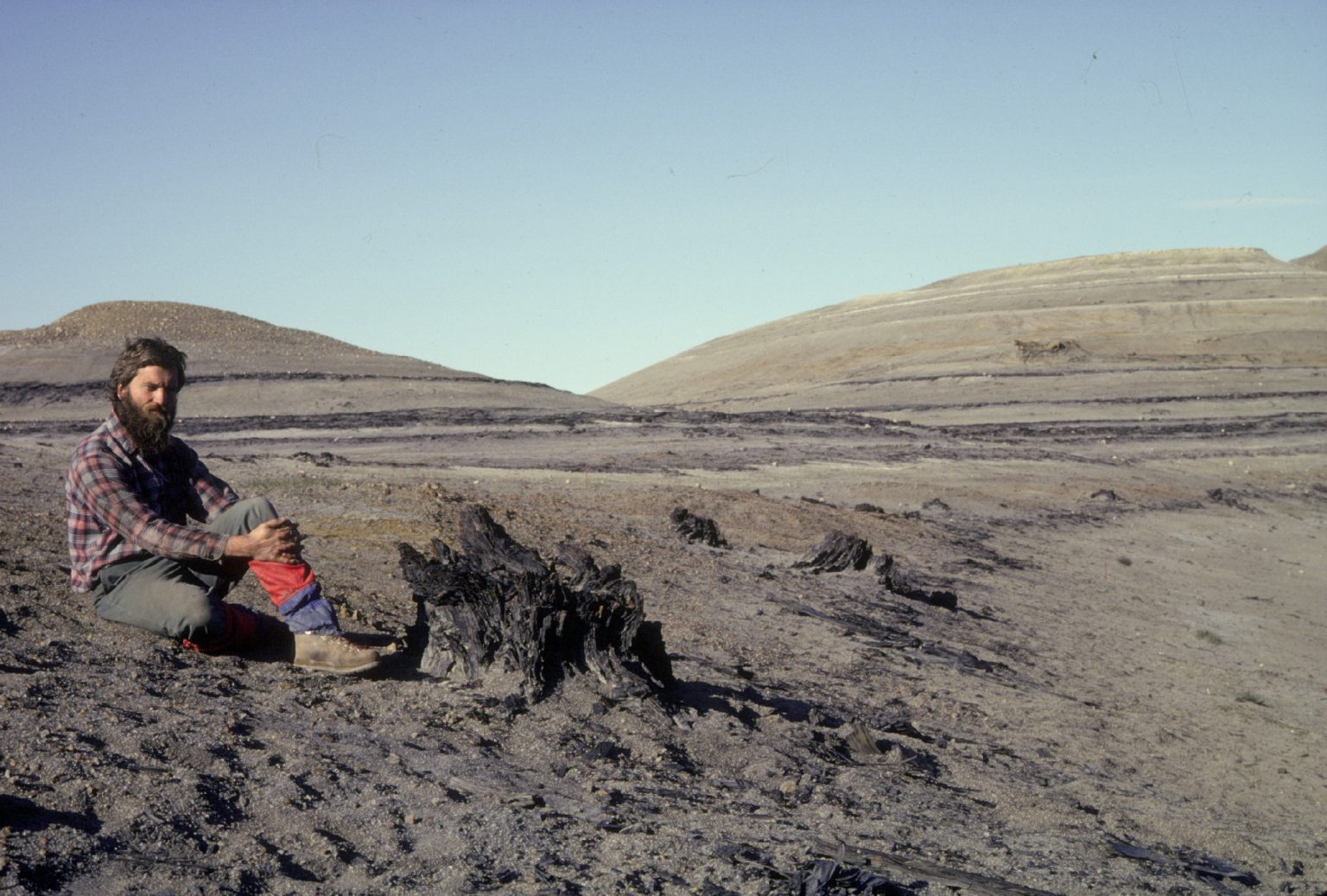
Geological Survey of Canada crews working near the Geodetic Hills in the 1980s could distinguish fallen logs from trees rooted in place. They also found mats of fallen leaves. Burial had compressed the plant material, yet much of the wood remained wood. When a stump reached Ottawa in 1986, it had begun to split along its layers despite careful packing. Conservators treated it with polyethylene glycol to limit shrinkage, then freeze-dried it. A museum could preserve the trunk that way. Recovering its relationship to the next tree required work on the hillside. [3][4]
Under the stump
David Greenwood and Basinger described that work in a 1993 study of the Buchanan Lake Formation. At one exposure, roots spread outward from small and medium-sized stumps midway through a bed of peat, the accumulated remains of swamp plants. Some roots branched downward but seemed to stop short of the clay beneath. Nearby, several large stumps appeared to sit on top of the peat. When the researchers dug under them, they found clay directly below the wood. The big trees appeared to have taken root in an older soil, before the peat built up around them. From above, the order was easy to miss. [2]
Imagine planting a flag beside each stump and drawing the flags on a plan. The result would be a good map of places where a tree once stood. To turn it into a count of living trees per hectare, one more condition has to hold. Each tree must have been alive during the interval being counted. Some clay-rooted trees could have lived long enough to shade young trees sprouting on the peat. Others could have died before those seedlings took root. Adding every flag to the same census risks filling gaps in the canopy with trees from another generation. An estimate of the weight of living timber would inherit the same error. [2]
The leaf mats offer another way to walk through the woods. Along one continuous layer, the researchers found a stretch rich in broad leaves from flowering plants. Elsewhere along that layer, dawn redwood foliage predominated. A person crossing this swamp could have passed between patches of quite different vegetation. Digging down through successive layers asks a different question about how the vegetation at one spot changed as peat accumulated and the ground grew wetter or drier. Mixing the leaves into a single collecting bag would obscure both patterns. [2]
Wind on Axel Heiberg still uncovers pieces of that forest. In years of collecting, Basinger and colleagues picked up nuts that had already weathered onto the surface. Their shells retained enough internal detail for CT scans to distinguish three extinct walnut species. A loose walnut could thus add a species to the island’s flora. To place a particular tree among its living neighbors takes a different kind of specimen, one that includes a little of the ground under its roots. [1][2]
Sources
- Florida Museum, “Three new extinct walnut species discovered in high Arctic mummified forest” (2024). Field photography and the surface collections.
- David R. Greenwood and James F. Basinger, “Stratigraphy and floristics of Eocene swamp forests from Axel Heiberg Island, Canadian Arctic Archipelago” (1993). Journal abstract and publication record.
- Geological Survey of Canada, Current Research, Part D (1988), pp. 57–59. Field observations at the Geodetic Hills.
- Canadian Conservation Institute, “The Fossil Forest of Axel Heiberg Island.” Conservation of the Ottawa stump and fragile plant remains.