From the outside, the Blue Lake rhinoceros looks like a hole about two feet wide. It opens high on a basalt cliff in central Washington, close to several other holes where lava once enclosed tree trunks. Haakon Friele had good reason to expect petrified wood when he crawled inside in 1935. What he and his companions found included pieces of a jaw. The opening through which he had squeezed was at the rump end of a Miocene mammal. [1][2]
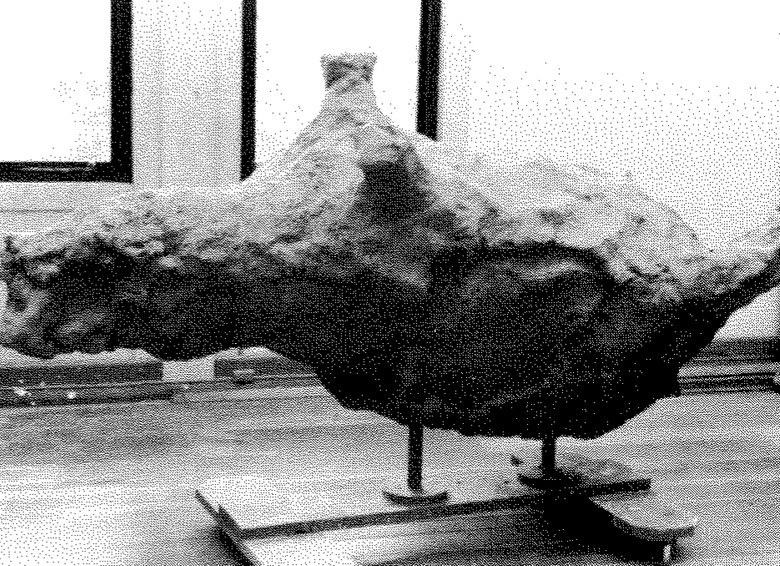
The opening owes its shape to erosion, which has taken the tail region with it. Farther in, the walls curve around the space once occupied by a belly. Recesses branch off where legs projected upward. A person inside can reach into one of those recesses, but has no vantage point from which to see the whole animal. In the late 1940s a crew from Berkeley hauled plaster and mixing water up the cliff. By taking an impression of its inside wall, they made a fossil you could step back from. [1][2]
Where the lava met water
In 1937, geologist George Beck put his finger on the part of the discovery he found hardest to credit. North America had yielded plenty of fossil rhinoceroses. How could the outline of one survive contact with molten rock? An important clue lies just beyond the animal’s skin, in the texture of the cliff itself. The hollow sits among rounded lobes at the bottom of the Priest Rapids lava flow, which reached this part of Washington roughly 15 million years ago. Geologists call these lobes pillows. [2][3]
A pillow forms as water chills the surface of advancing lava. For a time the skin can still bend as molten rock pushes from within. In their 1951 description, Walter Chappell, J. Wyatt Durham and Donald Savage proposed that successive pillows packed around a carcass in shallow water or at the water’s edge. The lobes had to yield enough to take an impression and stiffen soon enough to hold it. Once they had set, the basalt could carry the weight overhead even as the flesh disappeared. [4]
That sequence gives the awkward pose on the cast some significance. The animal lies on its back, its trunk swollen. A bloated carcass floating belly up would account for both features. The researchers also allowed for a body stranded at the margin of the water. The pillows locate the encounter between water and lava quite precisely. The body’s last movements are harder to recover. If the carcass drifted, the place where the lava found it could have been some distance from the place where it died. [2][4]
What the plaster missed
The cast gives the head a position and the legs a direction. Look for an ear or a horn and the surface offers little help. Chappell and his colleagues thought faint markings around the neck might record folds of skin. Keith Kaler, writing about the site in 1988, pointed out how difficult those marks were to see in the actual hollow. An uncertain wrinkle survives the trip to the museum just as readily as a well-defined limb. [2][4]
The strongest evidence for calling the animal a rhinoceros would be easy to overlook beside a life-size cast. A piece of lower jaw retained teeth, including a complete second molar. Its chewing surface had already acquired considerable wear during the animal’s life. The dental remains secured the identification at the family level, and the authors of the 1951 paper tentatively assigned the animal to the extinct genus Diceratherium. The missing impression of a horn counts for little beside that jaw. Even a feature the living animal possessed could disappear wherever the lava failed to take its shape. [2][4]
Usually a museum asks a visitor to picture the body that once surrounded a fossil tooth. At Blue Lake the visitor can do the reverse. Start with the bulk of the animal, follow the turn of its body and the set of its legs, and then ask how much of a rhinoceros anyone could recognize from that silhouette alone. The little patch of working tooth gives the great hollow in the cliff its name. [2]
Sources
- HistoryLink, “Climbers find basalt mold and bones of a 15-million-year-old rhinoceros at Blue Lake, Grant County, in July 1935.” Account of the discovery and plaster casting.
- Keith L. Kaler, “The Blue Lake Rhinoceros,” Washington Geologic Newsletter, October 1988. Site observations, jaw description and Arn Slettebak’s photograph in figure 4.
- George F. Beck, “Remarkable West American Fossil, The Blue Lake Rhino,” The Mineralogist, 1937. Central Washington University archive.
- W. M. Chappell, J. W. Durham and D. E. Savage, “Mold of a Rhinoceros in Basalt, Lower Grand Coulee, Washington,” Geological Society of America Bulletin, 1951. Original authors’ abstract.