The Nariokotome boy's second molars had come through. His wisdom teeth were still in his jaws. From that detail alone, you might picture a child in the first years of secondary school. His height would do little to disturb the picture. When Kamoya Kimeu discovered his remains on the west side of Lake Turkana in Kenya in 1984, the bones recovered there belonged to a boy who had stood roughly a metre and a half tall. Yet the best clue to his age comes from a tooth still taking shape in his upper jaw. It puts him closer to eight or nine. [1][2]
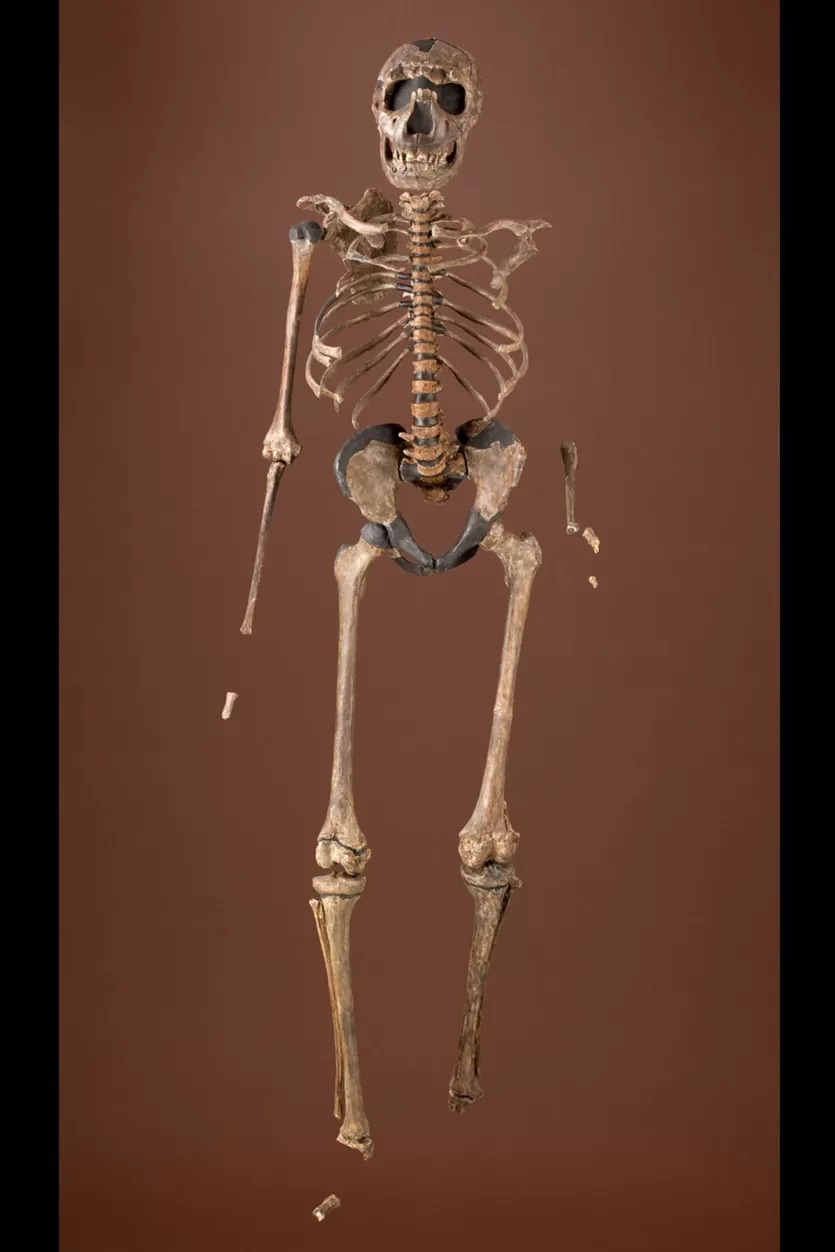
The boy lived about 1.5 million years ago, in the Early Pleistocene. He belonged to the early African humans often called Homo erectus. An isolated thighbone from that time could give a fair idea of its owner's height. A jaw from the same site could tell us how far someone's teeth had developed. At Nariokotome the jaw and the legs belonged to the same child. That association lets us ask a harder question. How much of his eventual height had he already reached? [1][3]
The unfinished canine
A permanent tooth grows in a sequence. The crown takes shape first, then the root lengthens. To work out how much time the boy's upper canine represented, researchers examined thin sections of modern human canines. Daily increments in the tissues let them put elapsed time against successive fractions of the tooth's height. They could then compare the fossil canine's stage of development with that timetable. Different estimates centred on about eight to nine years, with a wider spread from about six and a half to just over ten. [2]
Something striking happened when the researchers carried that age over to a second comparison. The boy's teeth fell within the variation they saw in modern dental development. His estimated height and weight fell well beyond those of the seven- to ten-year-olds in their comparison group of 438 Sudanese children. A dentist and a tailor, handed different parts of the evidence, might reasonably have pictured quite different children. Each comparison tells us something about him. Neither gives us his rate of growth in centimetres per year. For that we would need to see him at a second age. [2]
The missing years
Christopher Ruff and M. Loring Burgess approached the missing years through the ends of the leg bones. They sorted African apes into two groups. In one, the second molars had erupted and the third molars had yet to appear, just as in the boy. In the other, the ends of the long bones had fused to their shafts, a mark of skeletal maturity. By comparing thighbone and shinbone lengths across the groups, they could estimate the percentage of length gained between those two landmarks. They applied that increase to the boy's bones, then used human limb proportions to translate the projected lengths into standing height. Their best estimates came to 176–180 centimetres. [3]
The attraction of the method is that an ape can enter the comparison without anyone knowing its birthday. The difficulty lies in the match itself. Two species can reach the same dental landmark having completed different fractions of their leg growth. In 2018 Deborah Cunningham and colleagues used both chimpanzee and modern human growth patterns to explore the range of outcomes. Their projections ran from 160 to nearly 178 centimetres. At one end the boy was already close to his adult height. At the other he still had room to grow roughly the length of a hand. [3][4]
Look again at the legs in the photograph. Their length helped make this child famous as a tall early human. The small unfinished tooth gives that length a different significance. Here was a member of our lineage who could already stand shoulder to shoulder with many adults while his permanent teeth were still developing. Whether he would one day have stood a head taller depends on how his species spent the years between a second molar and a finished thighbone. [1][2][3][4]
Sources
- Smithsonian Human Origins Program, KNM-WT 15000. Specimen record and photograph by Chip Clark.
- “Combining radiographic and histological data for dental development to compare growth in the past and the present,” Annals of Human Biology (2014).
- Christopher B. Ruff and M. Loring Burgess, “How much more would KNM-WT 15000 have grown?” Journal of Human Evolution (2015).
- Deborah L. Cunningham and colleagues, “The effect of ontogeny on estimates of KNM-WT 15000's adult body size,” Journal of Human Evolution (2018).