ZERO begins with a refusal that sounds almost too clean: start again. In late-1950s Dusseldorf, Heinz Mack and Otto Piene named a project that wanted to move beyond the weight of postwar expressionism, private anguish, and inherited artistic seriousness. Gunther Uecker soon joined the inner circle, and the idea widened into an international network rather than a disciplined school.[1][2] The name was not an empty brand. It proposed a pause before ignition, a count before launch, a field cleared for light, movement, reflection, smoke, fire, serial reliefs, and materials that changed as the viewer moved.
That is why ZERO is easiest to misunderstand when it is treated as a look. White surfaces, polished metal, nail fields, perforated disks, rotating lamps, and sparse monochromes can seem cool or decorative in reproduction. In the room, the work is less settled. It vibrates, throws shadows, catches glare, burns, reflects, flickers, or makes the viewer's body complete the event.[2][3] ZERO was not minimalism before minimalism, and it was not simply kinetic art with a German address. Its strongest works turn perception into a moral and historical problem: how can art begin again without pretending the past has disappeared?
A Network, Not A Uniform
The institutional history matters because ZERO was loose by design. The ZERO Foundation describes the movement as a conscious break with convention that began in Dusseldorf and expanded across Europe, with Mack, Piene, and Uecker at its center.[1] Almine Rech's 2026 exhibition text frames the trio through three coordinates: light, space, and time.[2] Those coordinates are more useful than a checklist of motifs because ZERO's coherence came from behavior, not uniform appearance.
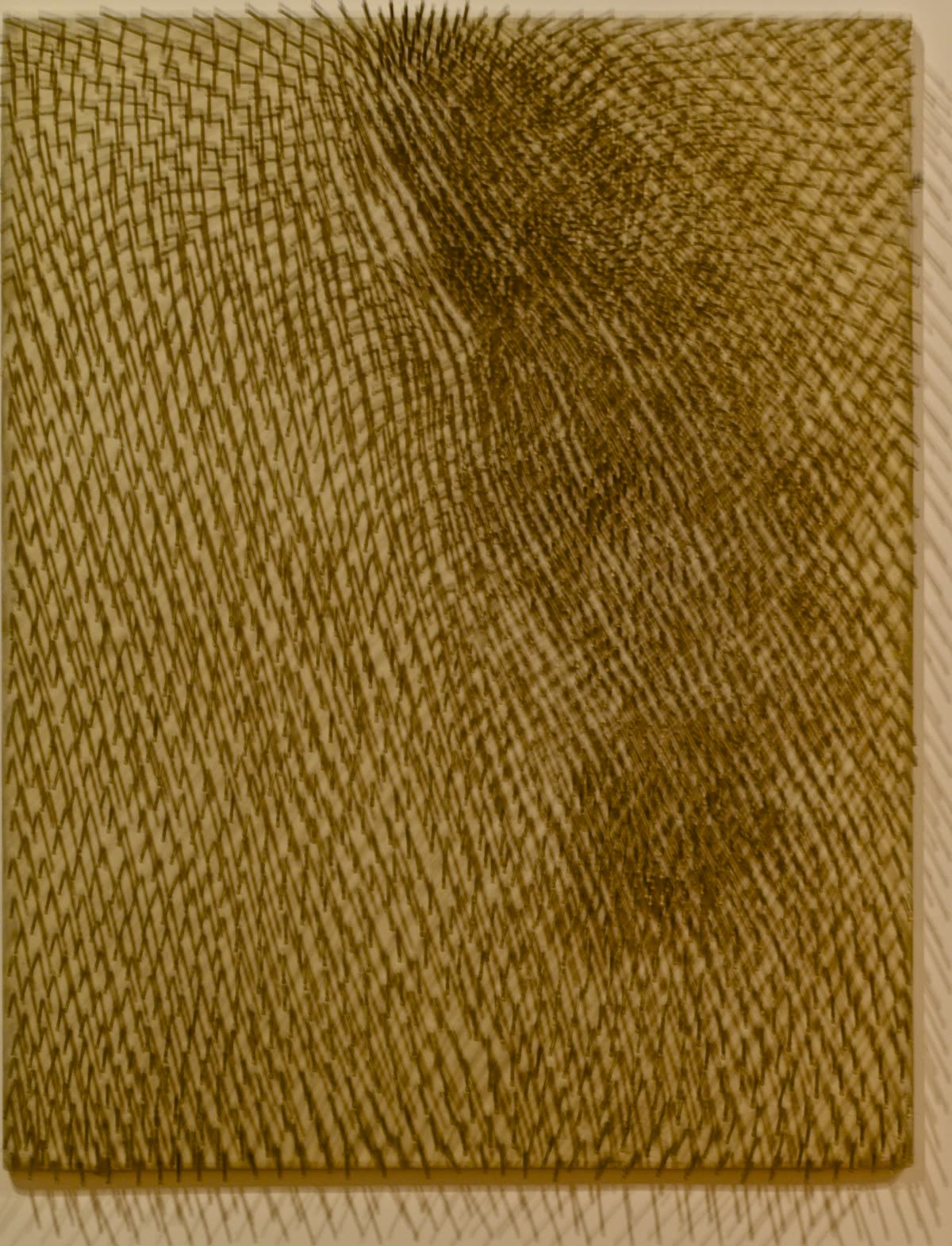
Mack's reflective metals and desert projects, Piene's light ballets and fire paintings, and Uecker's nail reliefs do not look identical.[2][3][5] Yet they share a refusal to let the artwork sit quietly as a sealed object. A Mack relief turns ambient light into a participant. A Piene light machine makes projection feel choreographed rather than illustrative. A Uecker nail field is both brutally material and optically unstable: rows of hammered points cast changing shadows, so a white surface starts behaving like a field of weather.[5]
The exhibition record gives the movement another clue: ZERO was not just a style of pale surfaces. Sperone Westwater's 2010 Piene exhibition grouped historical Light Ballet sculptures with fire paintings from the core ZERO years, stressing light, environment, nature, science, smoke, soot, and burning as connected practices rather than separate phases.[4] A movement built around brightness still needed heat, motors, residue, timing, and the practical machinery of display.
Light Was Not Decoration
Piene's work makes the point most directly. MIT List Visual Arts Center describes him as a pioneering figure in multimedia and technology-based art, known for smoke and fire paintings, environmental sky art, and light-based sculptural work.[3] In the Lichtballett works, light is not applied to sculpture as atmosphere. It is the sculpture's operating condition. Lamps, perforated stencils, revolving disks, globes, grids, and electric switchboards produce movement that cannot be fully captured by a still photograph.[3]
This matters because postwar renewal can become a sentimental story if the medium stays passive. ZERO did not merely paint brighter pictures after catastrophe. It chose materials that made brightness precarious. Fire can illuminate and destroy. Smoke can draw and stain. Aluminum can look clean while reflecting the room's clutter back at the viewer. Nails can organize a surface while recalling repair, barricade, labor, and defense.[2][5] The reset is never innocent. It is made by materials that remember force.
The movement's optimism therefore has a hard edge. Almine Rech notes ZERO's interest in movement, energy, and light, and also its use of materials ranging from aluminum and plastic to iron and fire.[2] Those materials belong to a technological century as much as to nature. ZERO's light is not pastoral. It is electric, industrial, controlled, unstable, and sometimes theatrical. The old art object gives way to a situation in which the room, power supply, viewer, and surface all matter.
Surfaces That Refuse Stillness
Uecker's nail works are especially useful for seeing how ZERO turns stillness into activity. The nails in Composition are fixed in wood, but the relief is not visually fixed.[5] Each head and shaft creates a small event of shadow. The pattern looks serial, even disciplined, yet it keeps shifting with light and angle. The viewer reads the object first as a pale field, then as a damaged plane, then as a vibrating instrument.
That double condition gives ZERO its tension. The movement wanted a new beginning, but it did not escape matter. It drove metal into wood, burned pigment, wired lamps, polished aluminum, printed editions, staged exhibitions, and built archives.[1][2][3][4][5] It made dematerialization out of stubbornly physical things. Even the most airy light event depends on motors, bulbs, switches, timing, heat, and maintenance.
This is why ZERO still feels contemporary without needing to be updated into "immersive art." A great deal of today's digital spectacle treats light as volume: more pixels, more projection, more surround. ZERO often worked in the opposite direction. It asked what the smallest disturbance could do. A rotating disk can make a wall breathe. A nail can turn into a shadow clock. A reflective relief can make the viewer aware of walking, pausing, and looking from the side rather than the front.[2][3][5]
The Reset Was A Discipline
The word "zero" risks making the movement sound like a clean wipe. The better reading is stricter: ZERO was a discipline of beginning under pressure. The artists did not erase history so much as refuse to let historical damage dictate the old expressive vocabulary. They looked for a language in which art could become less confessional and more environmental, less image-bound and more event-like, less attached to heroic brushwork and more open to anonymous forces such as light, serial rhythm, vibration, and weather.[1][2][3]
That discipline explains the movement's international reach. Once the artwork is understood as an event of perception rather than a national style, it can connect with related experiments in Italy, the Netherlands, Belgium, France, Switzerland, Japan, Brazil, and beyond.[1][2] ZERO becomes a relay system: not one doctrine, but a way for artists to test how much could be rebuilt from brightness, motion, repetition, and material risk.
The strongest ZERO works do not ask the viewer to admire the future from a distance. They make the future conditional. Stand here, and the surface flares. Move there, and the relief darkens. Wait, and the light changes. Look too quickly, and the work seems blank. Stay longer, and the blankness begins to pulse. That is the movement's lasting intelligence: it made renewal visible as an action, not a claim.
Sources
- ZERO Foundation, "History" and "Task" sections - institutional overview of ZERO's Dusseldorf origins, founding figures, archives, and research mission.
- Almine Rech, "Piene, Mack, Uecker - Light, Space and Time" - 2026 exhibition text on ZERO's founding, materials, light, movement, and postwar context.
- MIT List Visual Arts Center, "Otto Piene: Lichtballett" - exhibition page on Piene's light sculptures, Group Zero role, light machines, fire paintings, and multimedia practice.
- Sperone Westwater, "Otto Piene: Light Ballet and Fire Paintings, 1957-1967" - exhibition page on Piene's ZERO-period light sculptures, fire paintings, smoke, projection, and kinetic light machines.
- Wikimedia Commons, "Composition (1963) - Gunther Uecker" - photographic file page for the article image, with material notes, dimensions, camera metadata, and original upload.