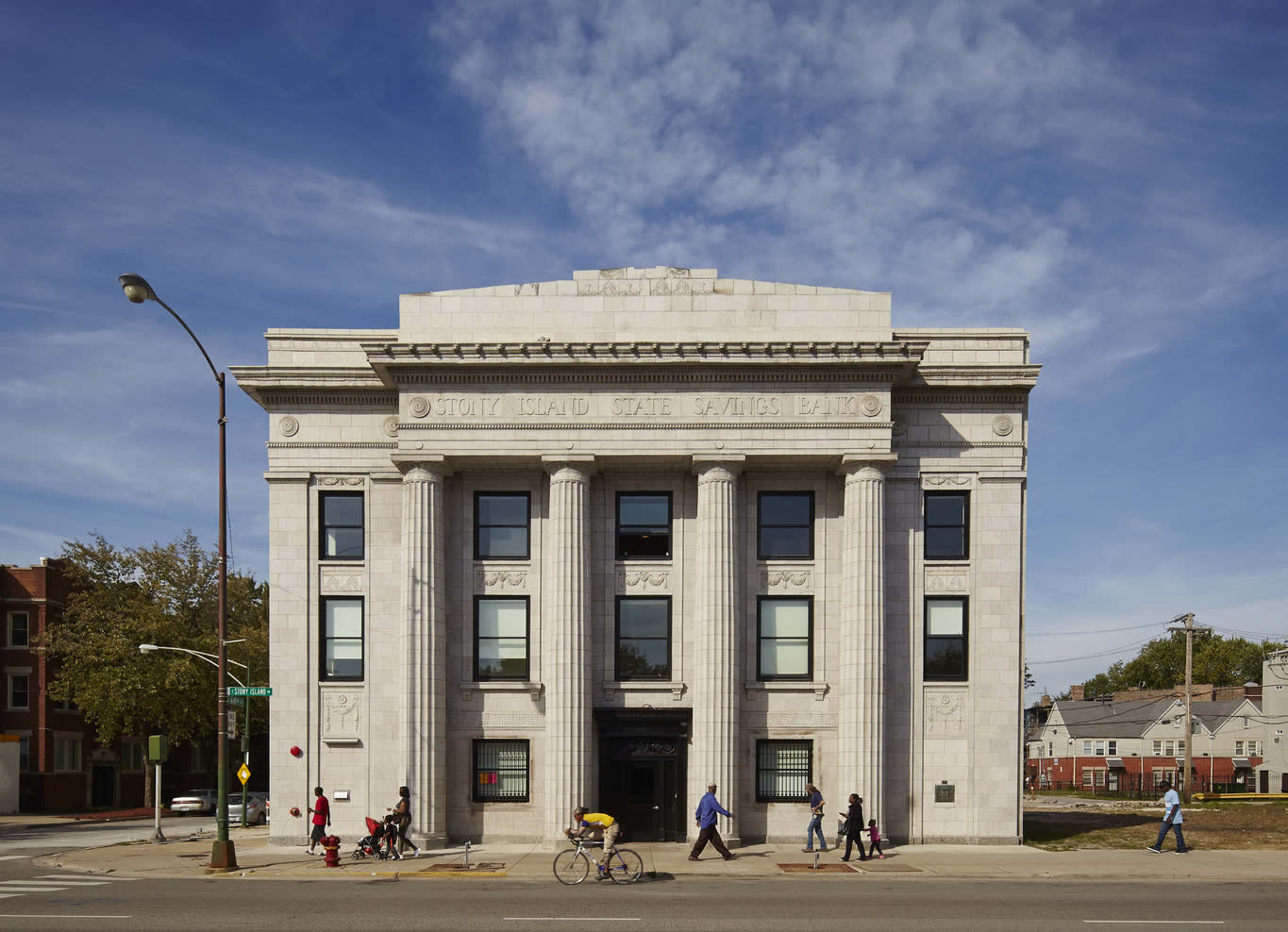

Theaster Gates is easiest to misunderstand when his work is described as community development with better lighting. That description notices the social result but misses the art-historical method. Gates does not simply move art into renovated buildings. He turns buildings, salvage, archives, performance, fundraising, neighborhood trust, and public use into interdependent materials. Stony Island Arts Bank is the clearest test of that method: a former South Side bank becomes sculpture before it becomes venue.[3][4]
Art21's segment Theaster Gates in "Chicago" is worth watching because it keeps those categories unstable.[1][2] Gates appears as potter, singer, planner, collector, builder, and artist, but the video does not ask the viewer to choose one identity as the real one. Instead, it shows a practice that works by converting the raw matter of neglected urban space into cultural infrastructure. Art21's artist profile is precise about the method: Gates makes sculptures with clay, tar, and renovated buildings, transforming urban neighborhoods into reimagined vessels of opportunity.[2]
The Stony Island Arts Bank sharpens that claim because it began with a specific building and a specific address, not an abstract ideal. Theaster Gates Studio identifies the structure as a 1923 bank designed by William Gibbons Uffendell at 68th and Stony Island, once a community savings and loan, now a 17,000-square-foot space for contemporary art and archival practice.[3] The Arts Bank's own history page adds the institutional sequence: Gates acquired the building in 2013, restored it, and reopened it in 2015 as a permanent exhibition space for his work and the archives in his care.[4] Those facts matter because the work's scale is not only architectural. It is procedural.
Before watching, hold onto one question: where does the artwork stop? If the answer is "at the object," Gates's practice becomes confusing. If the answer is "at the operating system," the Art21 segment begins to make sense. The building is an object, but it is also a container for books, slides, records, gatherings, restoration labor, and public memory. The artwork is not the bank alone. It is the bank as a machine that changes what neglected material can do.
Watch the conversions, not only the spaces
The most important viewing move is to notice conversion. In Gates's work, abandoned does not mean empty. It means value has been misrecognized, stranded, or administratively abandoned. Art21's artist page describes how Gates strips dilapidated buildings of components, transforms those elements into sculptures that can act as bonds or investments, and uses proceeds to finance rehabilitation.[2] That loop is not a side story about funding. It is the form. Matter moves from building to artwork to capital to building again.
Around the moments where the Art21 segment shows Gates speaking from the South Side context, the useful question is not whether the practice is "really" sculpture or "really" urbanism.[1][2] The sharper point is that Gates makes that distinction behave badly. A salvaged beam can be architectural debris, sculptural material, financial instrument, and historical witness. A bank can be a failed financial shell, a restored civic facade, a performance site, and an archive. The work asks viewers to follow the circulation of meaning rather than stare only at a finished object.
That is why the Stony Island Arts Bank's archival holdings are not decorative programming. Gates Studio lists the University of Chicago glass lantern slides, Johnson Publishing Company books and periodicals, Frankie Knuckles's vinyl collection, and Edward J. Williams's collection of racist memorabilia as core parts of the Arts Bank's life.[3] The Arts Bank's own page similarly centers the Johnson Publishing Company Library as one of the monumental collections in Gates's care.[4] These archives make the building operate as memory infrastructure. They also prevent the renovation from becoming a generic preservation story.
The bank keeps its old argument in view
The building's former life matters. A bank is not just a handsome shell. It is an institution built around deposits, credit, trust, risk, and who is allowed to accumulate value. When Gates turns a vacant bank into an arts bank, he does more than reuse a facade. He changes the grammar of deposit. Money is no longer the only thing that can be held, grown, and redistributed. Books, records, slides, objects, voices, and neighborhood access become deposits too.[3][4]
This is where the Art21 video is more useful than a still photograph. A photograph can show the restored neoclassical front and the impressive act of rescue. The video shows Gates thinking through movement, voice, work, and use.[1] It makes clear that Stony Island Arts Bank is not a trophy project in which a famous artist saves a ruined building and then steps back. It is a working proposition: if a community's cultural memory has been undervalued, then the artist can build a structure that makes that value visible, usable, and difficult to dismiss.
The risk, of course, is that language like "community" can smooth over the hard edges. Gates's method depends on resources, charisma, institutions, donors, and real estate conditions that cannot be wished away. The article should not pretend the work escapes those pressures. Instead, the importance of the Arts Bank is that it makes those pressures visible inside the artwork's own system. Finance, salvage, Black archival care, architectural preservation, and public programming are not outside the piece. They are the piece's moving parts.
What the segment teaches
The Art21 segment's strongest lesson is that Gates expands artistic medium without abandoning material specificity.[1][2] He is not making a vague statement that anything can be art. He is making a demanding statement that certain materials carry histories, and those histories require forms that can hold them. Clay asks for touch and firing. Tar asks for surface and labor. A closed bank asks for restoration, negotiation, capital, access, and a new public script. An archive asks for care, friction, and repeated encounter.[2][3][4]
Seen this way, Stony Island Arts Bank is not a venue with an artist's name attached. It is a sculptural system whose medium is conversion: vacancy into use, debris into value, private collections into public memory, neighborhood address into cultural platform. The embedded video gives that system a human rhythm, but the written frame matters because the work's intelligence lies in how many registers it keeps active at once. Gates makes the bank hold more than money, and that is why the building remains one of the most persuasive arguments for socially engaged art as form rather than supplement.
Sources
- Art21, "Theaster Gates in 'Chicago' - Season 8" - YouTube video embedded in this post.
- Art21, "Theaster Gates" - artist profile on Gates's materials, renovated buildings, Rebuild Foundation projects, and biographical context.
- Theaster Gates Studio, "Stony Island Arts Bank" - project page with building history, square footage, image credits, programs, and archive list.
- Stony Island Arts Bank, "About" - official history page on the 1923 bank, Gates's 2013 acquisition, 2015 reopening, and current archival mission.