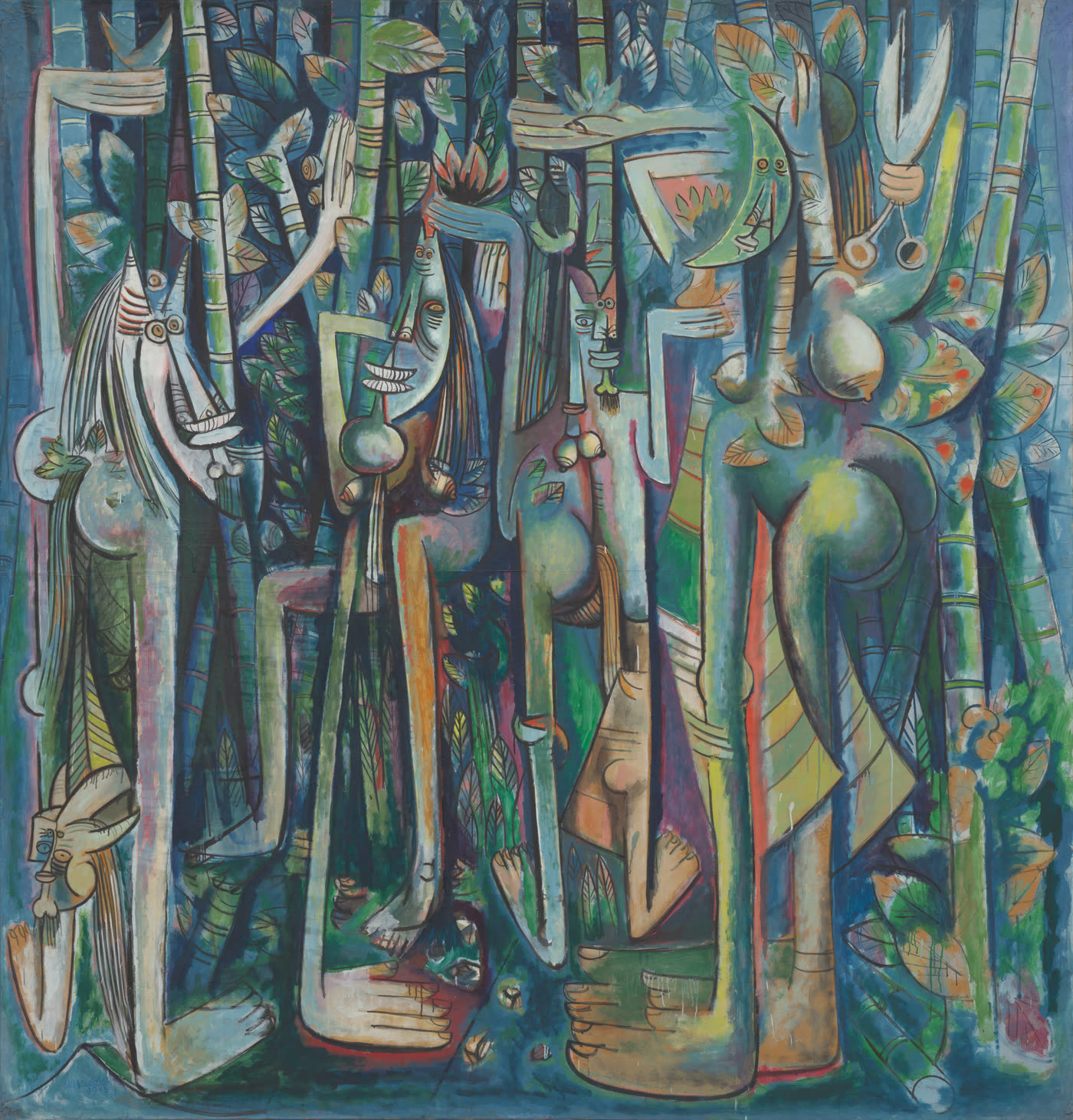
Wifredo Lam's The Jungle looks overgrown at first, but its pressure comes from control. The painting does not open into a lush vista. It crowds the viewer with vertical cane, masklike faces, elongated limbs, broad leaves, tropical fruit, and bodies that keep changing category before the eye can settle them.[1][2] The title promises wilderness. The picture gives something harsher: a cultivated field that has learned to look like a dream because plantation history, Afro-Caribbean spirituality, European modernism, and colonial fantasy have all been forced into the same shallow space.
That is why the work still feels sharper than a simple fusion painting. Lam was Cuban, of African and Chinese descent, and had spent nearly two decades abroad before returning to the Caribbean in the early 1940s.[4][5] He knew European modernism from inside its circles, including Cubism and Surrealism, yet The Jungle does not merely apply those languages to Caribbean subject matter.[3][4] It makes the imported language answer to a different ground. The painting takes the modernist mask, the fractured figure, and the dream image, then pushes them into sugarcane, slavery's afterimage, Afro-Cuban ritual presence, and the cheapening fantasy of Cuba as playground.[1][2][3]
Image context: the lead image needs the full painting rather than a cropped detail because Lam's argument is spatial. The work is not a parade of isolated symbols. Its meaning comes from crowding: legs become stalks, stalks become bars, faces become masks, and the viewer is denied the distance that a picturesque landscape would normally provide.[1][2]
The title says jungle, but the plants say labor
The first trap in The Jungle is the title. A viewer primed for tropical wildness may expect untamed nature, but the painting repeatedly contradicts that expectation. Smarthistory makes the essential distinction: sugarcane is not jungle flora; it is a cultivated crop, and in 1940s Cuba it belonged to a labor system and export economy rather than to a fantasy of untouched nature.[2] Annenberg Learner makes the same point from another angle, noting that the painting includes domesticated crops such as sugarcane and tobacco, not simply wild plants.[3]
That correction changes the whole painting. The vertical green and blue stalks are not neutral scenery. They carry the memory of work, extraction, and enclosure. Lam's figures do not stand before the landscape as tourists or owners. They are interwoven with it, almost trapped inside its uprights.[1][2][3] The cane stalk becomes an architectural device. It divides the canvas into narrow lanes, denies depth, and makes the bodies appear both present and hemmed in.
This is the work's anti-postcard intelligence. A postcard of Cuba would create distance: sun, palms, beach, music, a view offered to the visitor. Lam removes that distance. There is almost no horizon, no open sky, and no stable ground.[2] The viewer cannot enter as a relaxed observer. The picture presses forward as a wall of relations. What looked decorative for a second begins to feel like a system.
The figures refuse to stay human, animal, plant, or emblem
The bodies in The Jungle are not simply distorted. They are unstable. MoMA's object page identifies faces reminiscent of African masks, handlike feet, elongated legs, and figures with male and female attributes.[1] Annenberg describes four prominent female figures interwoven among sugarcane, with long limbs that blend into the stalks; it also notes the rightmost woman-horse hybrid as a signal of spiritual entities.[3] Smarthistory's reading is useful because it names the visual experience as a game of perception: crescent faces, rounded backsides, willowy arms and legs, and flat hands and feet keep assembling into bodies and breaking apart again.[2]
That instability is not a decorative Surrealist trick. It is the painting's way of refusing a colonial grammar of classification. The figures cannot be sorted into ethnographic object, plantation worker, mythic creature, mask, goddess, or modernist form. They are all of those pressures at once, and none of them comfortably. Lam makes hybridity difficult rather than fashionable. The bodies do not celebrate mixture as a lifestyle badge. They show what it means to live inside histories that have already mixed peoples, religions, crops, markets, and images by force.
The masklike faces are crucial here. European modernism often treated African masks as formal fuel: a way to break naturalistic faces, sharpen planes, and produce new pictorial force. Lam understood that inheritance, but he also changed its ethical direction.[3][4] In The Jungle, the mask is not a borrowed museum form used to refresh European painting. It returns inside a Caribbean field marked by African diaspora, Santeria, plantation labor, and colonial tourism.[1][2][3] The face does not become modern because it resembles a mask. It becomes modern because it exposes the violence hidden in the viewer's old categories.
The composition is crowded because distance would lie
The painting's scale matters: MoMA gives the dimensions as roughly 94 by 90 inches, and Smarthistory emphasizes that the canvas is nearly eight feet square.[1][2] Yet Lam uses that size against spaciousness. A large canvas could have produced panorama. Instead, it produces compression. The upper half is especially dense, while the lower portion feels too thinly supported by long legs and strange feet, giving the picture an uneasy top-heavy balance.[2]
That imbalance is one reason the painting feels alive. The figures seem not quite planted. Their feet are huge, awkward, handlike, and insufficient all at once.[1][2] Some limbs touch the bottom edge like roots; others hang or taper. The result is a field that appears both vertical and unstable. The cane rises; the bodies rise; the whole image seems close to tipping forward.
This formal pressure helps separate Lam from an easy politics of illustration. He does not paint a clear scene of plantation work or a didactic allegory of oppression. He makes the pictorial system itself behave like pressure. No horizon means no escape route. No empty middle ground means no comfortable viewing distance. No stable boundary between body and plant means the history of labor is not something that happened behind the figure; it is in the figure's very construction.
Modernism is inside the painting, but it is not in command
Lam's European training is unmistakable. Tate's introduction to Lam places him in relation to Picasso and the Surrealists, while Annenberg stresses Picasso's impact and the wider Surrealist environment in which Lam worked.[3][4] MoMA's 2025-26 retrospective framing makes the larger arc clearer: Lam forged modernist commitments in war-torn Europe, then reimagined his artistic project after exile and return to the Caribbean.[5]
That sequence matters because The Jungle is not provincial modernism arriving late. It is modernism redirected. Cubist fracture, Surrealist metamorphosis, and mask-derived facial structure are all present, but none has the final word.[2][3][4] The painting's deepest force comes from making those European tools face the Caribbean realities they had often abstracted, exoticized, or consumed at a distance.
This is why the work can be read as anti-picturesque without becoming anti-beautiful. The blues, greens, pale flesh tones, orange accents, and rhythmic verticals are visually seductive. Lam does not drain pleasure from the surface. He makes pleasure answerable to history. If the viewer enjoys the color, the painting asks: what kind of field is this? If the viewer enjoys the masklike faces, it asks: who has been allowed to treat masks as style? If the viewer enjoys the dream atmosphere, it asks: whose nightmare is being aestheticized?
Why the painting still holds
MoMA's recent retrospective described Lam's art as an "act of decolonization," a phrase that can sound broad until The Jungle is placed in front of it.[5] Here decolonization is not a slogan pasted onto an image. It happens through the painting's refusal to let inherited images remain innocent. Jungle, mask, female body, tropical crop, plantation field, tourist island, Surrealist dream, Cubist distortion: each term enters the work carrying a prior history, and Lam makes those histories collide.
The painting still holds because it does not resolve that collision into a neat identity statement. It does not say Cuba is one thing, modernism is one thing, or diaspora is one thing. It builds a space where those claims become visibly inadequate. The cane is too cultivated to be wilderness. The figures are too spiritual to be workers alone, too embodied to be pure symbols, and too politically charged to be exotic dream forms.[1][2][3]
That is the achievement of The Jungle. Lam took the visual materials that could have made Cuba picturesque for outsiders and made them turn back against the gaze. The painting refuses the postcard not by rejecting beauty, but by making beauty difficult to consume. It gives the viewer a field full of faces and still denies easy encounter. It gives the viewer a jungle and then reveals a crop. It gives the viewer modernism and then makes modernism answer to the plantation, the ritual, the body, and the island.
Sources
- The Museum of Modern Art, "Wifredo Lam. La jungla (The Jungle). 1942-43" - official object page with medium, dimensions, image, gallery label, and formal description.
- Dr. Doris Maria-Reina Bravo, "Wifredo Lam, The Jungle," Smarthistory - close reading of the painting's perception games, cane field, Afro-Caribbean context, and anti-tourist landscape.
- Annenberg Learner, "Art: The Jungle" - educational essay on Lam's European modernist context, Afro-Cuban references, hybrid figures, sugarcane, tobacco, and mythic vision.
- Tate, "Who is Wifredo Lam?" - museum introduction to Lam's life, European connections, Cuban return, and the breakthrough role of The Jungle.
- The Museum of Modern Art, "Wifredo Lam: When I Don't Sleep, I Dream" - exhibition page for the 2025-26 retrospective, framing Lam's modernism, exile, Afro-Caribbean histories, and decolonizing ambition.