Lewis Hine’s mechanic looks strong enough to loosen the nut. The question is whether his wrench has a grip on it. Follow the handle past the man’s hands to the point where the tool meets the pump. The Metropolitan Museum of Art draws attention to the fit in its print, titled Steamfitter. The wrench has yet to seat fully on the nut. By the time you notice that small discrepancy, you may already have felt the pull in your own shoulders. How did Hine get you to supply so much of the effort? [1][2]
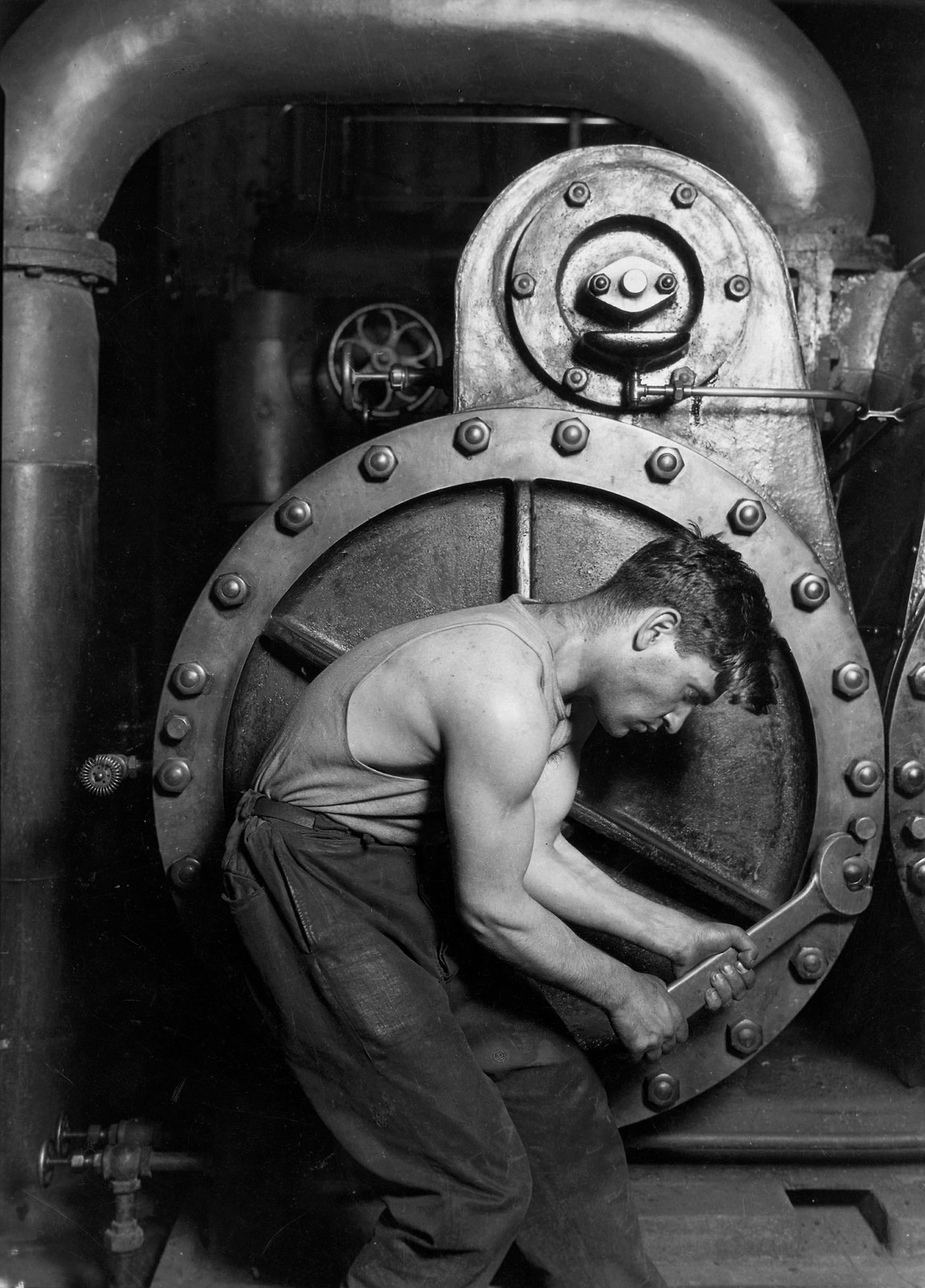
Start with the hardware. The ring of nuts gives the eye a path around the cylinder head. Each nut is much like its neighbor, so the eye can continue the circle even where the man gets in the way. Then follow his outline. His bowed head, the slope of his neck and the rounded shoulder carry you partway around that same curve. The resemblance lasts just long enough for the differences to register. Steel keeps its radius all the way around. A man has to bend at the waist, tuck his chin and bring his arms in close to take this shape. [1]
The wrench crosses both outlines. One end belongs among the fittings. Farther down the shaft, fingers curl around it. That short distance is where Hine makes the size of the machine intelligible. A cylinder head seen by itself could be almost any size in a photograph. Here we can measure one of its fastenings against a fist. We can also imagine the first fraction of a turn, the moment when a stubborn nut gives and the whole arrangement of back, hands and shoulders has to change. Hine holds us just before it. [1][2]
The mechanic had another job that day. He had to hold still for a man with a camera through repeated exposures. Winterthur records that Hine made exhibition prints from four closely similar negatives of the mechanic, part of a series he photographed in 1920 and 1921. Repetition changes what there is to admire in the pose. Anyone who has held a heavy tool in position while somebody else takes their time can recognize a kind of exertion here, even with the wrench barely engaged. Look at the fingers curled under the handle. Keeping it at that angle was part of the sitting. [2][3]
Hine knew how much a photograph could leave out of a working day. In his investigations for the National Child Labor Committee, caption cards could record a child’s hours, wages or words. Sometimes they even named a witness. A reader could look from a small figure in a factory to a line of type and learn how long that child had been on the floor. The familiar titles of the pump photographs give the viewer an occupation and a piece of equipment. The mechanic’s own account of the job is harder to come by. [1][2][4]
That makes his lowered head worth another look. His profile is clear enough to pick out the nose against the machinery, yet his attention passes right by us and down toward his hands. Hine has placed us near enough to inspect the fit of a wrench, the sort of detail a visitor to a running plant might easily miss. We can spend as long as we like there. The man who held that position for the photographer is the one person in the room who would have known exactly what it cost. [1][3]
Sources
- U.S. National Archives via Wikimedia Commons, Lewis Hine’s Power house mechanic working on steam pump, archival photograph and reproduction details.
- The Metropolitan Museum of Art, Steamfitter, 1921, collection record and curator’s note on the wrench.
- Winterthur Museum, Hine Photograph, exhibition research on the negatives and surviving prints.
- Library of Congress, National Child Labor Committee Collection, overview of Hine’s investigations and the caption cards.