
Yoko Ono's Cut Piece is one of those works that sounds almost too simple when described from a distance. The performer sits on stage. A pair of scissors is placed in front of her. Members of the audience may come forward, one at a time, and cut away pieces of her clothing. The performer remains still. That is enough to make the work famous, but not enough to understand why the archival film still feels tense.
The important thing is that Cut Piece does not merely invite audience participation. It makes participation visible as an ethical act. A viewer who climbs onto the stage cannot hide inside the general word "audience" anymore. The person must decide how close to come, where to cut, how much to take, how to behave under other people's eyes, and when to stop. Ono's stillness is therefore not passivity in any simple sense. It is the structure that makes everyone else's agency harder to excuse.[2][4]
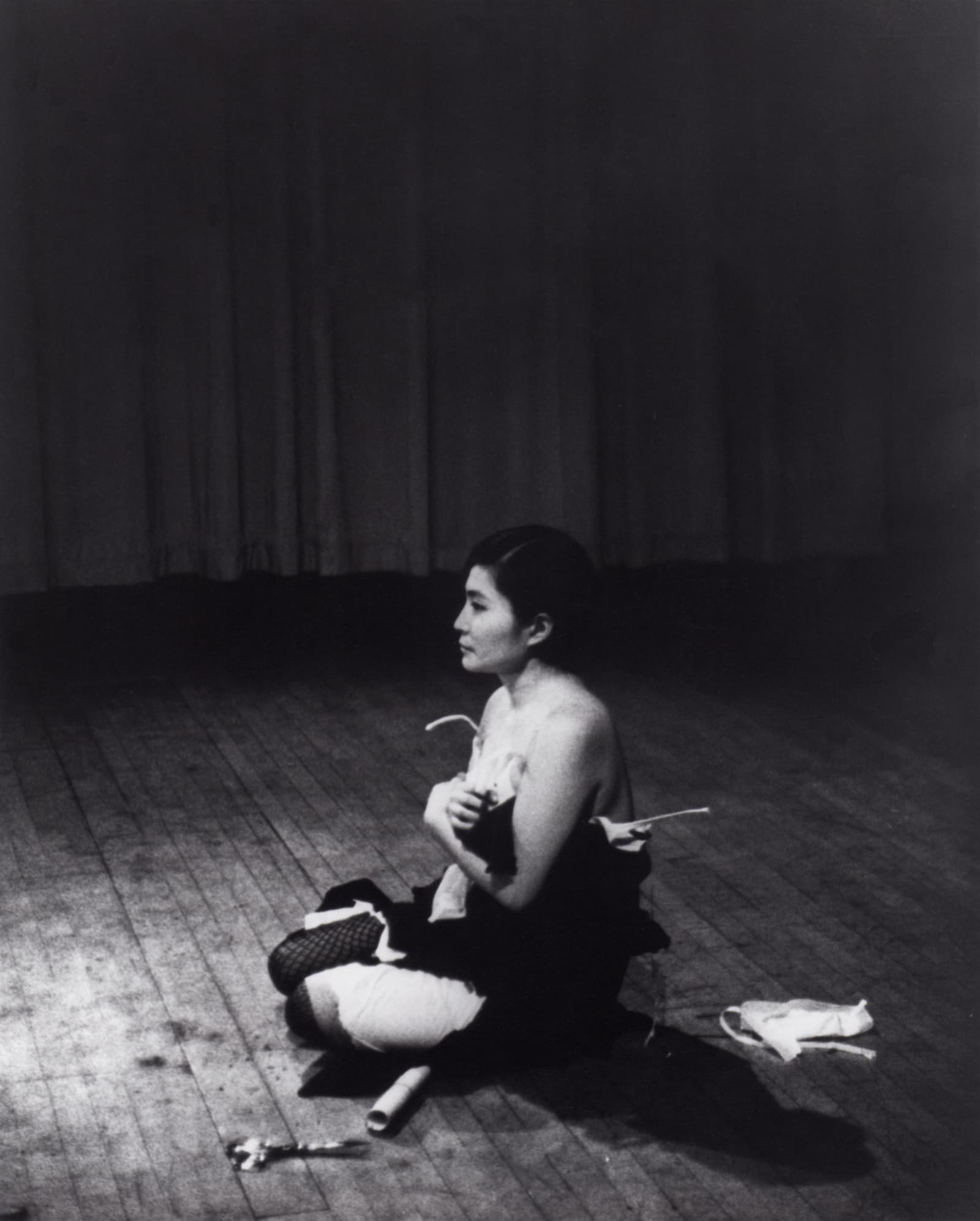
Historically, the work sits inside Ono's early 1960s practice of instruction, performance, Fluxus-adjacent experiment, and audience completion. MoMA identifies the photographed New York performance as part of New Works of Yoko Ono at Carnegie Recital Hall on March 21, 1965, with Minoru Niizuma as photographer.[2] Fondazione Bonotto's collection record adds the crucial moving-image provenance: the 1965 Carnegie Hall performance was filmed by documentary filmmakers Albert and David Maysles, and the surviving excerpt runs 9 minutes and 19 seconds.[3] That film record matters because it returns the piece from legend to tempo. The cutting does not happen as one symbolic gesture. It unfolds as a sequence of hesitations, approaches, small decisions, and escalations.
The embedded video below is an archival excerpt of the 1965 performance.[1] It should be watched less as a relic of "shocking" performance art than as a study in how a rule organizes conduct. The rule is plain enough that nobody can claim confusion. The scissors make the rule physical. The stage makes the action public. Ono's silence makes the sound of the room, the movement of bodies, and the timing between participants feel unusually exposed.
The film turns an instruction into duration
The first thing the video clarifies is that Cut Piece is not a still image slowly losing fabric. It is an event made from intervals.[1] Someone must decide to be first. Then the room has to absorb that first action before the next person comes forward. Each later participant inherits a changed situation. The garment has already been opened somewhere. The artist's body is already more exposed. The room has already learned that cutting is permitted. The performance grows through precedent.
That is why the piece is stronger than a simple allegory of victimhood. Ono supplies the score and accepts the risk of exposure, but the work's behavior is made by the audience. MoMA's audio guide states the basic situation directly: viewers were invited to approach and cut away pieces of her clothing while she knelt silently on stage.[2] Guggenheim Bilbao's teaching guide likewise anchors the Carnegie Recital Hall performance on March 21, 1965, and places it within action art, where the viewer's deed becomes part of the work rather than a response after the fact.[4]
The archival film makes that transformation concrete. A participant's hand, the angle of a cut, the decision to take a small piece or a larger one, the distance kept from Ono's face, the return to the audience: these are not incidental details. They are the work's material. The scissors do not simply remove fabric. They draw a line between permission and restraint, then ask each person to locate that line in public.
Stillness is the engine, not the absence of action
Ono's stillness is easy to misread as surrender. In the film, it functions more like pressure. Because she does not direct the participants after the instruction has been given, the audience cannot convert her into a conventional performer managing their reactions.[1][2] They have to manage themselves.
This is where the work's feminist force begins, though it should not be narrowed to one label. The scene undeniably exposes the relation between looking, touching, undressing, and social permission. It lets the audience enact forms of entitlement that women already knew from ordinary life, but it does so in a room where the action can no longer pretend to be invisible. At the same time, Cut Piece is also a conceptual artwork about authorship. If the artist writes the condition and the audience completes the act, where does the artwork live: in the score, the body, the film, the cut fabric, or the decisions made by strangers?
The answer is all of them, but not equally. The score creates the possible field. Ono's body and stillness give the field stakes. The participants make the work irreversible, cut by cut. The documentation carries the event forward after the stage is empty.[1][3] That layered authorship is why Cut Piece still resists a tidy moral. It does not say simply that audiences are cruel, or that exposure is liberating, or that vulnerability is power. It builds a situation in which those readings compete under real social pressure.
The archive keeps the discomfort from becoming myth
Without the film, Cut Piece can harden into a famous art-history sentence. The archive slows that sentence down. Fondazione Bonotto's record is useful because it treats the 1965 Carnegie Hall material as both performance documentation and video documentation, while also noting later photographic and video versions by Ono and by other performers.[3] That reminds us that Cut Piece was not a single fixed object. It was a repeatable structure whose meaning changed with performer, audience, location, and historical moment.
MoMA's 2015 exhibition frame, Yoko Ono: One Woman Show: 1960-1971, also matters here because it places the work before the later celebrity narratives that often distort Ono's reception.[2] The Carnegie Hall footage belongs to an artist already testing instruction, silence, audience action, and conceptual form. Tate's current exhibition overview similarly treats Cut Piece as part of a wider practice in which Ono invited participation and challenged the ordinary rules of art spectatorship.[5] The work is not important because fame later attached itself to the artist. It is important because it changes what "viewing" means.
The photograph performs a related archival job. Minoru Niizuma's image does not show the whole performance, but it catches the aftermath of decisions: cut fabric, exposed shoulder, scissors on the floor, the stage's emptiness around Ono.[2] Its power is not decorative. It fixes the work at the scale of evidence. The famous instruction has produced visible consequences.
What the footage asks now
Seen in 2026, Cut Piece feels contemporary because it understands a problem that has only become more visible: spectatorship is rarely innocent. Watching, sharing, entering, touching, recording, and taking are different actions, but they can slide into one another when a system grants permission. Ono's work makes that slide visible without explaining it away.
That is why the archival excerpt is worth embedding rather than merely citing. The video does not provide a complete experience of the 1965 room, and it should not be treated as a substitute for the live performance. What it does provide is something text alone cannot: the pace at which public permission becomes private decision, and private decision becomes public evidence.[1][3] A reader who cannot watch can still understand the central claim. Cut Piece turns a simple instruction into a responsibility machine. A viewer who does watch sees how quietly that machine starts to move.
Sources
- Corinne Bourdenet Vicaire, "Yoko Ono Cut Piece 1965" - YouTube video embedded in this post, presenting an archival excerpt of the Carnegie Recital Hall performance.
- The Museum of Modern Art, "Yoko Ono. Cut Piece. 1964" - audio and image page for Yoko Ono: One Woman Show: 1960-1971, identifying the 1965 Carnegie Recital Hall performance and Minoru Niizuma photograph.
- Fondazione Bonotto, "Ono, Yoko - Cut Piece (1964)" - collection record documenting the 1965 Carnegie Hall performance filmed by Albert and David Maysles, later photo sets, and later performance records.
- Guggenheim Museum Bilbao, "Action Art" - teaching guide entry on Cut Piece at Carnegie Recital Hall, March 21, 1965, with Minoru Niizuma photographs and action-art framing.
- Tate Modern, "Yoko Ono: Music of the Mind" - exhibition page situating Cut Piece within Ono's participatory and conceptual practice.