
Howardena Pindell's art is easy to split into two convenient rooms. In one room, there are the dense abstract paintings: punched-paper dots, grids, stitched surfaces, glitter, color, labor, and optical vibration. In the other room, there is the direct-address political work, especially Free, White, and 21, the 1980 video in which Pindell speaks plainly about racism and sexism while also performing a white female character who dismisses that testimony.[3][4] Art21's Howardena Pindell: Inner Circle is valuable because it refuses that split.[1][2] The film presents abstraction, autobiography, memory, and confrontation as one continuous practice.
That matters because Pindell's surfaces can look decorative if a viewer arrives too quickly. The paintings shimmer; the dots multiply; the handmade density rewards close looking. But the Art21 film keeps tying that density back to lived pressure, childhood memory, institutional exclusion, and the discipline of staying with work over decades.[1][2] The result is not a simple biography of influence, as if hardship explains style. It is a clearer argument: Pindell's art repeatedly turns fragments into fields. Whether the fragments are punched circles, recollected injuries, or speech acts that have been denied public authority, the work asks how pieces can survive erasure and become visible together.
The still below comes from Free, White, and 21, held by the Studio Museum in Harlem.[4] It is a real photographic video still, not a diagram, chart, generated image, or decorative abstraction. I am using it here because the Art21 film's strongest lesson is that Pindell's most confrontational video and her materially intricate abstract work should not be treated as separate careers. The still gives the article a fixed point before the moving image opens that larger circle.
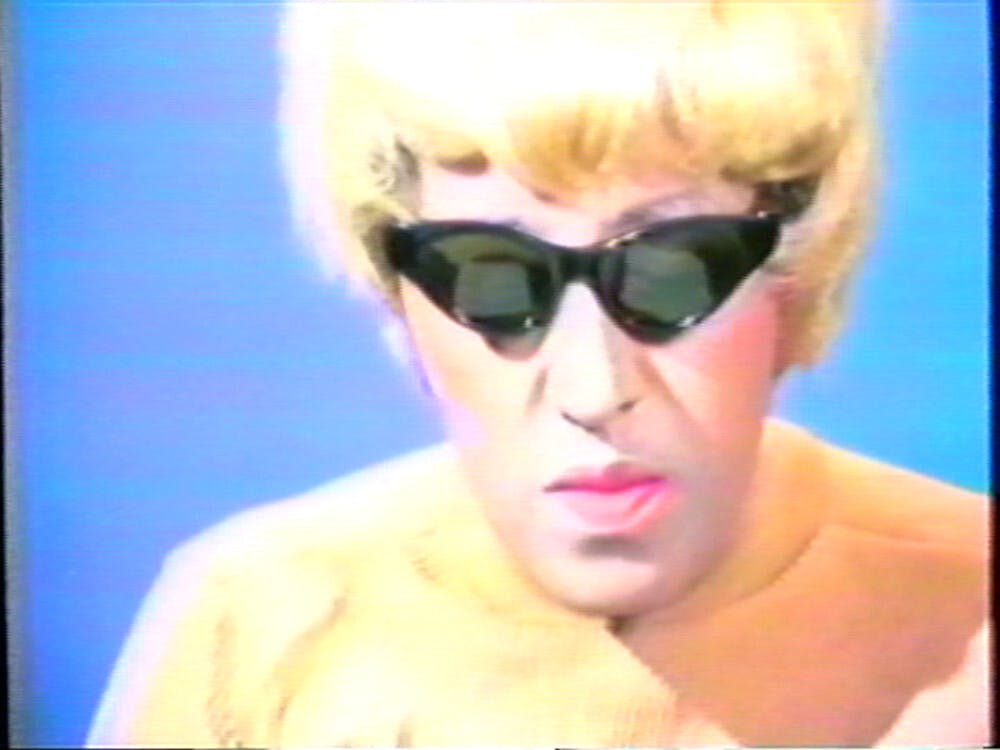
Before watching, hold onto one chronology. Pindell studied painting at Boston University and Yale, then joined the Museum of Modern Art in 1969, eventually becoming an associate curator in Prints and Illustrated Books.[6] In 1979, after leaving MoMA and after a serious car accident that affected her memory, she made Free, White, and 21 in her apartment during a hot New York summer.[5][6] Whitney's collection record fixes the work in museum terms as a 1980 color video with sound, running 12:15 minutes in a 4:3 aspect ratio.[3] Pindell's own later writing is sharper about motive: she describes the video as a response to racism in the art world and in white feminist spaces, made after injury, isolation, and a need to reconstruct missing fragments from the past.[5]
Watch how the film starts with continuity, not rupture
The first thing to notice in the Art21 film is that it does not introduce Pindell as an artist who moved from beauty into politics or from politics into beauty.[1] It lets her practice feel continuous. The abstract works and the autobiographical video both depend on accumulation. A Pindell surface is often made from small repeated acts: cutting, punching, numbering, layering, attaching, painting, and letting optical incident build into a field.[6] Free, White, and 21 uses a different material, but the procedure is related. It accumulates incidents, voices, refusals, and interruptions until private experience can no longer be dismissed as isolated anecdote.[3][4][5]
That continuity is the film's most useful correction. Viewers sometimes read abstraction as a withdrawal from history because it avoids readable figures. Pindell's case makes that assumption weak. Her abstraction does not flee experience; it processes experience through systems of mark, surface, color, and repetition. The work knows that memory is not always available as a clean narrative. Sometimes it returns as a fragment, a pattern, a gap, a repeated gesture, or a field that has to be reconstructed by hand.[5][6]
Around the sections where Pindell discusses early experiences and the persistence of art-making, listen for the way the film joins endurance to method.[1] It does not ask the viewer to admire difficulty from a distance. It shows a working artist whose language has been built through long contact with materials and with systems that tried to narrow her place. That is why the film's title, Inner Circle, carries more than studio intimacy. It suggests the circle as motif, community, memory structure, and repeated unit.
The video work is not a side note
Free, White, and 21 can be summarized quickly, but it should not be softened by summary. The Studio Museum describes the work as Pindell's first video, built around accounts of racism and sexism faced by Pindell and her mother, interrupted by another figure played by Pindell in disguise.[4] Landmarks gives the same split performance in practical terms: Pindell appears as herself and as an anonymous white female character whose role is to respond dismissively to those accounts.[6] The point is not theatrical novelty. The point is that disbelief is made visible as a voice.
This is why the Art21 film's return to the work matters.[1] It helps place Free, White, and 21 within a larger career rather than isolating it as the "political" exception. Pindell's later account of making the video says she was responding to domination and erasure: one group's voice canceling another group's experience, rewriting history so that exclusion could feel normal.[5] That language clarifies the formal intelligence of the video. It is not simply confessional. It stages the social mechanism by which confession is neutralized.
The disguise matters for the same reason. In the still image, Pindell's performed white character is almost too frontal: blond wig, dark glasses, pale surface, a mask of social entitlement.[4] The figure does not need to be psychologically subtle because the work is analyzing a structure, not inventing a rounded fictional person. The character is the voice that says the problem is not real unless power validates it. When the Art21 film places that work beside Pindell's abstract practice, it makes a difficult point: abstraction and direct speech can both expose systems, but they do so through different pressures.[1][3][5]
Abstraction becomes repair without becoming comfort
The film is especially good at resisting a comforting reading of Pindell's abstract work.[1] Repair is present, but repair does not mean resolution. Her material processes often gather small units into luminous fields, yet the labor remains visible. The surface does not hide effort. It asks the viewer to stay with it long enough to notice how density has been made.
That is where the childhood and memory material in the Art21 film becomes important.[1][2] Pindell's art does not treat memory as a smooth archive that can simply be opened. It treats memory as something vulnerable to breakage, omission, and pressure. Her own writing about Free, White, and 21 connects the work to reconstruction after injury and to the need to recover fragments from the past.[5] The abstract paintings belong to that same ethics of reconstruction. They do not illustrate remembered events. They build a surface where repeated acts can hold dispersed experience without flattening it into a single message.
Landmarks' account of Pindell's early abstraction helps make this concrete: it describes her move into circles, grids, hole-punched paper, stitched canvases, layered acrylic, glitter, sequins, and complicated effects of light and dimensionality.[6] Those details matter because they keep abstraction physical. The paintings are not vague atmospheres. They are made from decisions that accumulate until the surface begins to pulse. The Art21 film lets that material intelligence sit beside the directness of Pindell's speech rather than ranking one mode above the other.[1]
The lesson is not that every abstract dot secretly stands for one autobiographical fact. That would be too small. The better lesson is that Pindell's practice keeps asking how a damaged or excluded subject can make a field wide enough to hold complexity. The dot, the grid, the stitched unit, the video testimony, and the performed interruption all become ways of thinking about visibility under pressure.
What to carry away
Use the Art21 film as an antidote to tidy categories.[1] Pindell is not best understood as an abstract painter who occasionally made political work, or as a political artist who sometimes used abstraction. Her strongest work makes those categories answer to one another. The abstract surfaces teach patience, accumulation, and material attention. Free, White, and 21 teaches how testimony can be attacked by disbelief, politeness, and institutional habit.[3][4][5][6] Together, they show an artist building forms that resist disappearance.
That is why the film is worth embedding rather than merely citing. It lets the viewer hear Pindell's own pace and see the work across registers: studio, archive, video still, painted surface, voice, and hand.[1][2] A reader who cannot watch still has the core argument: Pindell's art turns fragments into fields without pretending the fractures were harmless. A viewer who does watch gets the additional force of relation. The paintings and the video begin to look less like separate chapters and more like one long practice of making memory public without surrendering its complexity.
Sources
- Art21, "Howardena Pindell: Inner Circle" - YouTube video embedded in this post.
- Art21, "Art21 to Release new film: Howardena Pindell: Inner Circle" - official release note on the film's 2024 premiere and its focus on formative memories, systemic prejudice, and Pindell's long practice.
- Whitney Museum of American Art, "Howardena Pindell, Free, White and 21" - collection record with date, medium, duration, aspect ratio, accession, and exhibition history.
- The Studio Museum in Harlem, "Free, White, and 21, 1980" - collection record identifying the work as single-channel video, 12:15 minutes, and the source page for the still used as this post's image.
- Howardena Pindell Papers / MCA Chicago, "On Making a Video: Free, White and 21" - Pindell's 1992 account of the video's art-world, feminist, racial, and post-accident context.
- Landmarks, The University of Texas at Austin, "Howardena Pindell - Free, White and 21" - overview of Pindell's education, MoMA curatorial work, abstraction, hole-punched surfaces, and the video's two-role structure.