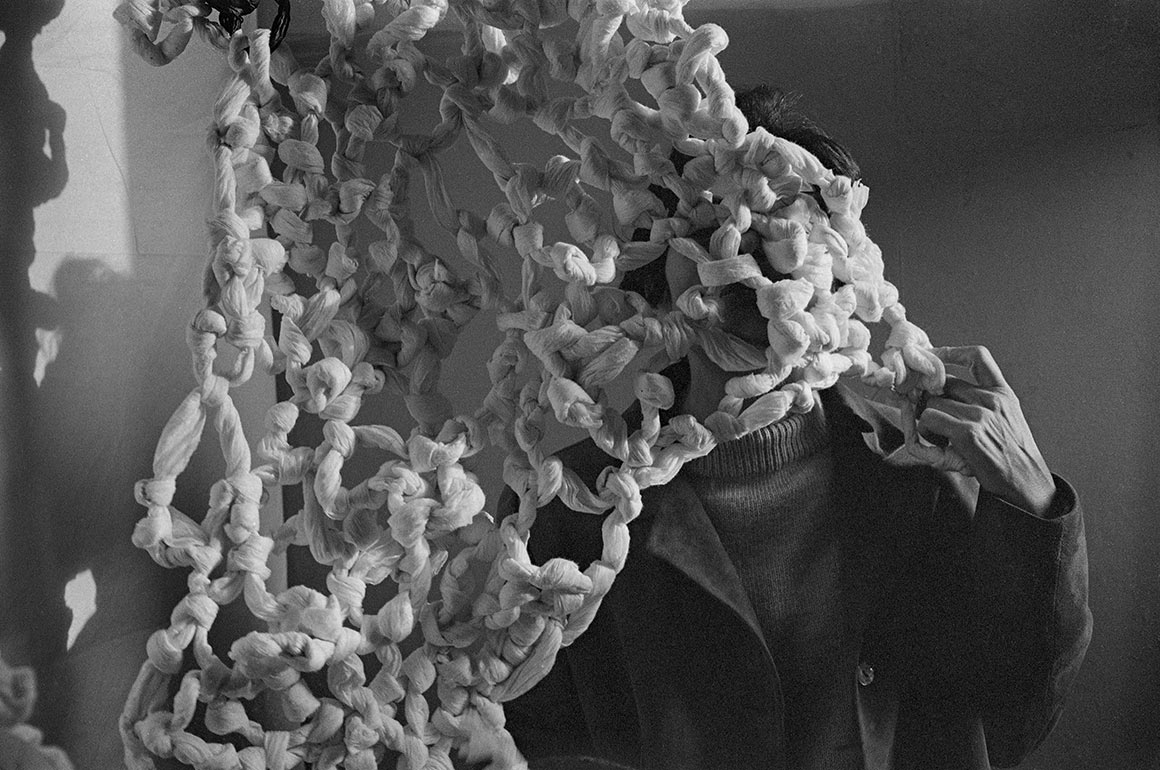
Mira Schendel's Droguinhas begin with a material that seems almost too slight for sculpture: thin Japanese paper, twisted by hand into cords, braided, knotted, gathered, hung, piled, handled, and allowed to fray. The works were made mainly in 1965 and 1966, after Schendel had already used rice paper for her Monotipias, the transfer drawings in which letters and marks hover between front and back because the support is so translucent.[1][2] The technical move looks simple. The consequence is not. Schendel took paper away from its usual job as a surface and made it behave like a vulnerable body in space.
That is why the series is best read as a medium invention, not as an eccentric detour. Paper usually receives line. In the Droguinhas, paper becomes line. Paper usually stabilizes an image. Here it produces instability. Paper usually promises that a drawing or print can be held, filed, framed, and owned. Schendel twists that promise into something that resists a single shape, a single viewing angle, and even a single confidence about what kind of artwork it is.[1][3]
Image context: this post uses one real archival photograph, Clay Perry's 1966 image of Schendel with the rice-paper forms. The photograph matters because it shows the work at the scale of the body: the knots screen the artist's face, hang like a net, and turn the act of looking into a physical encounter with opacity and touch.[1]
Paper Stops Being Support
Schendel's paper was not neutral stock. MoMA's artist page notes that a gift of thin Japanese paper in the early 1960s transformed her practice, leading first to thousands of Monotipias and then to the later Objetos graficos that pressed language and drawing into transparent spatial objects.[3] The Droguinhas sit inside that material turn, but they push it sideways. Instead of marking the paper, Schendel made the paper itself take on the job of mark-making.
The procedure matters. A sheet becomes a strip; a strip becomes a rope; a rope becomes a knot; knots become a web or lump or hanging cluster. No single stage cancels the earlier one. The paper remains visibly paper even as it stops behaving like a page. Its folds, wrinkles, and fibers are not hidden under finish. They are the evidence of transformation.
That evidence gives the Droguinhas their strange authority. The works do not monumentalize paper by making it look durable. They make fragility active. MoMA's object page for an Untitled from the series identifies the medium simply as Japanese paper and describes works that could hang from the ceiling or gather on the floor, made from twisted and knotted delicate paper.[2] That plain material description is enough to show the technical gamble. Schendel is not asking paper to impersonate bronze, wood, or cloth. She is asking paper to remain paper while taking on sculptural consequence.
The Knot Is A Temporary Argument
The knot is the series' basic unit, but it is not a symbol with one fixed meaning. A knot can join, block, thicken, delay, repair, or confuse. In the Droguinhas, it does all of those things at once. Each twist makes the paper stronger than it was as a flat sheet, yet also more vulnerable to fraying and compression. Each knot produces form while refusing clean outline.
AWARE's essay by Maggie Borowitz is especially useful on this instability. It follows Schendel's photographed interactions with the works and stresses how the forms resist a stable identity: stretched out, rolled, worn, draped, or hung, they keep becoming something else.[1] That is not a failure of definition. It is the work's method. The Droguinhas make sculpture depend on a state that can be changed by handling, gravity, display height, and proximity to the body.
This is why calling them "little nothings" is not a modest joke. The title family points toward something that can be dismissed as inconsequential, but the objects use that dismissal as pressure. If the work looks like nothing much, then what kind of attention does it demand? If it can be bundled, draped, or moved, what makes it an artwork rather than leftover material? Schendel's answer is not to stabilize the object with a heavy base or heroic scale. Her answer is to let the object keep asking.
Drawing Leaves The Page
The Droguinhas also belong to Schendel's larger investigation of language, sign, and the limits of communication. MoMA's Tangled Alphabets exhibition framed Schendel, alongside Leon Ferrari, as an artist who made language a visual subject: letters, gestures, naming, writing, and the visible body of words became material problems rather than transparent carriers of meaning.[5] The Droguinhas do not display letters in the same direct way as the Monotipias or Graphic Objects, but they continue the same question in another register.
A written line is normally expected to carry meaning from one person to another. Schendel's twisted paper line carries something less settled: pressure, touch, delay, and partial recognition. It looks almost legible, because line has become so familiar as the basis of drawing and writing. Yet it refuses to become script. The viewer reads its crossings and knots as if they might be syntax, then discovers that the work keeps meaning at the level of encounter.
Arte al Dia's report on the Tate Modern retrospective describes the show as spanning Schendel's paintings, drawings, and sculptures, with the Droguinhas highlighted as malleable knotted rice-paper nets and the later Graphic Objects as works that explore language and poetry.[4] The Droguinhas make that crossing unusually concrete. They are drawings without a flat support, sculptures without stable mass, and language works without readable words. The category trouble is not decorative. It is the technical achievement.
Ephemerality Is Built Into The Handling
The Droguinhas are often described through ephemerality, but the word needs care. The paper does not vanish like smoke. It can survive in museum collections, as MoMA's object record shows.[2] The more radical ephemerality is formal and conceptual: each encounter threatens to make a new object. A pile is not the same as a hanging net. A piece wrapped around a body is not the same as a piece isolated in a vitrine. A photograph catches one state while admitting that another state could have existed seconds earlier or later.[1]
That is where Schendel's technique becomes philosophical without becoming abstract in a vague way. The paper is materially specific. It wrinkles, knots, casts shadows, absorbs touch, and frays. The philosophical pressure comes through those facts. What does an artwork become when its identity depends on a configuration that can be altered? What kind of ownership is possible if preserving the work means limiting the handling that made it vivid? AWARE notes that Schendel herself understood the preservation problem around these works, especially the tension between allowing them to "be" and protecting them as objects.[1]
The answer is not that museums should ignore care. It is that care must admit the work's original instability. The Droguinhas are not failed durable sculptures. They are sculptures that make durability feel like an argument rather than a given.
Why The Medium Still Feels Alive
Schendel's broader biography helps explain the pressure behind this material intelligence. Born in Zurich, formed in Europe, and eventually settled in Sao Paulo, she worked across languages, places, and intellectual worlds rather than inside one tidy school.[3][4] But the Droguinhas should not be reduced to biography. Their power lies in a concrete technical proposition: if paper can leave the page, line can leave drawing, and sculpture can leave stable objecthood, then meaning can also leave the fantasy of fixed transmission.
That proposition still feels contemporary because so much visual culture now pretends that frictionless circulation is the same as communication. Schendel's rice-paper knots insist on the opposite. Meaning has texture. It catches. It loosens. It depends on support, handling, time, and the body standing in front of it.
The Droguinhas are small only if sculpture is measured by mass. Measured by what they do to medium, they are large. They turn paper from passive support into active material, from page into line, from line into object, and from object into an event that resists settling down. Schendel made paper refuse to stay paper, and in doing so she made fragility behave like a rigorous artistic method.[1][2][5]
Sources
- Maggie Borowitz, "Anything or Nothing: Mira Schendel's Droguinhas," AWARE: Archives of Women Artists, Research and Exhibitions, November 17, 2019 - essay on Schendel's Droguinhas, Clay Perry's 1966 photographs, handling, instability, and ephemerality.
- The Museum of Modern Art, "Mira Schendel, Untitled from the series Droguinhas (Little Nothings), c.1964-66" - object page with medium, dimensions, collection record, and notes on knotted Japanese paper.
- The Museum of Modern Art, "Mira Schendel" - artist page covering Schendel's Japanese paper turn, Monotipias, Graphic Objects, and collection context.
- Arte al Dia, "Mira Schendel at the Tate Modern," October 24, 2013 - report on the Tate retrospective, including Droguinhas, Graphic Objects, biography, and exhibition scope.
- The Museum of Modern Art, "Tangled Alphabets: Leon Ferrari and Mira Schendel" - exhibition page framing Schendel's work through language, gesture, writing, and the visual body of words.