Yinka Shonibare's The Swing (after Fragonard) begins as a quotation and then makes quotation feel unsafe. The pose is familiar: a woman flies forward on a swing, one slipper kicked into the air, foliage spilling around her as if pleasure itself had become a garden machine. But Shonibare removes the painting's surrounding drama. There is no older man pulling the ropes, no hidden lover in the bushes, no Rococo garden opening into soft theatrical depth. There is a life-size body, a swing, artificial greenery, a missing head, and a dress whose fabric refuses to behave like a simple costume.[1][3]
That subtraction is the work's sharpest intelligence. Fragonard's The Swing could once hide behind charm: pink silk, flirtation, brushy foliage, private mischief. Shonibare keeps the airborne thrill but strips away the alibi that this is only erotic play. The Tate identifies the work as Shonibare's 2001 installation after Fragonard; DACS classifies it as sculpture and lists its material world as Dutch wax printed cotton, a life-size mannequin, swing, and artificial foliage, with the whole object occupying roughly 330 by 350 by 220 centimeters.[1][3] Those details matter because this is not a flat parody of an old painting. It is a room-sized argument about how decorative pleasure gets built, staged, and inherited.
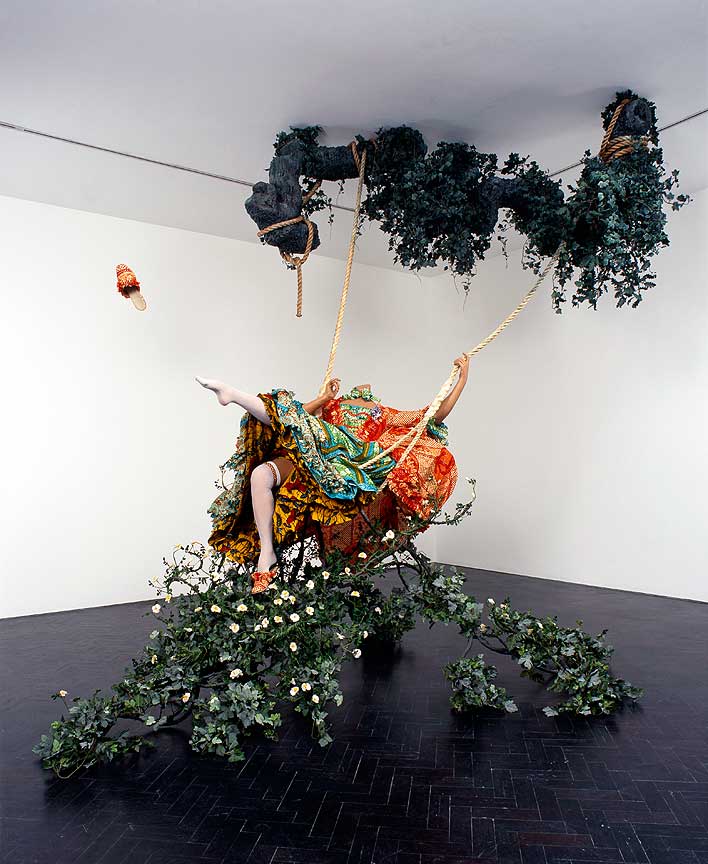
The missing head changes the time signature. In Fragonard, the woman's face is part of the game: turned, animated, knowing, and caught in a network of looks. Shonibare's figure cannot return the viewer's gaze. The body still performs the famous movement, but the person has been converted into an historical type. The decapitation inevitably pulls the eighteenth century toward revolution and aristocratic vulnerability, but it also does something colder. It blocks the easy fantasy that a viewer can read pleasure directly from expression. Without a face, the figure becomes more theatrical and less available. She is no longer a flirtatious protagonist; she is evidence suspended midair.
The fabric pushes the argument further. Dutch wax-printed cloth is often read as African, and in many contexts it functions as a proud marker of African style and identity. Britannica's account of the textile stresses a more complicated route: industrial wax printing developed through European and Asian trade circuits and became deeply associated with West and Central African dress through commerce, adaptation, and local naming practices.[5] Shonibare's use of that cloth therefore refuses purity in either direction. It is not simply "African fabric" replacing French silk. It is a material with a history of imitation, trade, colonial exchange, and reinvention, worn here as if Rococo luxury had always been global even when its paintings pretended otherwise.[5][6]
That is why the dress is not just the loudest surface in the installation. It is the engine. In Fragonard, the dress helps the scene float: pink, frothy, mobile, a brushwork cloud around flirtation. In Shonibare, the dress is heavier as an idea even when it keeps the pose light. Its pattern refuses the pastel innocence of Rococo seduction. It drags empire into the room without turning the sculpture into a lecture panel. The eye enjoys the cloth before it has finished understanding it, which is exactly the trap. Shonibare makes beauty arrive first, then makes beauty account for where it came from.
The flying shoe is a perfect test of that reversal. In Fragonard, the kicked slipper is a witty erotic detail, a tiny missile of loosened etiquette. In Shonibare, the shoe still hangs in the air, but the surrounding anecdote has been evacuated. The object no longer belongs to a private joke between lover, husband, and viewer. It becomes a relic of a pleasure system whose human supports have been removed. We see the accessory, the theatrical instant, the ornamental foliage, and the swing's ropes, but not the social world that made such leisure possible. The absence makes the old privilege louder.
The Wallace Collection's recent framing of Fragonard's original is useful here because it emphasizes the painting's afterlife as much as its restoration. After conservation in 2021, the Wallace presented The Swing as an image whose composition had traveled far beyond its own eighteenth-century setting, shaping fashion, film, and later art.[4] Shonibare's installation belongs to that afterlife, but it does not treat influence as neutral inheritance. It asks what has to be suppressed for a work to remain merely charming across centuries. A painting can become iconic by shedding context. Shonibare puts context back, not as background information, but as sculptural pressure.
The installation also changes the viewer's body. A painting lets the viewer hover outside the garden. Shonibare's sculpture shares the room. The swing is not an illusion of depth but an object occupying air. The mannequin is close to our scale. The artificial foliage reaches into the gallery rather than receding behind varnish and brushwork. That spatial shift matters because it turns spectatorship into proximity. One cannot simply admire the old scene from a safe distance. The figure's headless body and spectacular textile occupy the same physical world as the viewer, making the act of looking feel less innocent.
This is where Shonibare's work is most precise about decoration. The installation does not reject ornament, theatricality, or seduction. It uses them. Shonibare understands that empire rarely announced itself only through maps, laws, ships, and armies. It also moved through cloth, taste, collecting, display, and the domestic languages of refinement. Britannica's biography of Shonibare describes his practice as an examination of authenticity, identity, colonialism, and power relations across sculpture, photography, film, and installation.[6] The Swing (after Fragonard) condenses that project into one suspended body: a decorative object that knows decoration is never innocent.
The work's irony is therefore not a punchline. It is a structure. The more faithfully Shonibare preserves the famous pose, the more aggressively he changes the terms of viewing. He does not need to mock Fragonard. He lets Fragonard's delight survive, then asks what delight costs when it is detached from labor, trade, class, and colonial circulation. The answer is not that Rococo pleasure was false. The answer is more uncomfortable: pleasure was real, and so were the systems that made it available to some people as leisure and to others as material history.
That is why the headless figure stays so memorable. She is not only a victim of symbolic revolution, nor only a mannequin in a fabulous dress. She is the point where several histories fail to stay separate. Eighteenth-century erotic play, aristocratic display, the guillotine's shadow, Dutch wax cloth, African diasporic style, museum collecting, and contemporary installation all meet in one frozen swing. The body has no head because the old story can no longer speak for itself. The fabric speaks instead, and it says that the decorative surface was carrying the world all along.[1][4][5]
Sources
- Tate, "The Swing (after Fragonard), Yinka Shonibare CBE, 2001" - official artwork record for the installation.
- Art21, "shonibare-photo-005.jpg" - direct photographic image file of Shonibare's installation used for this article.
- DACS, "The Swing (after Fragonard), 2001" - artwork details including work type, medium, dimensions, artist byline, and photographer credit.
- The Wallace Collection, "Fragonard's The Swing" - institutional context on the original painting, its 2021 conservation, and its continuing cultural afterlife.
- Britannica, "Dutch wax-printed fabric" - background on the textile's production history, trade routes, and association with African dress.
- Britannica, "Yinka Shonibare" - biographical overview of Shonibare's practice around identity, authenticity, colonialism, and power relations.