Trisha Brown's Roof Piece is easiest to summarize and hardest to actually picture. One dancer begins a phrase on a rooftop. Another dancer, stationed far away on another roof, receives what can be seen, copies it, and sends it onward. The phrase moves across a chain of buildings, losing and gaining information as it travels. What begins as choreography becomes something closer to weather, signal, rumor, and urban perception.[1][2]
That is why the work deserves to be read as a medium invention. Brown was not merely staging dance outdoors because SoHo rooftops looked photogenic. She made the distance between bodies into the material of the dance. The official Trisha Brown Dance Company repertory page gives the simple working facts: Roof Piece was choreographed by Brown, used no sound, lasted thirty minutes, involved eight to twelve dancers, and premiered in New York on November 5, 1971 from 53 Wooster Street to 381 Lafayette.[1] Those details matter because they strip the work of theatrical support. No score organizes time for the audience. No proscenium gathers the dancers into one frame. The city becomes the apparatus.
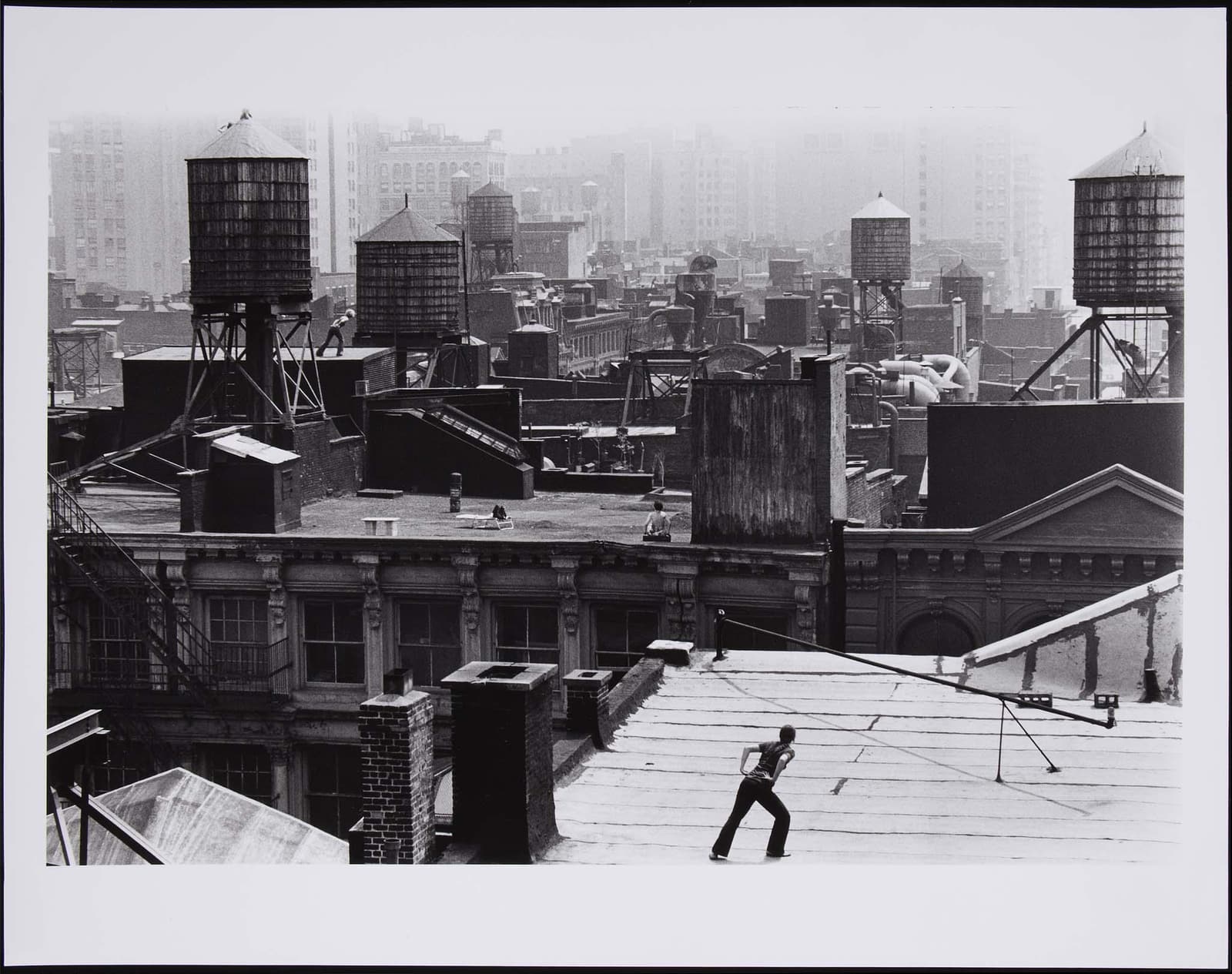
Image context: this post uses one real photographic image of the artwork from Museo Reina Sofia's collection page, not a diagram, chart, generated visual, or decorative stock image. The image-work match is direct: Babette Mangolte's black-and-white photograph documents Roof Piece as a rooftop performance environment, where dancers and Manhattan roof structures share the same field of vision.[2]
Transmission Is the Technique
Most choreography assumes that repetition protects a phrase. A dancer learns a sequence; another dancer learns the same sequence; the company performs it together or in designed variation. Roof Piece begins from the opposite premise. The phrase has to survive being seen imperfectly from one roof to the next. That survival is not a failure condition. It is the work.
Museo Reina Sofia's object record is unusually precise on this point. It describes the action as one performer making improvised movements on the first building, with each following dancer emulating what could be seen and passing it onward until the chain ended.[2] The record also notes that the succession produced accumulating small variations because of the visual and temporal gap between performers.[2] That is the technical core: Brown makes copying unreliable enough to become expressive.
The word "semaphore" often appears around the piece because it fits. The dancer is not only moving; the dancer is signaling. But a semaphore system normally tries to reduce ambiguity. Roof Piece uses ambiguity as form. A lifted arm arrives as a slightly different arm. A pause becomes longer or shorter. A turn gets flattened by distance. A rooftop unit, chimney line, sun angle, or sight obstruction changes what the next body thinks it has received.
That makes the work feel contemporary without needing technological updates. It is a dance about transmission before network culture made transmission a daily metaphor. Information moves through bodies and architecture, but the movement is never clean. The chain does not preserve an original perfectly. It exposes what preservation costs.
The City Is Not a Backdrop
Brown's early work repeatedly tested what happens when dance leaves the stable assumptions of the stage. Walker Art Center's essay on Brown and the visual arts treats Man Walking Down the Side of a Building as a site-specific answer to choreographic problems, with architecture and gravity becoming conditions that caused movement rather than a neutral setting around it.[3] The Whitney's account of Brown's early works similarly emphasizes her use of architecture, including walls and facades, and notes that viewers had to adjust their own positions as the work unfolded.[4]
Roof Piece belongs to that same line of thought, but it does something different from the wall works. A wall piece changes orientation. A rooftop piece changes scale and access. The viewer cannot possess the whole event from one place. Museo Reina Sofia makes that limitation explicit: no single viewing point allowed the spectator to see the entire sequence.[2] That is not a logistical inconvenience. It is the work's perceptual ethics.
In a conventional theater, the audience sees more than any one performer. In Roof Piece, the audience sees less than the work contains. That reverses the hierarchy of attention. The dance continues beyond the viewer's field. The viewer has to accept partial knowledge, just as each dancer accepts partial reception. Brown turns spectatorship into a version of the same problem the dancers face: what can you know from here?
The rooftops matter because they make that question spatially exact. A stage creates one agreed rectangle. A roofline creates a broken sequence of platforms, gaps, heights, parapets, chimneys, ledges, and distances. Mangolte's photograph, held by Reina Sofia as a gelatin silver print, catches this beautifully: the dancers are not isolated theatrical figures but small upright signals among roof structures.[2] The chimneys are not incidental scenery. They show how close the bodies are to becoming part of the urban grammar they are using.
Memory Becomes Public and Fragile
The technique also changes what memory means in dance. In many repertory works, memory is internalized. The dancer carries the phrase in muscle, count, and rehearsal discipline. In Roof Piece, memory is externalized into a route. The phrase exists because it is repeatedly received, guessed, adjusted, and sent onward.
That is why the work challenges the idea of choreography as a fixed set of memorized gestures. Reina Sofia's interpretation says the piece uses transmission and replication to question that definition.[2] The stronger point is that Brown does not discard choreography. She relocates it. Choreography becomes the rule for how movement may change under pressure. The work is not "anything can happen." It is "the same thing cannot stay the same once distance, time, and perception begin handling it."
The official repertory page's timing helps here. Thirty minutes is long enough for the viewer to stop hunting for a master image and start noticing the relay itself.[1] The absence of sound reinforces the shift. No music tells the audience when to feel climax or closure. The eye follows bodies across gaps and begins to understand the gap as active material.
This is also why the 1973 public version matters. The company page notes that the work was performed again and widely publicized on June 24, 1973 from 420 West Broadway to 35 White Street, under the alternative title Roof and Fire Piece.[1] By then the work's city logic had become more visible as public event. A private or semi-private rooftop experiment could become a public artwork precisely because its form was already distributed. It did not need to be moved into a theater to become legible.
Brown's Precision Was Not Cleanliness
Brown is sometimes described through ordinary movement, postmodern dance, and the refusal of virtuoso display. Those descriptions are useful, but they can make the work sound casual. Roof Piece is anything but casual. Its precision lies in the design of conditions, not in making every body deliver the same crisp result.
Walker Art Center's reflection on Brown's practice describes her early "equipment pieces" and later concern with revealing choreographic apparatus through the dance itself.[5] That phrase is especially useful for Roof Piece. The apparatus is not hidden backstage. It is the chain of roofs, the distance between dancers, the rule of watching and sending, and the viewer's inability to gather everything at once.
The Whitney's early-works account says Brown's choreography engages the viewer's own understanding of space and movement.[4] In Roof Piece, that engagement is almost severe. The audience has to reconstruct a dance that no one can fully see. The work therefore refuses the fantasy of total access. It asks for a more disciplined kind of attention: local, mobile, incomplete, aware of its own blind spots.
This is where Mangolte's documentation becomes more than evidence after the fact. A photograph cannot show the whole chain either. It freezes one relation between dancer, roof, and skyline. But because Roof Piece already denies total visibility, the photograph does not betray the work by being partial. It repeats the work's condition. It gives one fragment that points to a structure too dispersed to fit inside the frame.[2]
Why the Relay Still Feels Sharp
The lasting force of Roof Piece is that it makes choreography think like a city. Cities rarely transmit experience cleanly. A signal crosses distance through bodies, buildings, schedules, misreadings, blocked views, and local improvisations. Brown does not smooth any of that away. She builds the dance out of it.
That makes the piece more than a beautiful episode in SoHo performance history. It is a model for art that treats perception as a shared but uneven process. One person sees, changes, and passes on. Another receives something already altered. No one owns the original because the original matters only by traveling.
The later museum afterlife confirms the point. When MoMA presented Roof Piece Re-Layed in 2011 as a work based on Roof Piece, the institutional frame did not turn the piece into a closed historical artifact; it showed that the relay principle could be re-sited and still remain legible as Brown's experiment with space, gravity, and bodily orientation.[6]
The work's quiet radicalism sits there. Brown did not make dance bigger by adding spectacle. She made it bigger by distributing responsibility across a skyline. She let the city interrupt the phrase, let distance damage memory, and let damage become form. In Roof Piece, transmission is not a way to preserve choreography after the fact. Transmission is the choreography.
Sources
- Trisha Brown Dance Company, "Roof Piece (1971)" - official repertory page with choreography, sound, length, performer count, original cast, premiere route, and 1973 public-performance details.
- Museo Reina Sofia, "Trisha Brown 'Roof Piece' (1971)" - collection record for Babette Mangolte's photographic documentation, including date, medium, dimensions, registration number, image source, and interpretation of transmission, rooftops, and semaphore-like movement.
- Susan Rosenberg, "Accumulated Vision: Trisha Brown and the Visual Arts," Walker Art Center, March 11, 2014 - essay on Brown's site-specific architectural works, visual-art context, gravity, accumulation, scores, and choreography as a structured apparatus.
- Whitney Museum of American Art, "Trisha Brown: Early Works" - 2010 museum account of Brown's early choreography, architecture, walls and facades, viewer movement, and expanded performance space.
- Walker Art Center, "Simplicity of Movement, Directness of Address: Remembering Trisha Brown (1936-2017)" - institutional reflection on Brown's equipment pieces, choreographic apparatus, and long relationship to contemporary art and dance.
- The Museum of Modern Art, "Performance 11: On Line / Trisha Brown Dance Company" press release PDF - MoMA performance-series context for Brown's early works and Roof Piece Re-Layed as a 2011 work based on Roof Piece (1971).
Editor’s Pick Review
This piece earns the editor’s pick because it treats Roof Piece as a working system rather than as a famous image from postmodern dance history. The argument keeps returning to one strong idea: distance is not a setting around the choreography, but the medium that changes, delays, and exposes it. That gives the article a clean critical spine while still leaving room for texture—the rooftops, chimneys, partial sightlines, and Mangolte photograph all carry interpretive weight.
The source base is also unusually well matched to the claim. Official repertory facts, museum collection records, Walker and Whitney context, and MoMA afterlife evidence each do a distinct job, so the essay does not lean on general reputation. The visual choice passes the stricter image standard because it is immersive and topic-grounded: a real documentation photograph of the work itself, not an analytical diagram or decorative art-adjacent placeholder. The Chinese version preserves the article’s rhythm especially well, keeping the sense of transmission, fragility, and urban distance readable without flattening the dance language into jargon.