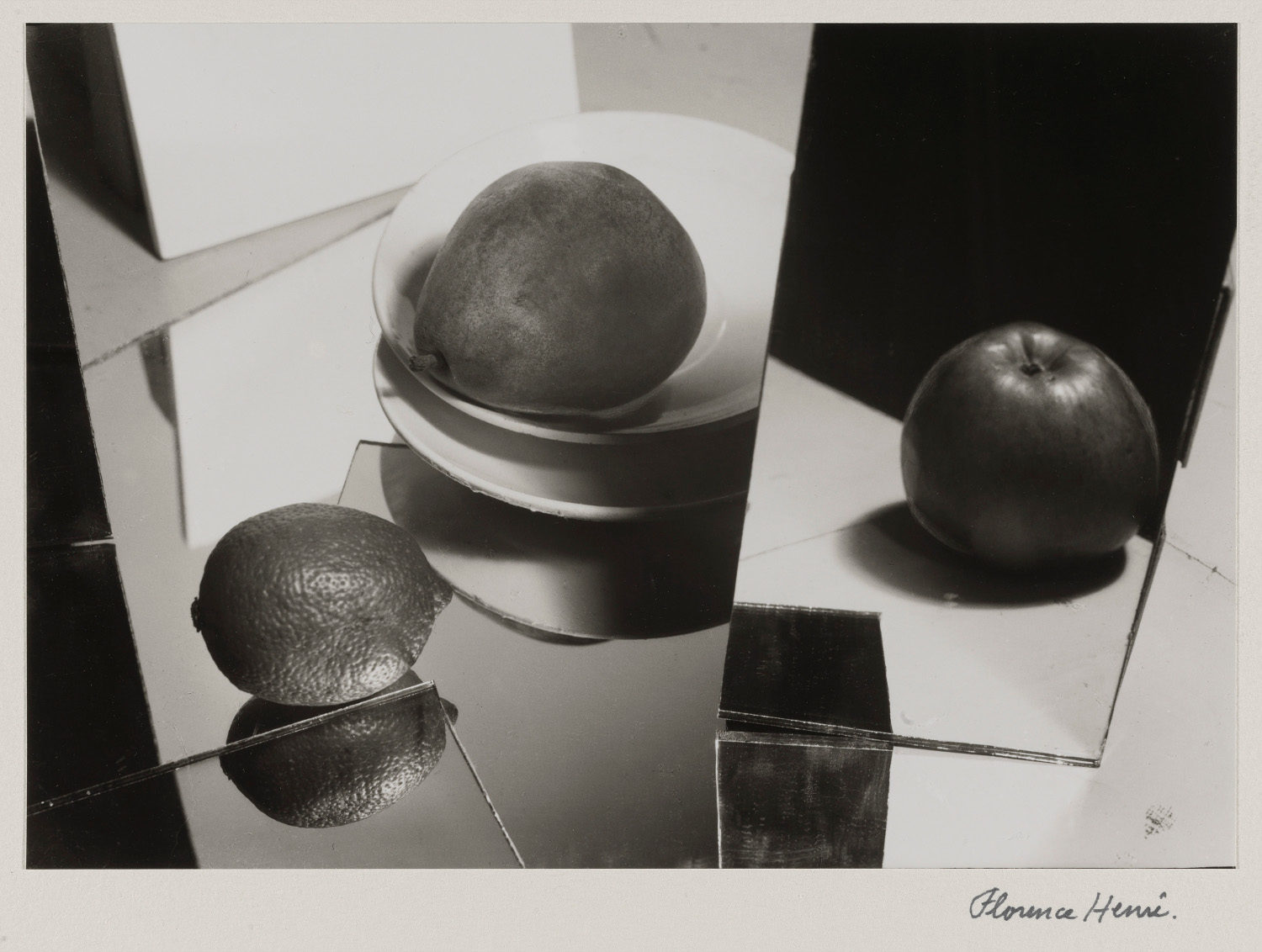
Florence Henri's Fruit looks, at first, like a clean modern still life: two pieces of citrus, a plate, a few hard planes, a reflective surface. The longer one looks, the less dependable the arrangement becomes. The lemon near the front appears twice. The larger fruit rests on a white plate but also seems caught by the mirror structure around it. Black wedges and pale rectangles make the table feel less like furniture than a stage set. Nothing in the image is exotic; everything in the image is unstable.
AWARE identifies the work as Obst [Fruit], a 1929 silver print measuring 16.8 by 24.2 centimeters.[1] The V&A places the same photograph within Henri's mirror compositions and says the viewer cannot clearly distinguish the real object from the reflected one.[2] That is the whole drama in miniature. Henri does not use the camera to make fruit more solid. She uses fruit to make the camera's claim to solidity look suspicious.
This is why Fruit is stronger than a clever optical game. The photograph asks a basic question about modern photography: if the medium is anchored in the real, what happens when the real is deliberately arranged to defeat ordinary certainty? Henri's answer is not dreamy blur or theatrical fantasy. It is precision. The image is sharp, balanced, and almost severe. Its instability comes from discipline.
Image context: the lead image is a real archival photographic artwork, not a diagram, chart, or generated visual. It is the right image for this essay because the argument depends on the print's exact visual mechanics: citrus, plate, mirror edge, black triangular shadow, and repeated forms inside a shallow constructed space.[1][2]
A Still Life That Refuses To Sit Still
Traditional still life often reassures the viewer. Fruit, bowl, table, and light become a compact lesson in material presence. The apple is an apple; the lemon is a lemon; the painter or photographer proves attention by making surface, weight, and placement believable. Henri starts from that familiar contract, then quietly breaks it.
In Fruit, the objects do not merely occupy space. They argue with space. The front lemon sits near a glossy black plane that reflects it downward, making the object feel doubled and displaced. The larger fruit on the plate is heavier, more stable, but even it is trapped in a surrounding system of reflected edges and hard tonal contrasts. The white plate should provide orientation. Instead, it becomes another circle in a photograph already full of circular echoes: fruit, reflection, rim, shadow.
The result is not confusion for its own sake. Henri makes perception work harder than recognition. One can name the objects quickly, but naming them solves very little. The real subject is the relation among object, reflection, and photographic frame. The citrus becomes a test object, useful precisely because it is ordinary. If a lemon can become uncertain under the camera, then the problem is not the strangeness of the subject. The problem is vision itself.
The Bauhaus Lesson Becomes Domestic
Henri reached this photographic language through a dense modernist education. AWARE describes her as trained in music and painting before turning decisively toward photography after her 1927 Bauhaus encounter, where Laszlo Moholy-Nagy was a major influence.[1] The International Center of Photography gives the practical version of the same turn: at the Bauhaus she studied photography for the first time, developed a close friendship with Lucia Moholy, and began experimenting with mirrors, prisms, reflective objects, photomontage, multiple exposure, photograms, and negative printing.[3]
That background matters because Fruit is easy to misread as a minor tabletop experiment. It is actually a compact transfer of avant-garde method into domestic scale. Henri does not need a city street, machine part, or abstract studio construction to make modernity visible. She can do it with fruit and a mirror because the modernist problem is not subject matter. It is how space is built by the image.
The V&A's short account of Surrealist photography helps locate the tension. It notes that photography posed a particular challenge for Surrealism because it begins from the material world, yet photographers used techniques such as photomontage, solarisation, and photograms to pressure ordinary reality.[2] Henri's Fruit is quieter than many Surrealist shocks. It does not stage a monster, dream, or impossible body. It shows how ordinary objects can become untrustworthy when reflection and framing are made rigorous enough.
Mirror As Construction Tool
The mirror in Fruit is not decoration. It is the photograph's engine. A decorative mirror would add sparkle or depth. Henri's mirror slices the composition into competing statements. It repeats an object while changing its orientation. It extends the shallow table into a spatial fiction. It gives the camera more to record while making the record less settled.
ICP's profile is useful here because it describes Henri's use of mirrors and reflective objects as one of the most adventurous features of her work, often making it hard to separate reality from reflection.[3] That is exactly what happens in Fruit, but the effect is not loose or atmospheric. It is architectural. The mirror behaves like a wall, floor, aperture, and editing device at once.
The photograph's black areas are just as important as its reflective ones. The dark triangular forms do not simply create contrast. They create stoppages. The eye moves from fruit to reflection to plate, then hits a black edge and has to reroute. Henri makes looking into a sequence of interruptions. The still life becomes almost cinematic, not because anything moves, but because the viewer's attention is cut and redirected.
Why The Fruit Matters
Fruit is a smart subject because it carries an older art-historical memory. Still life has long used fruit to show ripeness, appetite, decay, abundance, vanitas, and the pleasures of skilled depiction. Henri keeps the fruit's recognizability but drains away most of that symbolic warmth. The citrus is not primarily there to be eaten, admired, or moralized. It is there because it is round, textured, reflective enough at the edge, and culturally legible enough to survive abstraction.
AWARE's profile says Henri applied Cubist techniques to photography through mirrors and identifies her studies of shapes, rhythm, and values as among the reasons she may be considered one of the first abstract photographers.[1] Fruit shows how that abstraction works without abandoning objects. The photograph does not stop being about fruit. It makes fruit participate in a system of formal pressure: circle against rectangle, matte skin against mirrored shine, edible object against optical construction.
That is why the picture does not feel cold, even though it is severe. The lemon's textured skin keeps the image tied to touch. The plate keeps it tied to use. The mirror keeps undoing both. Henri's modernism is not an escape from the ordinary world; it is a way of making the ordinary world admit how constructed visibility already is.
A Small Photograph With A Large Claim
The Jeu de Paume's 2015 exhibition framed Henri's production from 1927 to 1940 as a broad photographic world of self-portraits, abstract compositions, artist portraits, nudes, photomontages, photocollages, and documentary photographs.[4] That range helps explain the confidence of Fruit. Henri was not trying one isolated trick. She was building a visual method that could move across still life, portrait, advertising, and street views.
The New Yorker, writing around that same Jeu de Paume exhibition, emphasized how Henri's shift from painting to photography at the Bauhaus led to mirror-based compositions that helped define her contribution to modern photography.[5] That historical placement matters, but Fruit should not be valued only because it belongs to a movement. The photograph still works because its problem remains current. Images still ask us to trust what they show. Henri's photograph makes that trust visible as a construction.
In the end, Fruit is not about tricking the viewer. A trick photograph usually wants the moment of revelation: here is how the illusion was done. Henri gives no such simple release. The mirror is visible. The objects are plain. The composition is legible. Yet certainty keeps slipping.
That is the photograph's exact achievement. Henri takes a genre associated with presence and turns it into a lesson in constructed perception. The fruit is real, the reflection is real, the print is real, and still the image refuses to behave like simple evidence. It teaches the eye to distrust the easy comfort of recognition without giving up the pleasure of looking carefully. In Fruit, modern photography does not abandon reality. It rebuilds reality on a tabletop, then lets the viewer watch the seams show.[1][2][3]
Sources
- AWARE: Archives of Women Artists, Research and Exhibitions, "Florence Henri" - artist profile and image source for Obst [Fruit], including date, medium, dimensions, Bauhaus context, mirror practice, and Constructivist framing.
- Victoria and Albert Museum, "Surrealist photography" - institutional essay placing Henri's 1929 Fruit within mirror compositions and explaining how the image blurs real object and reflection.
- International Center of Photography, "Florence Henri" - archive profile covering Henri's Bauhaus training, Lucia Moholy connection, New Vision context, and use of mirrors, prisms, photomontage, multiple exposures, photograms, and negative printing.
- Jeu de Paume, "Florence Henri" - exhibition page for Mirror of the Avant-Garde, 1927-1940, describing the range of vintage prints, documents, and photographic genres in Henri's work.
- The New Yorker, "Florence Henri's Pioneering Surrealism" - exhibition preview summarizing Henri's Bauhaus turn, mirror-based photographic practice, Paris studio, students, and later rediscovery.