James McNeill Whistler is often filed under one anecdote: the painter who sued John Ruskin after being accused of “flinging a pot of paint in the public’s face.” The anecdote is true, the reduction is costly. What matters for 2026 readers is that Whistler tested three systems at once—image-making, criticism, and price legitimacy—and forced all three to update under pressure.[1][2][3]
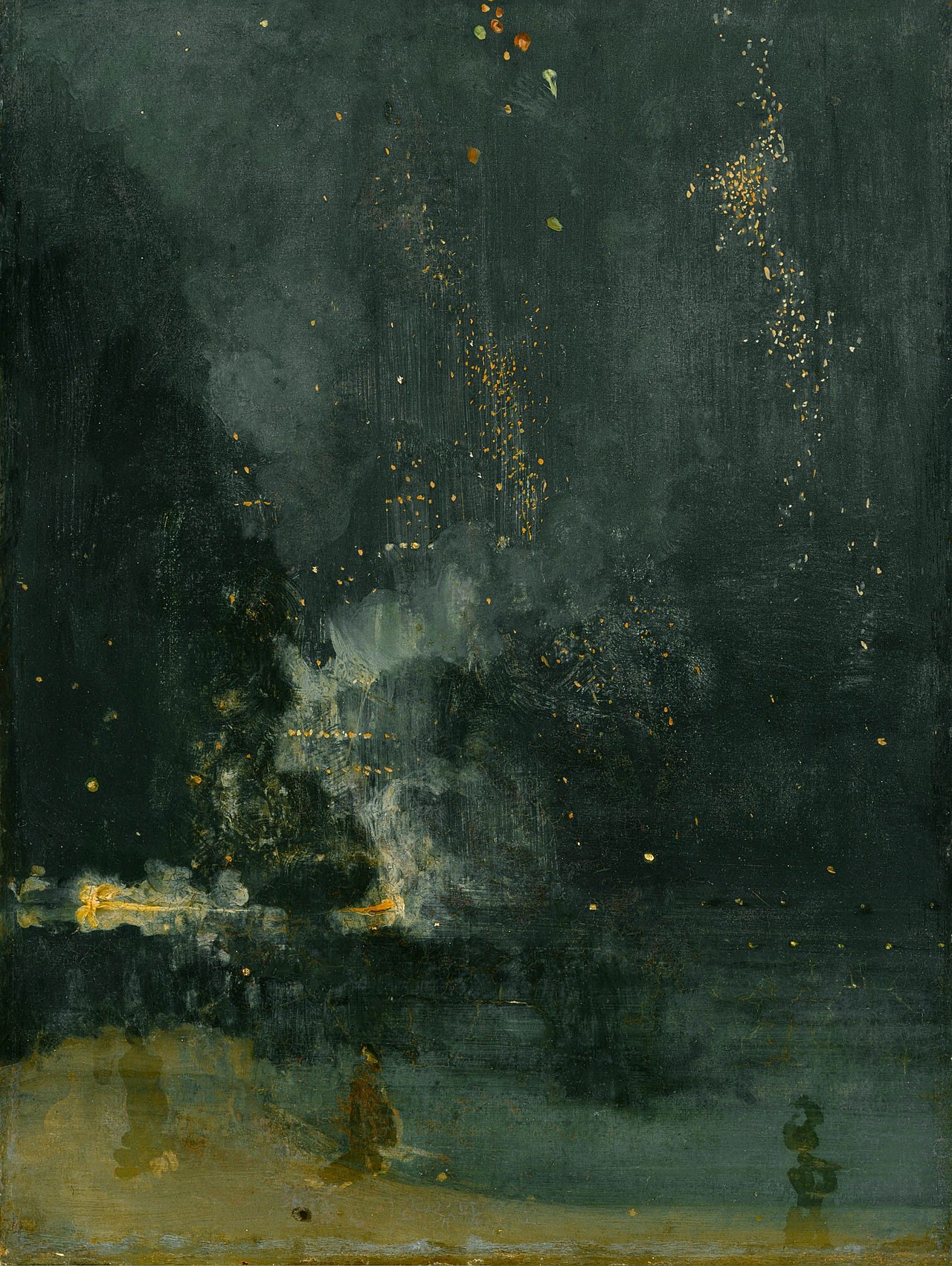
The painting at the center of that stress test, Nocturne in Black and Gold – The Falling Rocket (c. 1875), still reads as a strategic move rather than a stylistic accident. It strips scene description down to atmosphere, controls the palette into a near-monochrome field, and asks viewers to treat visual sensation as sufficient artistic content.[1][4][5]
Image relevance note: this article’s claims depend on the specific surface behavior and compositional indeterminacy of The Falling Rocket, so the primary image must be this work itself.
A career built on tonal risk, not just scandal
Whistler (1834–1903), American-born and London-based for much of his mature career, moved between realism, japonisme-influenced design choices, printmaking, and increasingly reduced tonal painting.[2][2] His naming system—arrangement, harmony, symphony, nocturne—was not decorative branding. It was a framing device that told audiences to read pictures by relation, rhythm, and interval, closer to music than moral narrative.[2][2]
That choice challenged dominant Victorian expectations, where high art was still frequently judged by storytelling clarity, finish, and social-moral purpose. Whistler’s wager was different: painting could justify itself through structure, tone, and perceptual timing.
Why The Falling Rocket became a fault line
The work shown at the Grosvenor Gallery in 1877 condensed this wager into one compact panel. Today’s basic object facts are stable: oil on panel/canvas work from around 1875, connected to fireworks at London’s Cremorne Gardens, now in Detroit.[1][4] The historically explosive part was interpretation.
John Ruskin’s published attack in Fors Clavigera framed the work as fraud against public value, with the famous “pot of paint” line and the “two hundred guineas” price jab.[3][3] The trial that followed in 1878 did not just stage two personalities. It staged two valuation regimes:
- Representation-first valuation: price follows labor visibility and descriptive finish.
- Perception-first valuation: price follows artistic judgment, compression, and effect.
Whistler won liability but only nominal damages (a farthing), while legal costs and market fallout still pushed him into financial collapse.[1][5] In business terms, legal victory and economic victory diverged sharply.
The real innovation: painting as event compression
Whistler’s method in the Nocturnes can look improvised from a distance; close viewing shows calibrated control. The fireworks scene is not rendered as object inventory. It is rendered as an event residue: haze, sparks, void, and flickering human presence held in unstable balance.[4][5]
This “event compression” model became historically consequential because it shifted critical labor from “What is depicted?” to “How does this field operate?” That pivot is a direct ancestor of later modernist and post-impressionist viewing habits, where painterly decisions are read as arguments rather than decoration.
Market lesson: price is a theory of art made public
Ruskin’s “two hundred guineas” insult was economically precise. It challenged not only quality but the legitimacy of pricing high for a work that seemed materially sparse.[3][3] Whistler’s response implied a modern creative-economy thesis: price can reflect years of skill acquisition and selective judgment, not simply hours spent on visible detail.
This remains current for contemporary audiences living among software, design, and conceptual labor markets where output often looks “light” while cognitive investment is heavy. The Whistler conflict is an early public case of intangible-value pricing.
What an artist profile of Whistler should foreground now
Treating Whistler as a one-trial provocateur misses the scale of his contribution. A stronger profile keeps five durable points in frame:
- He normalized tonal atmosphere as a primary artistic objective rather than background mood.[2][4]
- He reframed titling and exhibition rhetoric to precondition how viewers should look.[2][2]
- He forced criticism to confront works that resist narrative extraction.[1][5]
- He exposed that legal vindication can coexist with financial precarity in art markets.[1][3]
- He helped make “modern seeing” a public argument, not only a studio technique.[5][2]
In that sense, Whistler’s importance is infrastructural. He did not merely paint differently; he helped redesign the terms on which painting gets judged, sold, and defended.
Practical viewing drill (90 seconds)
- Distance (30s): stand back and track where your eye stabilizes in the dark field.
- Mid-range (30s): isolate the yellow bursts and ask whether they read as objects or timing cues.
- Near-view (30s): inspect edge behavior and transitions in haze; note how little contour is needed to sustain the scene.
If the work still feels “unfinished” after this sequence, the useful next question is not “Is this complete?” but “Complete for which viewing contract?” That question is where Whistler’s profile remains alive.
Sources
- Encyclopædia Britannica, Nocturne in Black and Gold, the Falling Rocket
- Encyclopædia Britannica, James McNeill Whistler (biography)
- Project Gutenberg, John Ruskin, Fors Clavigera (Vol. 3; includes Letter LXXIX / 1877 criticism)
- Wikipedia, Nocturne in Black and Gold – The Falling Rocket (work record, dimensions, exhibition context)
- Smithsonian National Museum of Asian Art, publication page for Linda Merrill, A Pot of Paint: Aesthetics on Trial in Whistler v. Ruskin
- Wikimedia Commons, file page for Whistler-Nocturne in black and gold.jpg (image source metadata)