Sonia Delaunay’s significance is often compressed into one sentence—co-founder of Orphism, collaborator of Robert Delaunay, pioneer of abstract color. That sentence is accurate, but it hides the mechanism that still makes her work operational in 2026. Her decisive move was not only formal invention inside painting. It was platform design: she treated color relations as a transferable system that could move from canvas to book design, from garment to room, from stage costume to public exhibition surface, while keeping the same structural discipline.[1][2]
Born in 1885 and active across nearly seven decades, Delaunay worked through multiple media before “multidisciplinary” became a cultural cliché. Her profile matters now because she solved a problem contemporary visual culture still struggles with: how to scale an aesthetic language across formats without turning it into branding noise.[1][3]
1) The technical core: simultaneity as a reproducible grammar
The Delaunay circle described their color logic through simultaneity: adjacent colors produce movement, vibration, and perceptual depth that are not reducible to contour drawing. In practice, this meant color was not filling form after composition; color was composition.[2][4]
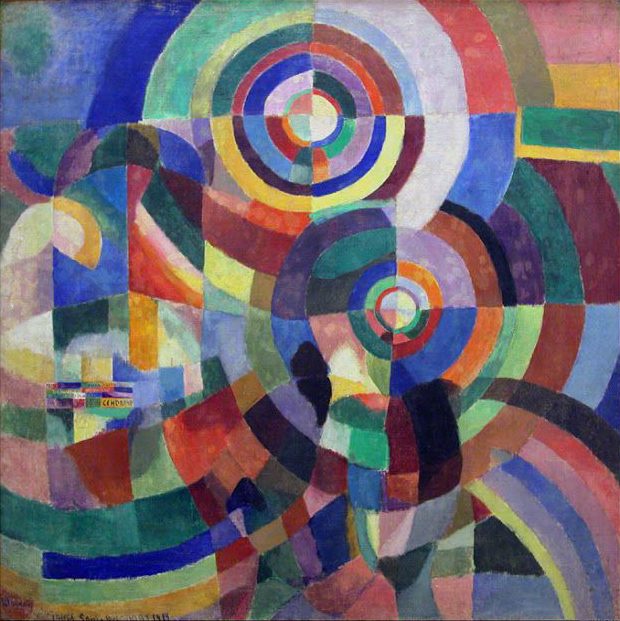
In works such as Prismes électriques (1914), scale and rhythm carry this claim with unusual clarity: the painting is approximately 250 × 250 cm, and the eye never stabilizes on one central figure because chromatic transitions become the scene itself.[1][5] This matters for an artist-profile reading because Delaunay’s later work in textiles and fashion keeps the same premise. The medium changes, the perceptual logic does not.
2) Why this profile is not just “fine art + side hustle design”
A weak reading of Sonia Delaunay separates “serious painting” from “commercial design.” Her own trajectory resists that split. During and after World War I, she expanded into costume, interior decoration, and fashion production under Casa Sonia, then into broader textile and applied-design circuits.[1][3]
The useful historical detail is not that she diversified. Many artists diversified under economic pressure. The useful detail is how she diversified: by keeping a single formal engine and letting context decide material output. In 1923, for example, she produced about 50 fabric designs for a Lyon manufacturer while still developing painterly work.[1] For today’s creators navigating image, product, and platform ecosystems, this is a stronger template than the familiar “artist versus market” story.
3) The book as bridge: a measurable prototype of cross-media modernism
Her 1913 collaboration with Blaise Cendrars, La prose du Transsibérien et de la Petite Jehanne de France, remains one of the clearest demonstrations of this transfer model. The accordion format reaches about 2 meters when unfolded, and the page is treated as a moving field where typography and color rhythm carry narrative together.[1][6]
For profile analysis, this object is crucial because it predates later “expanded publishing” conversations by decades. Delaunay is not illustrating text after the fact; she is constructing reading as a spatial-color event. That move links studio painting to public circulation formats—book, poster, dress, interior—without reducing any one of them to accessory status.
4) Institutional signal: recognition lag, then structural confirmation
Delaunay’s career also illustrates how institutions absorb formal innovation slowly. She became the first living woman artist to receive a retrospective at the Louvre in 1964, long after many of her decisive experiments.[1][3] This lag matters less as a symbolic injustice statistic and more as a governance clue: institutional validation often arrives after a new visual grammar has already reshaped adjacent industries.
In practical terms, her profile helps readers separate two timelines:
- Innovation timeline (where methods are invented in unstable conditions)
- Recognition timeline (where museums and canonical histories consolidate)
Conflating the two still distorts how contemporary visual fields evolve.
5) What this profile changes for a 2026 reader
If we read Sonia Delaunay only as a historical figure in early abstraction, we miss her operational lesson. Her work proposes three durable rules:
- A visual language becomes powerful when it can migrate across scales without losing logic.
- Commercial circulation does not automatically dilute rigor; bad translation does.
- Media boundaries are less important than whether the formal system survives context shifts.
This is why her profile still feels current: she treated modernism as infrastructure, not as a style episode.
Sources
- Wikipedia, “Sonia Delaunay” (biography, timeline, works, design activity)
- Wikipedia, “Orphism (art)” (movement context, simultaneity, color theory lineage)
- Encyclopædia Britannica, “Sonia Delaunay” (career arc, applied arts, Louvre retrospective context)
- TheArtStory, “Sonia Delaunay Artist Overview” (movement framing and media expansion)
- Wikimedia Commons file record, Prismes électriques image source and metadata
- Wikimedia Commons file record, La prose du Transsibérien visual source
- Museo Nacional Thyssen-Bornemisza, “Simultaneous Contrasts” collection note
- Wikimedia Commons file record, Simultaneous Contrasts image source and metadata