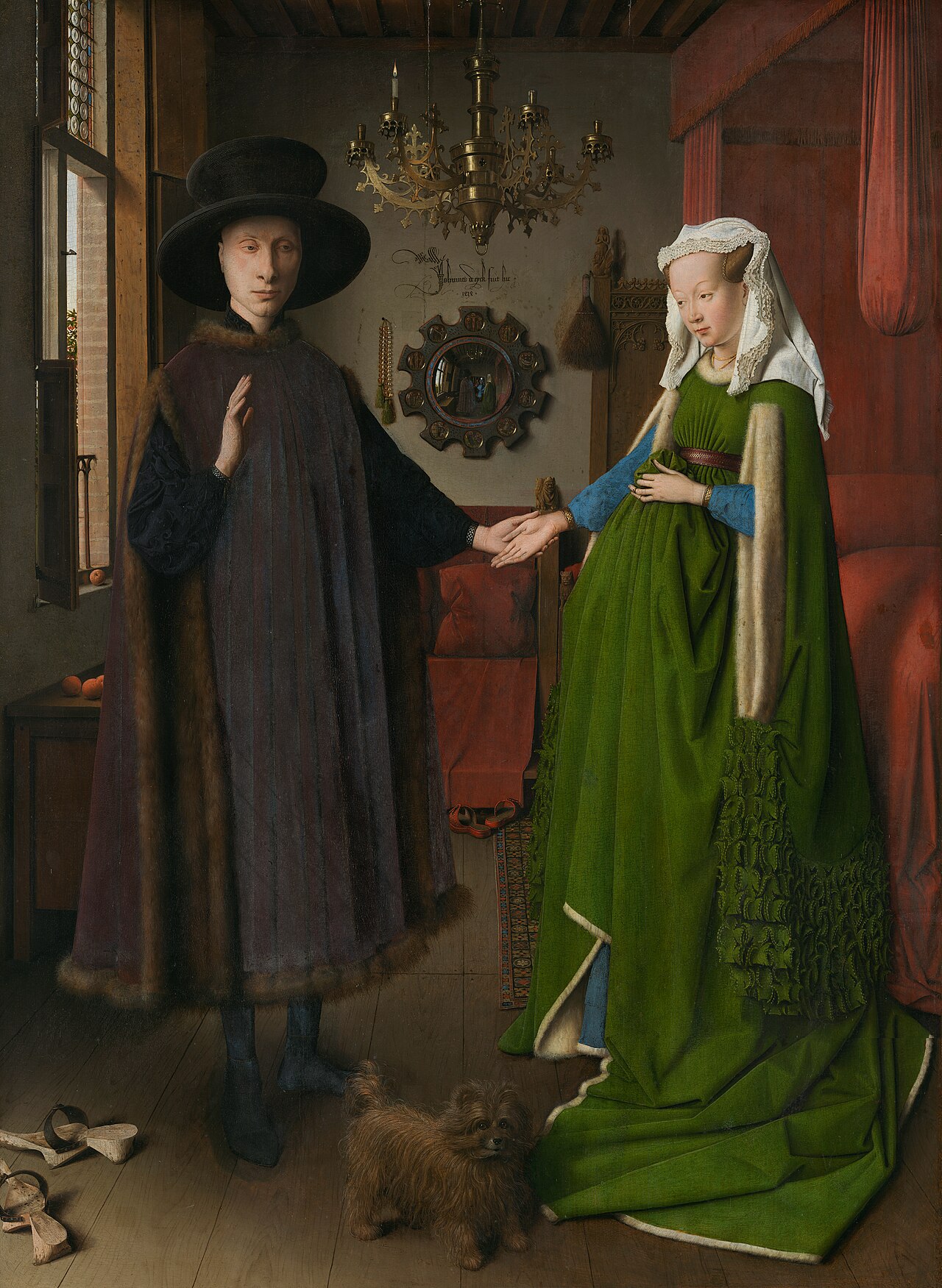
Jan van Eyck’s Arnolfini Portrait (1434) is usually introduced through one question: is this a wedding scene or not. That question is historically legitimate and visually too narrow. The painting’s deeper achievement is formal. Van Eyck turns a private room into a public event by building a witness machine inside the picture plane: mirror, inscription, gesture, and object detail all push the viewer toward legal attention without delivering a final legal verdict.[1][2][3]
That unresolved status is exactly why the painting has remained unusually active in art history. If the panel simply encoded one fixed ceremony, most debates would have closed long ago. Instead, the work keeps producing arguments because it is engineered to stage evidence rather than settle it.[1][4][5]
Image relevance note: the article’s claims are tied directly to specific painted elements (convex mirror, hand positions, brass chandelier, and the wall inscription), so the artwork itself is required as the primary image.
The room behaves like a courtroom, not a bedroom snapshot
The National Gallery record describes an affluent interior in Bruges, identifies the likely sitter as Giovanni di Nicolao Arnolfini, and notes a composition where each object appears deliberately selected.[1] That curatorial baseline matters because the room’s plausibility is only the first layer. The structure is too intentional to read as casual domestic observation.
The couple is placed frontally, almost on a shallow stage. The bed, chandelier, mirror, window, and chest are arranged so that every major surface participates in visibility. Nothing crucial is hidden in depth. This is one reason the scene feels ceremonious even when historians disagree on the exact ritual it depicts.[1][2][4]
Panofsky’s classic interpretation argued for a marriage act, and later scholarship revised, challenged, or narrowed parts of that claim.[5][6] Yet both camps continue using the same visual anchors: raised hand, joined hands, mirror witnesses, and inscription. That continuity is revealing. The painting keeps forcing legal-ritual reading because its design is forensic in temperament.
The convex mirror is an evidence device
The small convex mirror on the back wall is the painting’s most radical instrument. It does not just add virtuoso detail. It extends the scene’s jurisdiction by reflecting two additional figures entering the room, one often read as Van Eyck himself.[1][2][7]
This reflection does three things at once.
- It multiplies point of view: what seems like a two-person portrait now contains at least four participants.
- It converts the viewer’s position into a witness position, since the reflected doorway aligns with the imagined approach into the room.
- It links perception and attestation: seeing becomes structurally close to testifying.
The mirror frame’s Passion roundels intensify this logic by surrounding worldly contract-like signals with salvation imagery, binding mercantile life to devotional time in one visual circuit.[2][7] The painting’s legal energy is therefore not secular in a modern bureaucratic sense. It is civic, economic, and religious at the same time.
“Jan van Eyck was here” is painted like a notarization line
Above the mirror, the inscription reads “Johannes de eyck fuit hic 1434” (“Jan van Eyck was here”).[1][2] This is not a conventional signature tucked to the margin. It is positioned where witness logic peaks, directly over the reflective proof field.
The phrase matters because it shifts author identity from maker to attendee. “Painted by” would secure authorship; “was here” secures presence. In legal culture, presence changes status. A maker can fabricate from memory; a present witness can attest to an event. Van Eyck paints himself into that second category while still keeping the scene iconographically open.
That is one reason the panel feels modern in an almost photographic way. It anticipates a documentary impulse—“I was there”—while refusing the modern fantasy that evidence automatically eliminates ambiguity.
Material luxury is argument, not decoration
The oranges, fur, brass, glass, polished wood, and textile pile are often praised as technical brilliance, and they are. But in this work, surface realism also functions as social syntax.[1][3][6]
- Imported oranges index trade wealth in Bruges’s transregional economy.[2][6]
- Heavy textile and fur register rank performance inside domestic space.
- Brass and glass reflections become demonstrations of control over expensive matter.
Van Eyck’s oil-layering and glaze control let these materials hold distinct optical identities without fragmenting the scene.[3][6] The point is not merely “look how real this is.” The point is “look what kind of household can stabilize this many signs of credit, access, and discipline in one room.”
In that sense, the painting behaves like a portfolio statement and a status affidavit simultaneously.
Gesture and uncertainty: why the scene never closes
The man’s raised right hand and the couple’s hand contact have supported generations of ritual readings.[1][2][5] Yet none of these signs alone forces a single legal conclusion. Scholarship has moved from confident marriage-certification claims toward more cautious interpretations that emphasize betrothal possibility, memorial framing, or elite identity display.[4][6][7]
This is where the close reading matters most: the painting is full of signals that are individually legible and collectively underdetermined. Van Eyck calibrates interpretation bandwidth. He gives enough information to activate institutional categories (marriage, contract, witness, devotion, property), then withholds the final codex key.
That structural underdetermination is not a flaw to be solved by one better footnote. It is the work’s design intelligence.
Why this panel still feels current in 2026
Contemporary visual culture often treats documentation as closure: if the metadata is complete, the event is settled. Arnolfini Portrait gives a stricter lesson. Evidence can be dense, coherent, and still interpretively open. The mirror can show more and finish less.
This is exactly why the painting still teaches close looking better than many newer images. It rewards precision without promising certainty. It shows how representation can host legal, economic, religious, and emotional registers at once, and how none of those layers automatically cancels the others.
For readers visiting the National Gallery, one practical sequence works well: first map the mirror and inscription as a witness module; then read material detail as social argument; only then return to the wedding-question debate. In that order, the panel stops being an iconography puzzle and becomes what it is: a rigorous machine for staging public meaning in private space.
60-second viewing drill
- Mirror first (20s): identify the two reflected figures and the doorway axis.
- Inscription second (15s): read the line above the mirror and note why its placement matters.
- Hands and raised gesture (15s): compare bodily signals without forcing a single ritual script.
- Material sweep (10s): scan oranges, brass, fur, and wood as a status grammar.
Sources
- The National Gallery, Jan van Eyck | The Arnolfini Portrait | NG186 (collection entry: date, dimensions, inscription, mirror details)
- Wikipedia, Arnolfini Portrait (composition, iconography debate, mirror and inscription summary)
- Encyclopædia Britannica, Jan van Eyck (oil technique context and artist background)
- Lorne Campbell, The Fifteenth Century Netherlandish Schools (National Gallery Catalogues) — catalog context for attribution and interpretation history
- Erwin Panofsky, “Jan van Eyck’s Arnolfini Portrait,” The Burlington Magazine 64, no. 372 (1934)
- Linda Seidel, Jan van Eyck’s Arnolfini Portrait: Stories of an Icon (Cambridge University Press)
- Wikimedia Commons, file page for The Arnolfini portrait (1434).jpg (image source metadata)