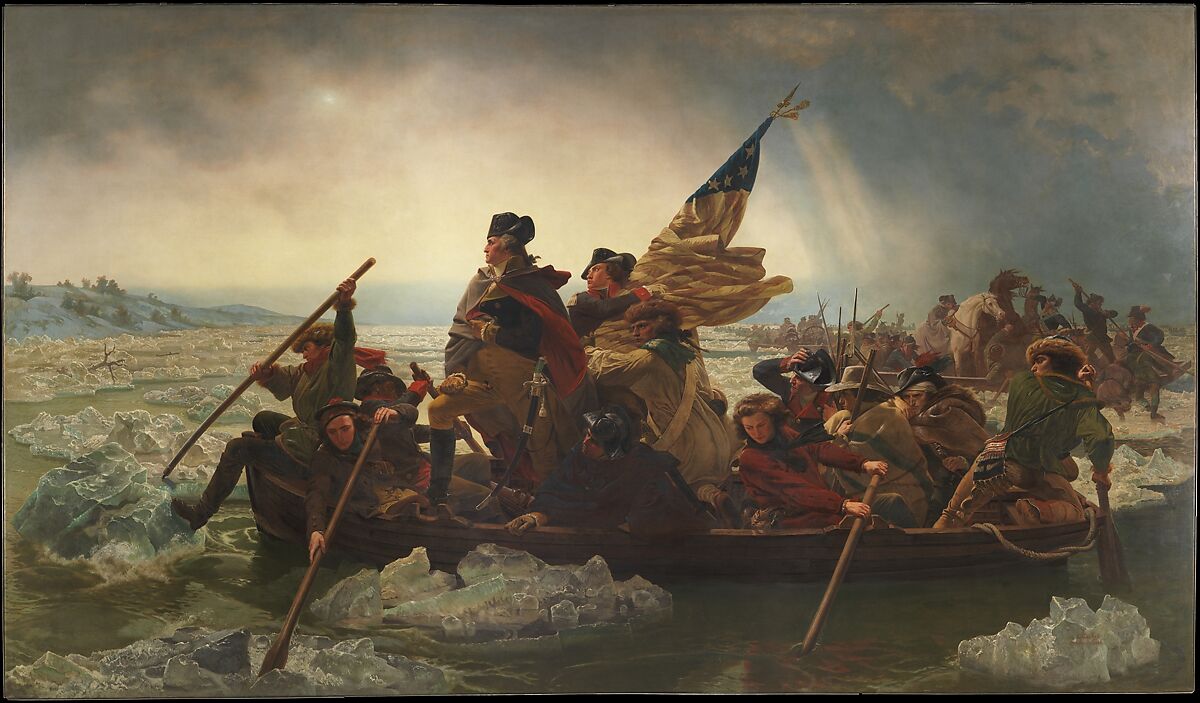
Washington Crossing the Delaware is so overfamiliar that it often gets flattened into one slogan, heroic nationalism on a very large canvas. That reading catches the painting's scale and leaves out its real intelligence. Leutze does not give us a calm monument after victory. He gives us a threshold scene in which victory is still only a wager, the boat overloaded, the river crowded with ice, the light uncertain, and Washington's famous upright body held inside a field of labor that has not finished its work.[1][2]
That matters because the painting was built to do more than illustrate December 1776. The Met's object page presents it as an icon that still triggers argument, patriotic feeling for some viewers, conflict and struggle for others, and a picture repeatedly recast by later artists.[1] The museum's restoration publication adds the crucial historical hinge: Leutze painted it in 1850, after returning from America to his native Germany, while revolutionary movements were sweeping Europe.[2] Once that context enters the frame, the stylization stops looking like mere historical inaccuracy. It starts to look like purpose.
The boat is a compressed republic
The painting's strongest decision is compositional before it is symbolic. Leutze packs the boat so tightly that nobody feels detachable.[1] Oars, elbows, flagstaff, rifle, fur cap, and bent backs all lock together in a single diagonal surge. Washington may rise above the others, but he does not float free of them. His stance depends on the physical pressure generated below him. The image therefore stages command as something carried, not something self-sufficient.
That is why the famous standing pose works. It is obviously theatrical, but theatrical in a disciplined way. A seated Washington would have made the crossing more plausible and the painting much weaker. Leutze needs the body upright so the canvas can find its vertical spine inside all that horizontal drift and shattered ice. The point is not to reconstruct what a general literally looked like in a freezing boat. The point is to give uncertainty a shape the eye can hold.[1]
The crew around him keeps that shape from turning into solitary myth. Leutze distributes different ages, faces, and tasks across the hull so the crossing reads as a collective burden. The oarsmen do not form a polished military machine. They look crowded, improvised, and cold. In that sense the painting's patriotism is inseparable from strain. What it celebrates is not ease or destiny, but the spectacle of people forcing motion through resistance.[1][4]
Ice and light keep the outcome open
Leutze also refuses the settled atmosphere of a finished triumph. The river is full of broken planes, each shard catching just enough light to register danger without stabilizing the space.[1] The water does not open for the boat; it resists it. That is one reason the painting stays visually alive even after endless reproduction. The river is not backdrop. It is the active antagonist of the composition.
The light does similar work. Dawn begins to gather behind the figures, but it has not yet turned into certainty.[1] The flag catches it first, then Washington's face and shirt, while the lower part of the boat remains packed into darker color. Leutze is effectively painting two times at once, night effort and morning promise. The crossing becomes legible as a hinge between them. That hinge quality is central to the picture's emotional charge. The viewer is asked to inhabit suspense, not to arrive late and admire a result already secured.
The Met's 2011 publication helps clarify why this tension mattered to Leutze's first audiences. The canvas was sent to New York in 1851, and within four months 50,000 people had paid to see it.[2] Viewers were not responding to documentary precision alone. They were responding to a picture that could turn political will into something bodily and immediate, a mass of figures pushing through cold toward a future the image allows you to feel before it allows you to trust it.[2]
Why the painting had to be made in Germany
Leutze's own biography sharpens this reading. Washington Crossing Historic Park notes that he was born in Germany, emigrated with his family to the United States, then later returned to Düsseldorf for study and work.[4] The painting's transatlantic logic follows from that movement. It is an American revolutionary subject painted by a German American artist for an audience that could read revolution in more than one national register.[2][4]
Seen from that angle, the huge scale and overt staging make complete sense. Leutze is not whispering private conviction. He is building public persuasion. Washington's profile, the wind-caught flag, and the ice-cleaving prow give the painting the legibility of a civic script. The script could travel because it organized feeling so cleanly: danger first, coordination second, moral elevation third. By the time the work entered American visual culture as an emblem, it had already been built for portability.[1][2]
That portability also explains why the picture remains available for revision. The Met's 2022 essay on Washington Crossing the Delaware: Then and Now is especially useful here because it treats the canvas not as a sealed patriotic relic but as a template later artists test and disturb.[3] Jacob Lawrence, Robert Colescott, Kara Walker, and Kent Monkman all reopen the image's relation to race, myth, and national memory.[3] Leutze's painting survives their pressure because it was never only a story about one man in one boat. It was always a grammar for organizing collective passage, which is precisely why later artists can seize that grammar and ask who got left inside it, who got excluded from it, and who has the right to steer it now.[1][3]
What the picture finally makes visible
The reason Washington Crossing the Delaware still works is not that it tells the event with literal fidelity. Its force comes from a more painterly achievement. Leutze converts political risk into a legible structure of bodies, ice, and light. Washington's impossible posture is part of that structure, not an embarrassment to be explained away. It is the visual answer the painting gives to a practical problem: how do you make precarious motion look shareable, and how do you turn a dangerous crossing into a public image of resolve?[1][2]
That is why the canvas still exceeds textbook familiarity. Under its patriotic afterlife sits a more exacting picture, one in which leadership is balanced on other people's effort, historical change looks crowded and unstable, and the future enters not as certainty but as cold light gathering at the edge of the river.[1][3][4]
Sources
- The Metropolitan Museum of Art, Washington Crossing the Delaware object page, with collection context, current display notes, and artwork details.
- The Metropolitan Museum of Art, Washington Crossing the Delaware: Restoring an American Masterpiece (publication page with history, European revolutionary context, and 1851 reception).
- The Metropolitan Museum of Art, "Washington Crossing the Delaware: Then and Now" (essay on later artists' revisions of Leutze's image).
- Washington Crossing Historic Park, "The Genius of Emanuel Leutze" (biographical context and public-history framing for the painting and artist).