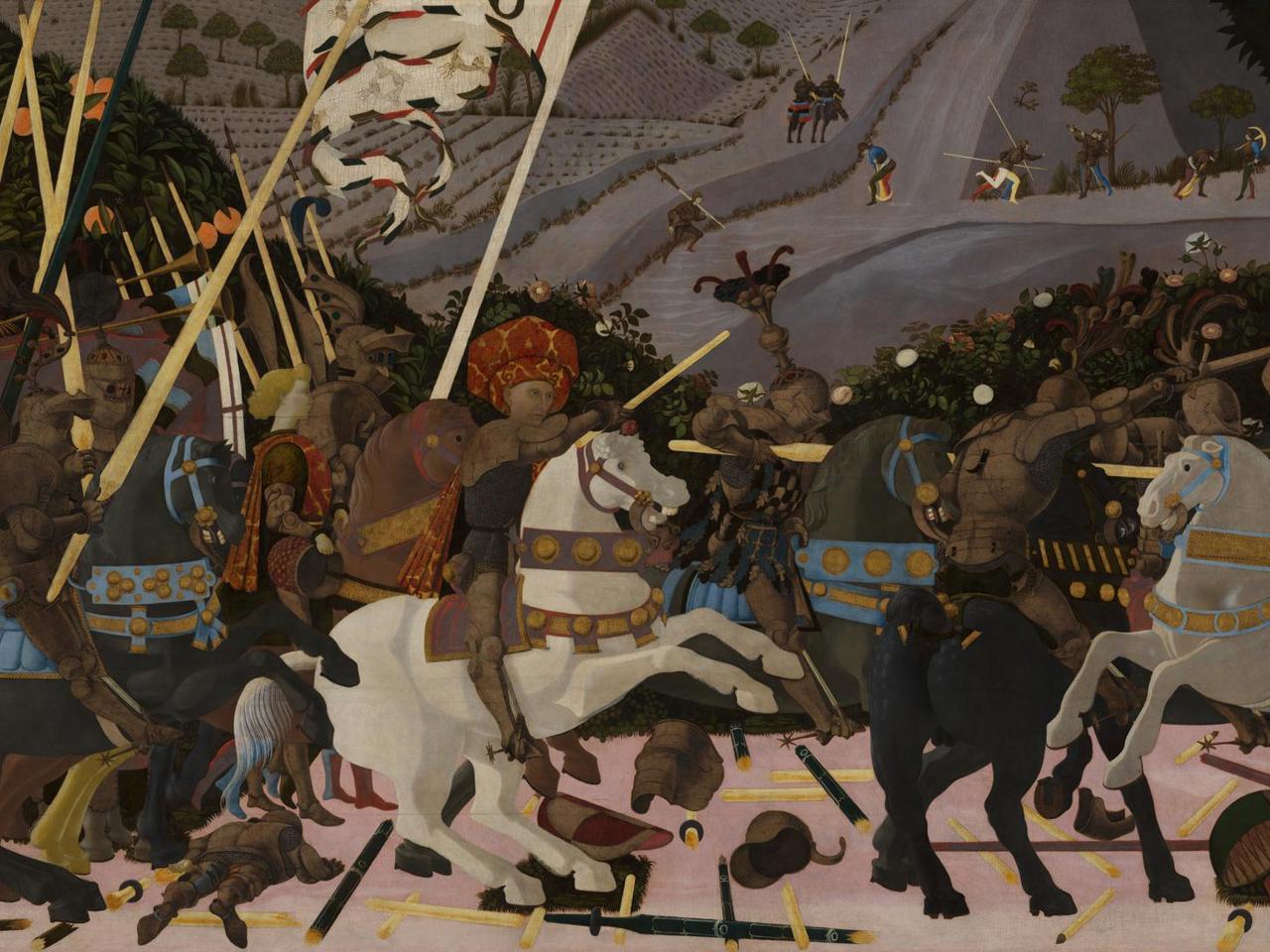

The easiest way to flatten Paolo Uccello's The Battle of San Romano is to treat it as a pure battle picture: cavalry, lances, Florence victorious, early Renaissance perspective on display.[2][3] Caroline Campbell's National Gallery talk is valuable because it refuses that reduction from the first minutes onward.[1] She keeps two tracks moving at once. One track is formal ambition: Uccello's delight in geometry, precious materials, heraldic costume, and the theatrical ordering of violence. The other is material and political afterlife: a panel whose colors have altered, whose upper shape has been cut down, and whose ownership history includes outright coercion by Lorenzo de' Medici.[1][2][3]
That double reading matters because this painting has been simplified twice. Textbooks turn it into a perspective landmark. Museum familiarity turns it into a stable masterpiece already explained. The surviving London panel is neither of those things by itself. It is one member of a three-part cycle now split between London, Florence, and Paris, and even its present rectangular form is the result of later alteration rather than original design.[2][3][4] Once the video restores that instability, the work becomes harder, stranger, and much more alive.
The talk is also useful because it resists the clean moral separation that museum labels often encourage. Campbell's opening premise is that the painting gathers the Renaissance's "good, bad and ugly" into one object.[1] That is exactly right for this panel. It is dazzling and damaged, innovative and coercive, ceremonial and violent. The writing below follows the video's most useful turns so that even if you do not watch the full twenty-four minutes, you can still hold onto the picture's real complexity.
Image context: the cover uses the National Gallery's photographed record of the London panel rather than a generic collage or a cropped detail. That choice fits the article's argument because the video's strongest point is objecthood. You need to see the current surface, the dimmed metallic passages, and the compressed top edge in order to understand what time and possession have done to the work.[2]
The opening minutes put collecting pressure inside the picture
In the first two minutes, Campbell frames the painting through a conjunction most short museum videos avoid: innovation under pressure.[1] She starts with the work as a high point of Renaissance art, then immediately folds in violence and the later discovery that the set originally belonged to the Bartolini Salimbeni before Lorenzo de' Medici forced it into Medici hands.[1][3] That sequence is not a dramatic flourish. It is the right way to begin because it prevents the panel from posing as an innocent illustration of victory.
The National Gallery's catalogue makes the chronology clearer. Gordon and Avery-Quash argue that the three Battle of San Romano panels were likely commissioned around 1438 for Leonardo Bartolini Salimbeni and later documented in Lorenzo's palace by 1492, after the work had already been appropriated into Medici display culture.[3] The painting therefore stages power twice over. First it commemorates Florentine military success at San Romano in 1432. Later it becomes a coveted object absorbed into another elite family's private room. Campbell's talk keeps those two victories uncomfortably close to each other.[1][3]
That matters for art viewing because patronage history is often treated as background. Here it changes the mood of the whole object. Once the later seizure is visible, the panel's polished authority stops feeling neutral. The picture is already about the conversion of battle into prestige. Its own afterlife repeats the same pattern.
Around five to ten minutes, perspective turns violence into ceremony
At about the five-minute mark, Campbell turns to Uccello's reputation as a painter of perspective and to the training background that made such technical hunger plausible.[1][5] The standard headline is true as far as it goes. Uccello organizes the foreground with broken lances that behave like measuring rods, armor fragments that tilt through space at deliberate angles, and a white horse carrying Niccolo da Tolentino as if geometry itself could steady the rush of combat.[2][3]
What the video sharpens is the cost of that order. By about ten minutes, Campbell insists that this is a bloodless battle.[1] That observation clarifies the painting's peculiar tone. The National Gallery's in-depth page makes the same point in different language: Uccello gives us a formal, almost courtly scene, shaped by parade armor, tournament maneuvers, fruit, flowers, and display logic more than mud or bodily ruin.[2] The Uffizi's companion panel confirms that the cycle as a whole prefers choreographed collision to battlefield confusion.[4]
Seen that way, perspective here is more than a technical breakthrough. It is a political filter. It makes conflict fit for a room. The lances form a grid; the commander wears a red-and-gold mazzocchio instead of practical head protection; the horses seem trained for ceremony as much as for war.[1][2][3] Uccello does not erase violence, but he submits it to design so thoroughly that triumph becomes collectible.
The middle of the talk is really about damaged brilliance
The section from roughly thirteen to seventeen minutes is the part I would most urge a reader to keep in mind after the video ends.[1] Campbell points to the silver and gold, then to what time has done to them. The painting page and catalogue supply the underlying material chain: silver leaf on armor has tarnished, reds have shifted, greens have darkened, glazes have worn, and the work's upper zone was cut down when the panels were reshaped for a different setting.[2][3]
That is the hinge on which the talk turns. It is easy to say the picture is dark now. It is harder, and much more useful, to understand that darkness as lost structure. The National Gallery's overview notes that the painting once glittered with burnished metal and brighter color, while the catalogue explains that all three panels probably began with arched tops and irregular corners designed for a vaulted room before later carpentry forced them into rectangles.[2][3] Campbell's lecture gives those facts interpretive weight. The surviving object carries Uccello's original ambition and the evidence of later violence at the same time.[1]
This is why the current surface matters so much. The clipped top edge makes the scene feel denser and more airless than it once did; the dark hedge and grey armor flatten what had originally been a livelier sequence of planes and reflections.[2][3] Even the later corner additions matter, because they are not just repairs. They are signs that the work was made to serve a new room and a new ownerly logic.[3] The painting remains beautiful, but the beauty arrives through damage rather than beyond it.
The final turn makes the painting less innocent
The last quarter of Campbell's talk returns to ownership, and that is what gives the whole video its edge.[1] Around the twenty-minute mark, she lays out the case that Lorenzo de' Medici coveted the panels and used political authority to remove them from the Bartolini Salimbeni house.[1][3] In other words, the cycle did not simply drift into a great collection. It was pulled there.
That fact changes the emotional register of the picture. A work that already stages triumph inside a carefully beautified battle also becomes a trophy in its afterlife. The Medici inventory of 1492 records the three San Romano panels in Lorenzo's camera, already adapted for a different display regime and a different social meaning.[3] What began as one family's monumental commission became another family's possession statement.
Campbell closes by asking the audience to think not only about battle in the image but about the struggles around images: who wants them, who can keep them, and what kind of authority turns admiration into ownership.[1] That is why this video deserves to anchor an article rather than float as a decorative extra. It returns friction to a painting that is too often taught as a solved example of early Renaissance perspective. Once you take the material losses and the coercive afterlife seriously, The Battle of San Romano stops being a classroom diagram and starts feeling like what it is: a beautiful, cut-down, darkened, highly desired object that still remembers the force used to make it and the force later used to own it.[1][2][3][4]
Sources
- The National Gallery, "Paolo Uccello, 'The Battle of San Romano' | Talks for all | National Gallery," YouTube video.
- The National Gallery, "Paolo Uccello, The Battle of San Romano" — painting page with overview, in-depth note, and image record.
- Dillian Gordon and Susanna Avery-Quash, "The Battle of San Romano," The Fifteenth Century Italian Paintings, Volume 1 — National Gallery catalogue entry with technical notes, later additions, and provenance.
- Gallerie degli Uffizi, "Battle of San Romano" — companion panel from the three-painting cycle.
- Encyclopaedia Britannica, "Paolo Uccello" — artist biography and Renaissance context.