Walter De Maria's The Lightning Field sounds, at first, like a promise of spectacle. The title makes the mind jump to impact: sky opening, metal conducting, the desert briefly theatrical. The work itself is slower and stranger than that. Completed in 1977 in a remote part of western New Mexico, it consists of 400 polished stainless-steel poles set in a grid measuring one mile by one kilometer.[1] The poles are only two inches in diameter, spaced 220 feet apart, and calibrated so their pointed tips define a level horizontal plane across uneven desert ground.[1][3]
Those facts can make the work sound severe: a Minimalist diagram carried outdoors. But the best way to read The Lightning Field is not as a diagram, and not even as a machine for attracting lightning. It is a sculpture that turns precision into waiting. The grid gives the field enough order to be seen, then hands that order over to light, walking, weather, and isolation. De Maria's great move was to make the form exact enough that the world around it could become unstable without becoming vague.[1][2]
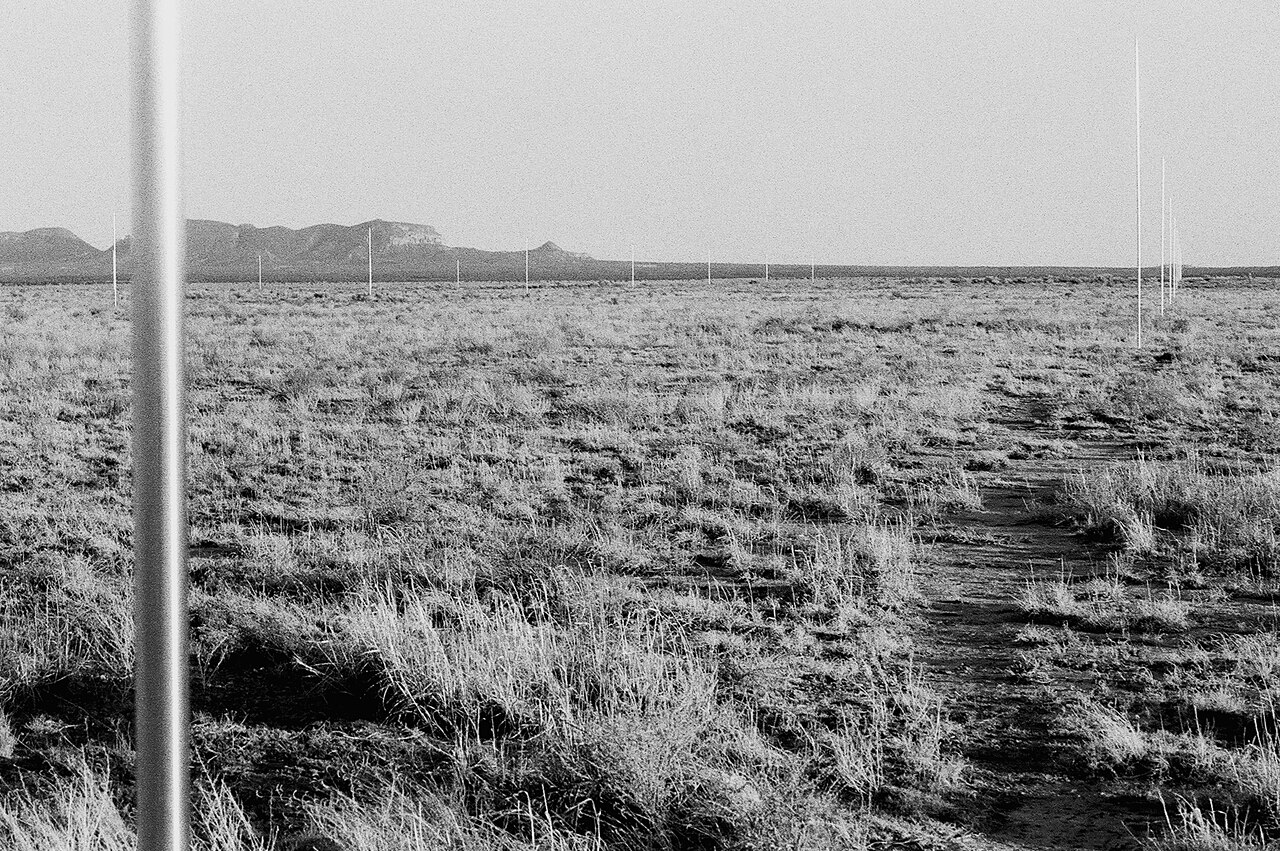
Image context: the cover uses a real Wikimedia Commons photograph of The Lightning Field in western New Mexico. That is the right visual for this essay because the argument depends on the work's actual photographic condition: thin metal poles, broad land, cloud mass, and horizon scale, not an abstract spiral, diagram, or generated desert mood image.[5]
The Grid Is Too Large To Possess
A grid usually promises mastery. It suggests measurement, ownership, and the ability to understand a field from above. The Lightning Field frustrates that promise because its grid is too large for ordinary possession. Dia describes the work as a sculpture "to be walked in as well as viewed," and encourages visitors to spend extended time there, especially around sunrise and sunset.[1] That sentence matters. It shifts the artwork away from frontal looking and toward duration.
From a distance, the poles can align into a visible system. From inside, the system keeps dissolving. Some poles sharpen in reflected light; others nearly vanish against the ground or sky. Smarthistory's account of visiting the site notes that at midday many poles become hard to see, while at sunrise and sunset they glow against changing color.[3] The work therefore refuses one stable viewing state. It is not a single image waiting to be photographed correctly. It is an arrangement that keeps changing its degree of visibility.
That is why the measurements do not feel cold. The one-mile length, one-kilometer width, 400 poles, and 220-foot spacing are not trivia. They create a perceptual problem. The viewer knows there is a precise order but cannot comfortably hold it all at once from the ground.[1][3] The grid becomes legible through partial evidence: a row that suddenly appears, a diagonal guessed by the eye, a glint that confirms the next pole, a missing patch where light has swallowed the structure. The sculpture is rational, but the experience is intermittent.
Lightning Is Not The Main Event
The title's brilliance is also its trap. It gives the artwork mythic voltage before a visitor arrives. Yet Dia is explicit that a full experience of The Lightning Field does not depend on lightning.[1] This is not a disappointing footnote. It is the key to the work's intelligence. Lightning may be the dramatic possibility, but light is the daily medium.
De Maria understood the risk. In his 1980 Artforum text introducing the work, he insisted that no photograph or recorded image could fully represent it, and he tied Land art to isolation and primary experience.[2] The claim can sound controlling, especially because the work's photographic circulation has always been unusually managed. But it also names a real formal condition. A lightning strike would be spectacular; the artwork's deeper force is that it trains attention before the strike, without the strike, and after the strike has failed to arrive.
The poles are built to receive weather without becoming ordinary equipment. They resemble lightning rods, survey markers, and minimalist columns, but they do not settle into any one of those roles. Their pointed tips make the horizontal plane feel almost imaginary, as if a sheet could rest across the desert, while their thin shafts keep the field from becoming a wall.[1][3] The ground remains open. Cattle, insects, wind, mud, and distant mountains do not become backdrop; they become part of the conditions by which the poles appear.
This is where The Lightning Field differs from a monument. A monument often consolidates attention around an object. De Maria disperses attention across a system. The viewer keeps asking where the work is: in the pole, in the spacing, in the horizon line, in the storm risk, in the walk between points, in the rule that only a small number of people can be there at once. The answer is not one location. The answer is the field.
Photography Is Both Evidence And Problem
The article's cover photograph is useful because it shows the work's basic drama: tall silver poles, grassy desert, a low horizon, and clouded sky.[5] It proves that The Lightning Field is not merely an idea written into a landscape. It has material presence. The photograph also proves the opposite: that a single image can make the work look more available than it is.
The site is deliberately difficult to consume. Dia's visitor page stresses remoteness, limited services, the possibility of weather-related cancellations, and overnight visits during the May-to-October season.[1] Southwest Contemporary's more recent account states the access rule even more sharply: visitors cannot photograph The Lightning Field or the adjoining cabin, and only six people a day visit during the season.[4] The rule can feel severe in an age when art tourism often turns instantly into image production. Here severity is part of the encounter.
That does not mean photographs are useless. John Cliett's authorized images helped shape the work's public identity, and later documentary photographs remain important records.[2][5] But the work itself pushes against the idea that an image is enough. If a photograph catches the poles under a dramatic sky, it risks confirming the title too neatly. If it catches the field in flat light, it risks making the work look empty. Both are true, and both are incomplete. The artwork lives in the gap between documentation and bodily duration.
Isolation As A Material
De Maria's most demanding claim may be that isolation is not a mood added to the work but one of its materials.[2] The remote New Mexico site, the limited visitor capacity, the overnight stay, and the scale of the grid all work together to slow the social tempo around the sculpture.[1][4] You do not drop into The Lightning Field between errands. You are delivered into it, stay with it, and leave it.
That structure changes the ethics of looking. In a crowded museum, a viewer can glance, identify, and move on. In the field, identification is not enough. The poles do not reward quick recognition. They reward noticing how much the same thing can change when the sun shifts, when clouds thicken, when the body moves away from the cabin, or when another visitor becomes a small figure inside the grid. The sculpture makes perception less like capture and more like exposure.
There is a paradox here. The work is highly controlled, yet the experience it protects is not fully controllable. Weather can cancel access.[1] Lightning may not occur.[1][3] Poles may disappear in glare or flare at the edge of day.[3][4] The visitor may search for a center, walk the perimeter, or drift without method, as Joshua Ware describes in his Southwest Contemporary essay.[4] De Maria's grid sets the conditions, but it does not script the feeling.
Why The Work Still Feels Exact
The durability of The Lightning Field comes from this balance between engineering and surrender. The sculpture is not vague about its form: it has 400 poles, a measured grid, level tips, and a defined place in western New Mexico.[1][3] It is equally not reducible to those facts. Its precision is a way of giving change something to act upon.
That is why the work remains one of Land art's most exact encounters. It does not decorate the desert, and it does not pretend the desert is untouched. It introduces a human system so spare that the surrounding conditions become newly visible. The field makes sunlight measurable without turning it into data. It makes isolation palpable without making it private fantasy. It makes weather dramatic without requiring lightning to perform on command.
Seen closely, the title is not misleading. It is incomplete in a productive way. The lightning is a possibility that sharpens attention; the field is the real artwork. De Maria built a grid that waits for the sky, but the waiting is not empty. It is the medium through which the viewer learns that a thin line of polished steel can hold space, time, weather, and doubt without closing them down.[1][2][3]
Sources
- Dia Art Foundation, "Walter De Maria, The Lightning Field" - official site page with location, materials, grid dimensions, visitor season, and access context.
- Walter De Maria, "The Lightning Field," Artforum, April 1980 - artist's published statement on the work, photography, isolation, and primary experience.
- Lara Kuykendall, "Walter De Maria, The Lightning Field," Smarthistory - interpretive account of the work's scale, pole heights, level tips, and changing visibility.
- Joshua Ware, "Three Ways of Walking The Lightning Field," Southwest Contemporary, 2023 - recent visit essay on walking routes, visibility, visitor limits, and photography restrictions.
- Wikimedia Commons, "File:Walter de Maria, The Lightning Field, 1977 (7873321374).jpg" - source page for the real photographic image used as the article cover.