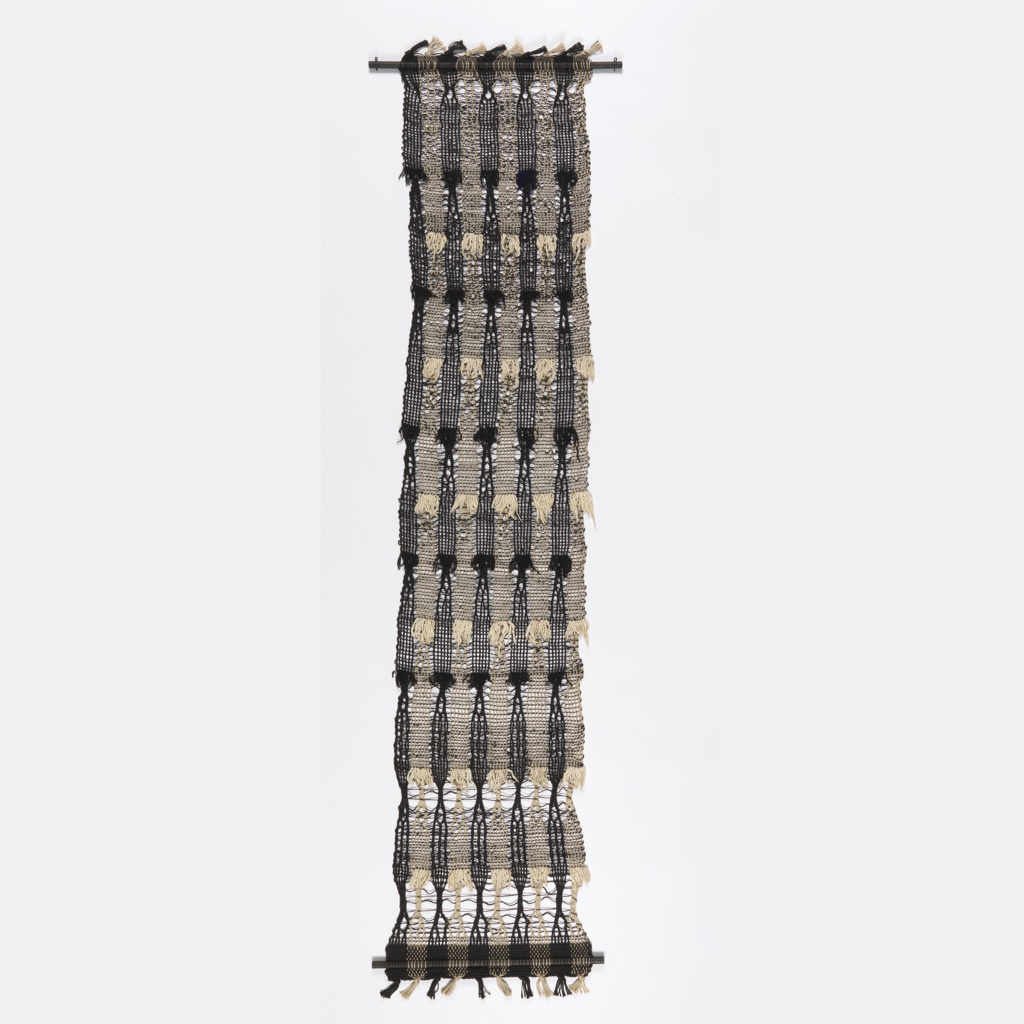
Lenore Tawney's Hanging, Seed looks fragile only if weaving is assumed to be a surface first. The longer one looks, the more that assumption fails. The work is not a cloth picture stretched into art status, nor a wall hanging pretending to be sculpture. It is a woven structure that makes air part of its medium. Black and natural fibers form an open ladder of knots, bars, tufts, and suspended intervals. The eye does not simply read the front. It passes through.
That pass-through quality is the point. Cooper Hewitt identifies Hanging, Seed as a 1961 work made from linen, wild cotton, and handspun wool, and places it inside Tawney's sculptural weaving period.[1] The material facts matter because the piece is not dematerialized minimalism. It is full of fiber decisions: loose sett, leno structure, alternating tufts, rods that hold tension, and warp ends that refuse to hide the making. Tawney's breakthrough was to let those textile facts become spatial facts.
Open Warp Is Not Empty Space
The ordinary romance of weaving often begins with density: the comfort of cloth, the integrity of a covered plane, the skill required to make threads become a continuous surface. Tawney reverses that expectation. In Hanging, Seed, the strongest passages are often the gaps. The open squares and elongated vertical intervals do not weaken the work. They let the work breathe, cast shadow, and change as light moves through it.
Cooper Hewitt's technical explanation is especially useful here. Leno weave twists two or more warp threads around the weft, producing an open but durable fabric.[1] That means the open areas are not simply holes or places where weaving stops. They are engineered openings. Tawney uses structure to make vulnerability hold. What looks gauzy is also disciplined. What looks loose is also tied, twisted, measured, and suspended.
That is why Hanging, Seed should not be praised with vague language about delicacy. Delicacy is present, but it is not the achievement. The achievement is tensile intelligence. The top rod, bottom rod, repeated dark verticals, natural fiber masses, and fringe-like endings distribute weight across the piece. Each opening is held in relation to its neighbors. The work behaves like a diagram of dependence, except it is not a diagram. It is a real object whose logic can be seen only because the textile has been opened.
The Wall Stops Being The Default
MoMA's account of Tawney's Little River helps clarify the larger method. The museum describes that 1968 work as free-hanging, emphasizing three-dimensionality and the contrast between solid and void; it also links Tawney's open-warp technique to vertical slits that disrupt the idea of textile as a flat, continuously woven surface.[2] Those same principles are already active in Hanging, Seed. The wall is no longer the textile's natural destiny. Suspension becomes a way of thinking.
This matters for art history because fiber art is often forced into a defensive argument: it has to prove that weaving can be as serious as painting or sculpture. Tawney's work takes a stronger route. It does not ask weaving to imitate either medium. Instead, it asks what weaving can do that a painted canvas or carved block cannot do in the same way. It can make line out of actual thread. It can hold openness without pretending openness is immaterial. It can let gravity, shadow, and tension remain visibly part of the form.
The Metropolitan Museum of Art's description of Tawney's later Shrouded River sharpens this point. The Met stresses open-warp vertical slits, free-hanging display, three-dimensionality, and light filtering through the work; it also notes rods, knotted and braided warp ends, and river or shroud associations.[3] Read beside Hanging, Seed, that later work does not feel like a separate invention. It feels like a continuation of the same problem: how to make weaving behave as a body in space while keeping its thread logic legible.
Leno Makes The Image Durable
The technique is not background craft. It is the argument. Leno weave allows openness without collapse because warp threads twist around weft threads rather than merely crossing in a plain over-under rhythm.[1] In Hanging, Seed, that twist turns visibility into structure. The viewer can see through the work because Tawney has made the openings durable enough to carry visual responsibility.
The alternating tufts are just as important. They interrupt the grid with small eruptions of fiber, so the surface does not become a dry exercise in openness. The black and natural masses gather like seed pods, knots, or signs of growth, then release back into laddered space. They make the work less austere than it first appears. Tawney is not eliminating textile richness. She is relocating it. Instead of covering the whole field with pattern, she concentrates texture at intervals, letting the eye move from mass to absence and back again.
This is where the title starts to matter. Hanging, Seed does not illustrate a seed in a botanical sense. It gives the word a structural feeling: potential held in small clustered forms, growth implied by repeated units, a vertical field that seems both planted and suspended. The work's seed-like force lies in its compression. Each tufted unit feels capable of expanding into the surrounding grid, but the weaving holds that energy in place.
Tawney's Radical Move Was Textile Specific
The John Michael Kohler Arts Center's 2019 Lenore Tawney: Mirror of the Universe framing names Tawney as a central figure in shifting weaving from utilitarian craft toward fiber art, emphasizing open-warp experiments, nonfunctional flowing works, and woven forms that moved beyond the flat rectangular format.[4] That is a useful summary, but Hanging, Seed shows why the shift was not just institutional. The object itself makes the case.
Nothing in the work apologizes for fiber. The medium is not hidden under polish. Thread remains thread. Twist remains twist. The hanging remains visibly dependent on rods, knots, and gravity. Tawney's modernism is not a flight from craft into pure form. It is craft pushed until it changes the room. That is why the work still feels clear rather than merely historical. It understands that abstraction can be built from the actual behavior of material, not only from simplified shapes.
MoMA's artist page places Tawney among Coenties Slip and textile contexts, with online works including Dark River, Little River, and related pieces from the 1960s.[5] The Coenties Slip setting is tempting because it links her to a downtown New York milieu usually narrated through painters and sculptors. But the better reading does not use that neighborhood to rescue Tawney by association. It lets her alter the story of the neighborhood. If postwar abstraction was testing how art could occupy space, Tawney's answer came through thread.
Light Becomes A Material
The real subject of Hanging, Seed is not only weaving, but what weaving can admit. Light passes through the open areas, catches on tufts, and turns the wall behind the work into a secondary field. Shadow becomes evidence of depth. The object does not stop at its outer contour because its openings keep recruiting the surrounding space.
That makes the work unusually patient. It does not deliver one central image. It asks for scanning. The viewer moves up and down, across the repeated darks and pale fibers, into the widened gaps near the lower section, back to the compact upper bars, then down to the loose endings. The eye behaves almost like a hand checking tension. That tactile looking is part of Tawney's intelligence. She makes a viewer understand space through the habits of textile attention.
Seen this way, Hanging, Seed is not a minor decorative object from the margins of modernism. It is a compact technical proposition: a weaving can stop covering and start holding; a thread can draw in air; a gap can carry weight; a textile can become sculptural without giving up the knowledge of the loom. Tawney made openness durable, and that is why the work still feels alive.
Sources
- Cooper Hewitt, Smithsonian Design Museum, "Lenore's 'Woven Forms'" - object essay on Hanging, Seed, its 1961 date, materials, leno weave, open structure, and ceiling-to-floor installation logic.
- The Museum of Modern Art, "Lenore Tawney, Little River, 1968" - collection record and gallery labels on open warp, vertical slits, free-hanging display, solid/void contrast, and Peruvian textile influence.
- The Metropolitan Museum of Art, "Lenore Tawney, Shrouded River" - collection record describing open-warp technique, vertical slits, free-hanging display, light, rods, knots, and shroud/river associations.
- John Michael Kohler Arts Center, "Lenore Tawney: Mirror of the Universe" - exhibition overview on Tawney's fiber-art legacy, open-warp experimentation, woven forms, and movement beyond flat rectangular weaving.
- The Museum of Modern Art, "Lenore Tawney" - artist page listing Tawney's works online, Coenties Slip and textile associations, and 1960s exhibition context.