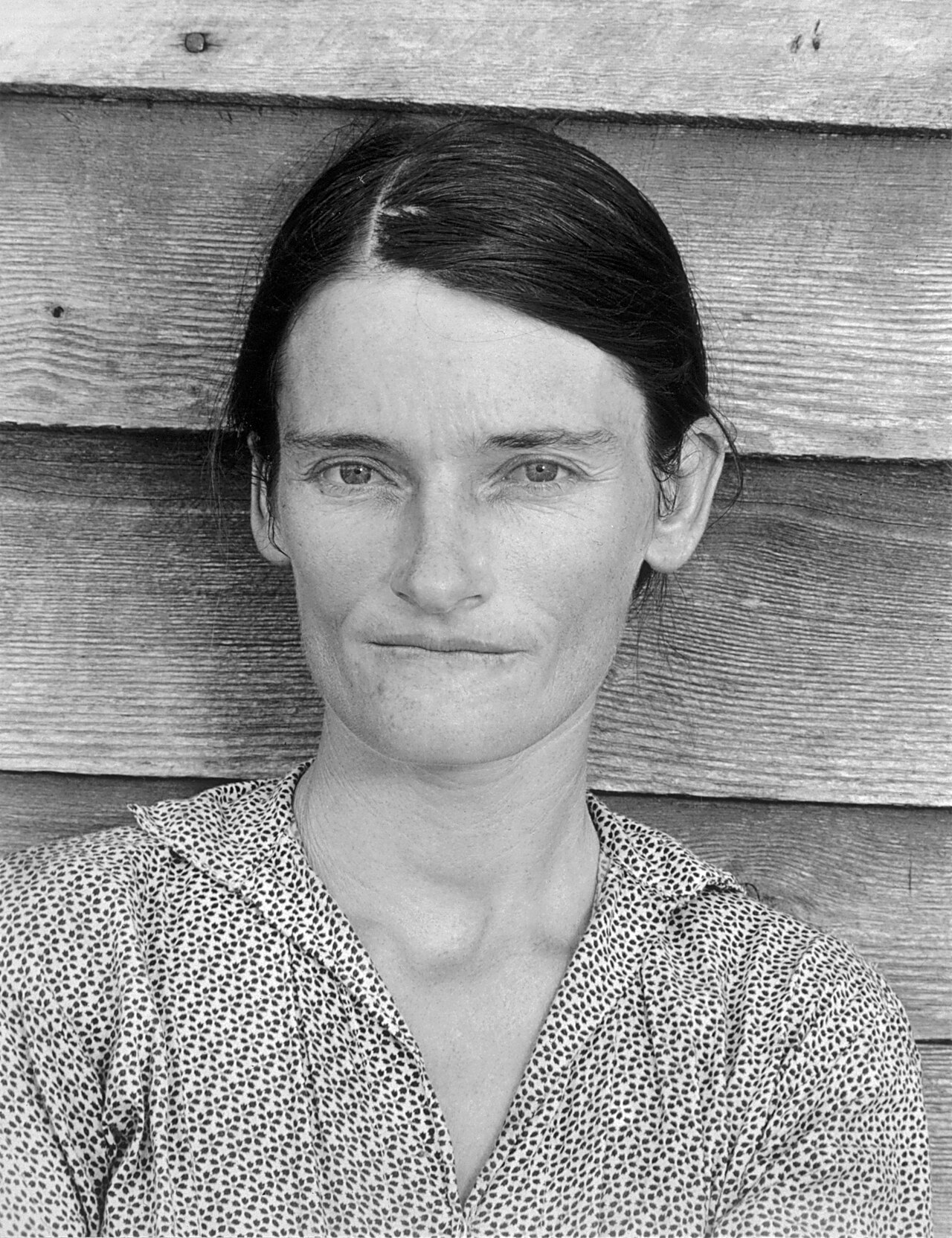
Walker Evans's portrait of Allie Mae Burroughs is severe before it is famous. A woman stands against a rough plank wall. Her dress is worn, its pattern flattened by the camera into a field of small marks. Her arms hang close to her body. Her face is neither softened into pity nor arranged into heroic endurance. The photograph's force comes from that refusal. It does not plead. It holds.[1][2]
The Met titles its print Alabama Tenant Farmer Wife and dates it to 1936. Its collection note places Evans in Hale County, Alabama, where he and the writer James Agee lived on and off near Floyd and Allie Mae Burroughs during August of that year. The same note records the economic structure beneath the portrait: the family leased their home, land, mule, and farm tools, and Floyd Burroughs worked as a cotton "sharecropper" or "halver."[2] That context matters, but the photograph does not illustrate it like a textbook caption. Instead, Evans compresses tenancy into posture, wall, fabric, light, and stare.
Image context: this post uses one real archival photographic image of the work under discussion. The image-work match is direct: the article is a close reading of Evans's Allie Mae Burroughs portrait, and the downloaded image is the portrait itself, sourced from the Wikimedia Commons file that identifies the Library of Congress record and digital ID.[1]
The Wall Is Not Empty
At first glance the wall looks like a neutral backdrop, almost a studio substitute improvised outdoors. It is not neutral. Its boards run behind Burroughs with a hard, shallow pressure. There is no deep landscape, no kitchen interior, no cotton field, no dramatic sky. Evans denies the viewer the usual documentary escape route, the little environmental detail that turns a person into an example of place. The place is there, but it is compressed into surface.
That compression is why the portrait feels so close. Burroughs is not simply in front of the cabin. She is visually pinned to it. The vertical planks make the photograph feel like a record of housing, labor, poverty, and exposure even before the viewer knows the biographical names. The wall has weather, but it also has discipline. It keeps the photograph from becoming sentimental theater. Nothing in the background competes for narrative priority. The face, the dress, and the boards must carry the whole burden.
MoMA's object page identifies the work as Alabama Cotton Tenant Farmer Wife, a 1936 gelatin silver print in its photography collection.[3] That medium matters because the print's values are not incidental. Evans's blacks and grays do not dramatize the scene through extreme contrast. They make the surface readable. The wall grain, the dress pattern, the face, and the hair all belong to one tight tonal system. The portrait is not soft because its subject is poor, and it is not harsh because the photographer wants shock. Its clarity is the argument.
The Face Refuses a Single Story
The most dangerous way to read the photograph is to decide too quickly what Burroughs's expression "means." The Met's note is useful precisely because it resists that simplification. Evans made four photographs of Allie Mae Burroughs against the rear wall of the cabin, and the museum describes those related exposures as recording different expressions, from more cooperative to more closed or angry moods.[2] In other words, the familiar image is not the transparent essence of a person. It is one selected moment from a sequence.
That sequence matters ethically. A portrait can pretend to reveal a subject completely, especially when the subject is poor and the viewer is distant. Evans's photograph is powerful, but its power should not be mistaken for total knowledge. The face is exact in the print and unknowable beyond it. The pressed mouth, furrowed brow, and direct gaze invite interpretation, yet they also stop interpretation from becoming easy. Burroughs looks at the camera, but she does not give herself over to it.
This is where Evans's restraint becomes complicated. The picture is not exploitative in the simple sense of staging tears, dirt, hunger, or collapse. But it is still a picture made through an unequal encounter: a photographer with a large camera, a national documentary apparatus in the background, and a tenant farmer's wife whose image would circulate far beyond Hale County. The photograph's severity asks viewers to admire Evans's control. It should also make them notice the cost of that control.
Documentary Becomes Composition
Evans worked inside the documentary tradition, but his best pictures do not merely report. The Met's Timeline essay calls him a central figure in American photographic documentary and emphasizes his ability to translate ordinary American subjects into enduring art.[4] The Allie Mae Burroughs portrait shows how that translation happens. Evans does not add symbols. He organizes what is already present until the ordinary becomes almost architectural.
The composition is simple enough to describe and difficult to exhaust. Burroughs is frontal. The wall is flat. The frame crops close enough that the body becomes an upright form, not a figure moving through space. The dress pattern breaks the central mass, while the face remains the sharpest psychological point. Her hands, low in the frame, are visible but not theatrical. The pose is still, not relaxed. Everything works against anecdote.
History Matters, a George Mason University project on historical photographs, explains that Evans often began sessions with a smaller 35mm camera before using a larger view camera whose slower process required subjects to hold poses carefully. The project notes that Evans preferred the view camera because it gave him more control over the final image's message.[5] That helps explain the portrait's particular stillness. This is not a snapshot catching Burroughs unaware. It is a formal encounter in which duration itself becomes visible.
That duration gives the picture its pressure. The subject had to stand; the photographer had to arrange; the camera had to wait. The result looks plain, but plainness is not the absence of style. It is style stripped down until every remaining choice feels unavoidable.
The Hale County Story Changes the Frame
The Hale County context is not just background information. It changes the photograph's moral weather. The Met records that Evans and Agee were connected to a Fortune assignment on tenant farmers, and that the later book Let Us Now Praise Famous Men grew from the rejected magazine project.[4] The portrait therefore sits between journalism, literature, federal-era documentary practice, and museum art.
That in-between status is why the photograph keeps generating discomfort. In a newspaper story, Burroughs might stand for Depression hardship. In a museum, she might stand for Evans's formal brilliance. In Agee and Evans's book, she belongs to a project that pushes documentary description toward anguish, self-consciousness, and literary excess. The same face can be made to serve different systems of meaning.
Evans's photograph survives because it does not fully submit to any one of them. It is too composed to be raw evidence. It is too socially specific to be pure form. It is too intimate to be a detached typology, and too controlled to be a private encounter. The picture is strongest where those categories rub against each other.
The Plainness Is the Trap
Calling the portrait plain can make it sound simple. It is not. The plain wall is a trap for the viewer's habits. Without props, the viewer may try to turn the face into the whole story. Without action, the viewer may overread posture. Without a visible field or household, the viewer may forget the tenancy system that made the Burroughs family's life so constrained. Evans removes distractions, but the removal creates responsibilities.
The Commons file used for the image identifies the photograph as Allie Mae Burroughs, taken in 1936, and traces it to the Library of Congress Prints and Photographs Division under digital ID cph.3g08200.[1] The Met object page gives the fuller art-historical and social frame: Hale County, the rear cabin wall, four related exposures, the 1938 selection for American Photographs, and the later use in Let Us Now Praise Famous Men.[2] Read together, those records keep the photograph from becoming either an icon without a person or a person without a historical structure.
That balance is the achievement. Evans made an image so controlled that every board and fold seems deliberately placed, yet the portrait's human center remains resistant. Allie Mae Burroughs is visible, but not solved. The camera has fixed her against a wall; the photograph has carried her into the history of art; the viewer still has to meet the fact that looking is not the same as knowing.
The picture's pressure comes from that boundary. It makes documentary art out of a woman standing still, then refuses to let stillness become silence. The plain wall does not empty the frame. It concentrates it.[1][2][4]
Sources
- Wikimedia Commons, "File:Allie Mae Burroughs print.jpg" - archival photographic file page identifying Walker Evans, the 1936 date, the Library of Congress source record, and digital ID cph.3g08200.
- The Metropolitan Museum of Art, "Walker Evans - Alabama Tenant Farmer Wife" - official object page with Hale County context, Floyd and Allie Mae Burroughs, sharecropping details, related exposures, and object metadata.
- The Museum of Modern Art, "Walker Evans. Alabama Cotton Tenant Farmer Wife. 1936" - official object page with title, date, medium, dimensions, department, and exhibition-history references.
- The Metropolitan Museum of Art, "Walker Evans (1903-1975)," Heilbrunn Timeline of Art History - museum essay on Evans's documentary practice, Depression-era work, Fortune/Agee assignment, Let Us Now Praise Famous Men, and American Photographs.
- History Matters, George Mason University, "How was the photograph taken?" - teaching page explaining Evans's use of 35mm and view cameras at the same rural Alabama household in 1936 and the role of formal posing.