Gunta Stolzl's Slit Tapestry Red-Green looks at first like a clean Bauhaus arrangement: upright bands, compact rectangles, deep red and green passages, black accents, and pale intervals that make the surface breathe. That first glance is useful, but it is also a trap. The work is not a painting translated into cloth. It is an argument made by a loom. Its geometry matters because every edge has to be built, not merely drawn.[1][3]
The Harvard/Scalar record identifies the photographed work as Slit Tapestry (Red-Green), dated 1928, from the Harvard Art Museums/Busch-Reisinger Museum, gift of the artist.[1] Bauhaus Kooperation likewise lists Slit Tapestry Red-Green as a 1927/28 work in its Stolzl biography.[3] Those dates place the tapestry inside the most consequential stretch of Stolzl's Bauhaus career: the Dessau years, after the school had left Weimar, when the weaving workshop was no longer only a refuge for women students pushed away from architecture or painting, but one of the places where Bauhaus modernity became materially testable.[3][6]
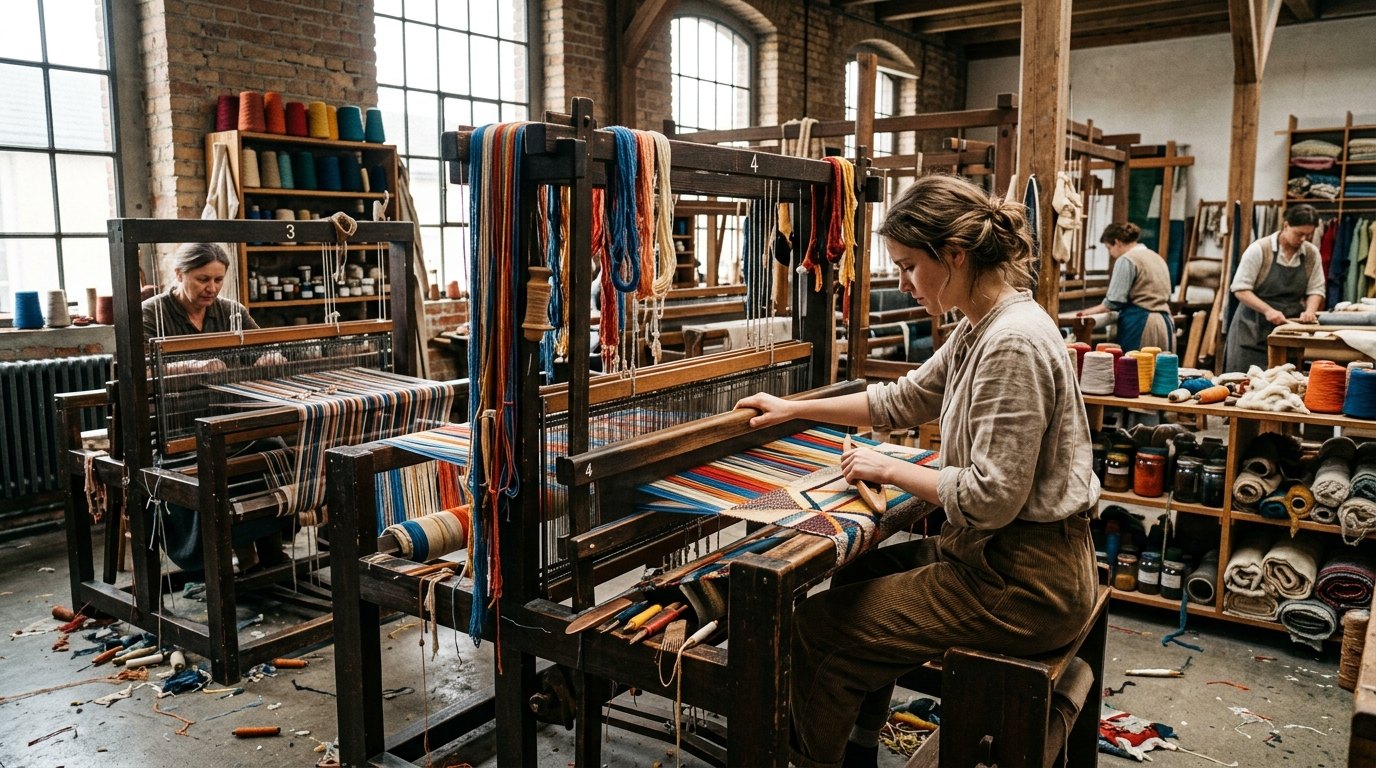
Image context: this post uses an immersive weaving-studio image rather than a flat artwork reproduction, diagram, chart, or analytical graphic. The image is topic-grounded in the material conditions the essay keeps returning to: loom discipline, warp tension, handwork, and the Bauhaus workshop's movement between craft and industrial design.
A Slit Is A Decision
The key word in the title is not only "red" or "green." It is "slit." In slit tapestry, adjacent color areas can be woven separately along the same warp, leaving a narrow vertical gap or join where one passage ends and another begins. That join is not a painted line. It is a structural event. Color changes because thread changes; edge appears because construction changes.
That is why Slit Tapestry Red-Green feels more severe than decorative. The vertical divisions are not arbitrary modernist stripes laid over a passive support. They are places where the textile declares how it was made. The work keeps bringing the viewer back to the fact that woven abstraction is never disembodied. A rectangle is also a sequence of passes. A line is also a boundary condition. A color block is also a negotiation among warp, weft, tension, density, and the hand's ability to keep a decision steady.
MoMA's 1924 Wall Hanging record gives the most concise general statement of Stolzl's method. The museum describes her as a prominent Bauhaus educator who developed the weaving workshop into a high-profile experimental department, and it reads the horizontal bands in that earlier wall hanging as demonstrations of different ways to introduce threads into a woven surface.[4] That label matters for the later slit tapestry too. For Stolzl, a textile could disclose its own procedures without becoming a dry sample chart. Method and expression are inseparable.
Bauhaus Geometry Had To Pass Through Fiber
The Bauhaus is often remembered through chairs, glass walls, sans serif lettering, and clean architectural planes. Stolzl's weaving forces a slower account. In cloth, geometry cannot simply announce itself as pure form. It has to survive friction. The line must be counted. The color must be carried. The surface must hold together under touch, gravity, and use.
Bauhaus Kooperation's biography makes the workshop history concrete. Stolzl studied at the Bauhaus from 1919, trained in the weaving workshop with Georg Muche, attended classes with Johannes Itten and Paul Klee, and became director of the weaving workshop in 1926-1930/31 after serving as master of form in Dessau.[3] AWARE emphasizes the gendered institutional pressure more sharply: Stolzl's proposed women's department merged with weaving, and she became the central figure in that workshop before being named its only woman director, or Jungmeister.[7]
Those facts change how the tapestry should be read. This was not a minor applied-art corner politely decorating the heroic Bauhaus. It was a workshop where the school's claims about art, craft, material, and industry had to be tested strand by strand. Stolzl's authority came from that test. AWARE summarizes her position as a search for balance between form and material, while also noting her work on technical textile needs: resistance, light sensitivity, and modern use.[7] The tapestry's geometric force is therefore practical before it is stylish. It asks what abstraction can become when it must be woven.
Handloom Knowledge, Industrial Pressure
The strongest tension in Stolzl's practice lies between handloom intelligence and industrial replication. Cooper Hewitt's essay on a Stolzl Jacquard design is especially useful here. It notes that Stolzl valued handlooms because they taught the weaving process and left room for play and experiment, even as she learned the more advanced Jacquard system, with punch cards controlling warp threads, and recognized its capacity for precision, complexity, and repeatable production.[6]
That tension does not weaken the art. It gives the art its historical charge. Slit Tapestry Red-Green belongs to handwoven display and to a Bauhaus culture increasingly pressured by production, furniture, interiors, and reproducible design. It is an object, but it also behaves like a research statement. The textile tests what happens when a workshop vocabulary can move between a unique wall hanging and patterns that might inform modern rooms, upholstery, curtains, and mass-produced cloth.
MoMA's c. 1928 Weaving record gives a related clue. The museum says Stolzl prioritized texture and materials over vibrant color, explored checks, stripes, and plaids on a handloom for designs intended for mass production, and carried that spare vocabulary into unique wall hangings for domestic interiors.[5] That description could almost serve as the operating manual for Slit Tapestry Red-Green: the work is specific, handmade, and visually alert, yet it keeps thinking about repeatable systems.
Color Is Built, Not Applied
The red and green in the tapestry are not atmospheric washes. They arrive as woven bodies. The red does not float above the textile; it sits inside the same physical grid as the black, cream, gray, and green. This is why the work's color has weight. Each chromatic decision is also a material decision, and each material decision changes the rhythm of the whole surface.
That rhythm is less symmetrical than the Bauhaus stereotype might suggest. The vertical units tighten and loosen. Some blocks look stacked; others feel like interruptions. Pale areas pause the eye, while dark bands act like hinges. The result is not a fixed modular diagram. It is closer to a constructed score, where repetition exists but never becomes dead regularity.
AWARE's note on Stolzl's Five Choirs helps clarify this musical aspect, even though it discusses a different work. The title's play on choir and Jacquard cords, the profile explains, links musical harmony, symmetry, and technical mastery.[7] Slit Tapestry Red-Green is quieter, but it shares that logic. The textile makes pattern audible to the eye: accents, rests, crossings, sustained fields, and abrupt joins. The loom becomes a compositional instrument.
The Medium Carries The Argument
The Met's Bauhaus Archive record for a Stolzl design states the point with useful directness: her design takes advantage of the linear nature of the loom's warp and weft to build pattern layer by layer, and it calls her perhaps the most important member of the Bauhaus weaving workshop.[8] That is the core of this technique deep dive. Stolzl's modernity does not come from making weaving look like painting, architecture, or graphic design. It comes from proving that weaving already had the means to think modern form through its own structure.
That proof matters because textile art has often been minimized by language that sounds innocent: decorative, domestic, applied, feminine, craft. Stolzl's work makes those categories unstable. A wall hanging can be decorative and still be structurally radical. A domestic textile can carry a rigorous theory of abstraction. A workshop associated with women can become one of the Bauhaus's sharpest laboratories for the relation between hand, machine, and modern life.[3][6][7]
Seen this way, Slit Tapestry Red-Green is not a colorful side note to Bauhaus history. It is a compact technical proposition. The slit turns edge into event. The warp and weft turn geometry into construction. The color fields turn material limits into rhythm. Stolzl made the loom think in joints, and the tapestry still asks viewers to see abstraction not as a clean idea above matter, but as matter arranged with intelligence.[1][4][5][8]
Sources
- Harvard/Scalar, "Photograph of 'Slit Tapestry (Red-Green)' by Gunta Stölzl, 1928" - image record crediting Harvard Art Museums/Busch-Reisinger Museum, the Stolzl estate context, and the artwork date.
- Wikimedia Commons, "File:Tapiseria Gunty Stölzl.jpg" - file page identifying the photographed work as Slit Tapestry Red/Green by Gunta Stölzl, with date and image-source metadata.
- Bauhaus Kooperation, "Gunta Stölzl" - institutional biography covering her Bauhaus training, Dessau workshop leadership, textile projects, and listing Slit Tapestry Red-Green as a 1927/28 work.
- The Museum of Modern Art, "Gunta Stölzl. Wall Hanging. 1924" - object page and gallery label on Stolzl's weaving workshop role, method/material relation, thread introduction, and wall-hanging construction.
- The Museum of Modern Art, "Gunta Stölzl. Weaving. c.1928" - object page on texture, material priority, checks, stripes, plaids, handloom practice, mass-production designs, and unique wall hangings.
- Carey Gibbons, "Reorientation and Replication," Cooper Hewitt, Smithsonian Design Museum, March 15, 2019 - essay on Stolzl, Bauhaus weaving, handlooms, Jacquard punch-card production, and geometric textile designs.
- AWARE, "Gunta Stölzl" - profile on Stolzl's Bauhaus role, women-and-weaving context, technical textile innovation, and Fünf Chöre as a synthesis of music, Jacquard cords, symmetry, and technical mastery.
- The Metropolitan Museum of Art, "Gunta Stölzl - Bauhaus Archive" - object record describing a Bauhaus weaving-workshop design built through the loom's warp-and-weft linearity.