Vorticism was short enough to seem like a flare: London, 1914, Wyndham Lewis, a circle of painters, sculptors, writers, and poets, then the First World War breaking the room apart almost as soon as the movement had named itself.[1][2] But the brevity can be misleading. Vorticism matters because it compressed several modernist ambitions into one hard-edged package. It wanted painting to absorb Cubism and Futurism without becoming either. It wanted sculpture to feel cut by machine-age force. It wanted a magazine page to behave less like a neutral carrier of words than like an object thrown into public space.
Nasher's exhibition site gives the useful baseline: Vorticism emerged in London after the English art scene had been jolted by French Cubism and Italian Futurism, but it defined itself against those idioms through machine-age forms, vortex imagery, zigzagging diagonals, and a more geometric abstract pressure.[1] Nasher Museum's main exhibition page frames the same movement as an Anglo-American response to Cubism, Futurism, and a settled English art scene that needed disruption.[2] Those summaries are right, but they can make the movement sound like a derivative midpoint between bigger continental stories. Its real distinction is more aggressive. Vorticism did not merely borrow modernist fracture. It turned fracture into a public temperament.
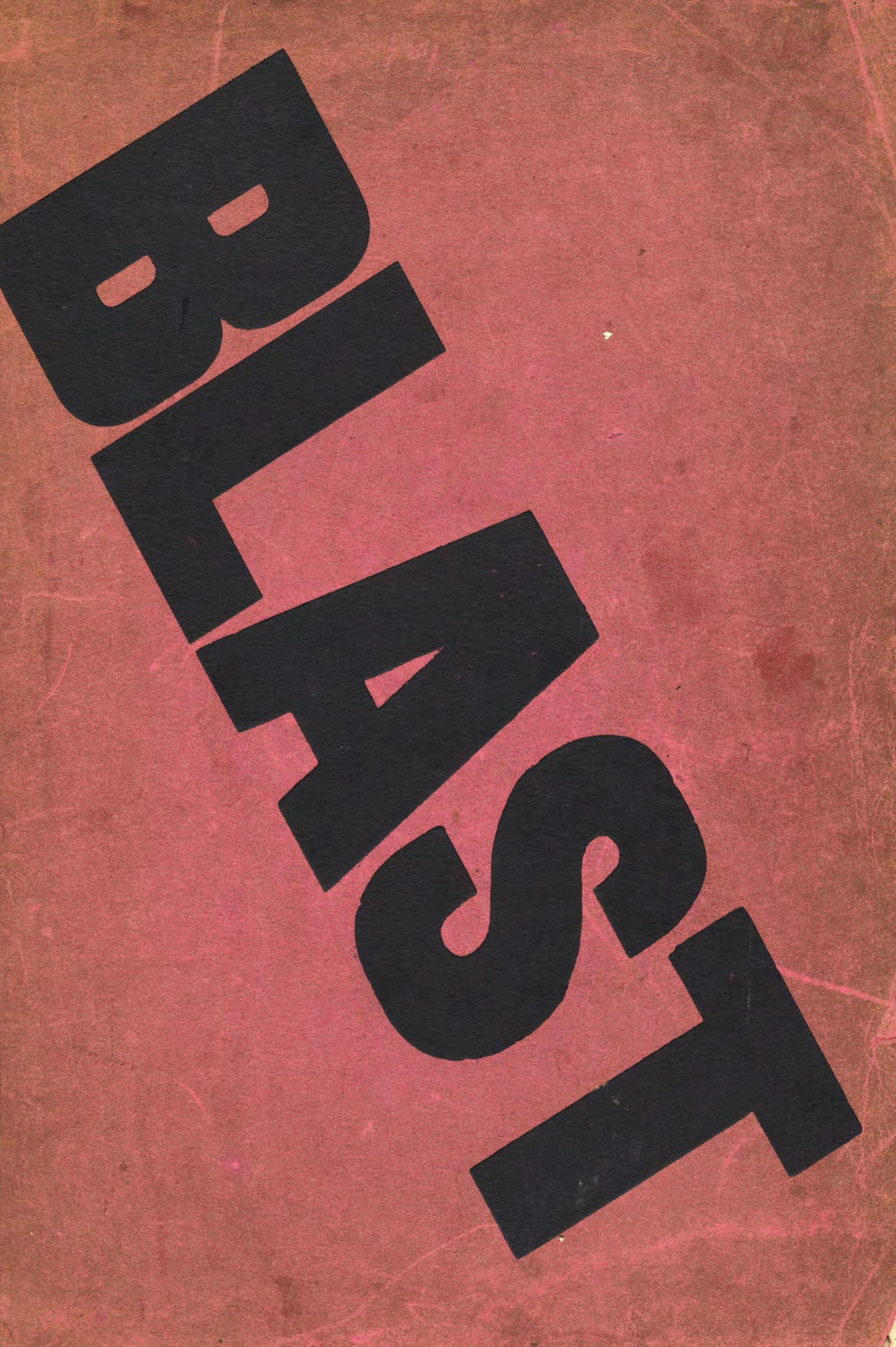
Image context: the lead image is a real archival scan of the 1914 BLAST No. 1 cover, not a diagram or generated visual. It belongs here because the article's argument turns on the page itself: Vorticism made typography, color, scale, and verbal attack part of the same visual program as painting and sculpture.[3][5]
The movement needed a page as much as a gallery
The quickest way to misunderstand Vorticism is to look only for a unified painting style. The angular compositions matter, and so do the sculptural forms of Jacob Epstein and Henri Gaudier-Brzeska, but the movement's most famous object is arguably a periodical: BLAST: Review of the Great English Vortex.[3][4] Britannica's summary is useful because it treats BLAST as Vorticism's polemical mouthpiece across two editions, in 1914 and 1915, with Lewis as editor and propagandist.[3]
That timing gives the cover a dangerous charge. The first issue arrived just before war made the European avant-garde's appetite for force look suddenly less abstract. Yet the cover is already a kind of visual blast: magenta field, heavy black type, diagonal thrust, no softness, no ornamental apology. It does not invite the reader into a tasteful literary review. It stages an impact.
The material facts support that reading. Whitworth's digitized record preserves the periodical as a 1914 publication from John Lane Company with keywords that bind together periodical, Vorticism, Futurism, manifesto, poetry, and microfilm.[4] In other words, this was never only an art magazine in the narrow sense. It was an operating platform. Reproduction, manifesto, typography, fiction, poetry, and image shared one loud object.
Vorticism defined itself by pressure, not by smooth doctrine
The name came from Ezra Pound's language of the vortex, used to describe the maximum energy he and his colleagues wanted to instill in London's avant-garde.[1][6] That metaphor explains why Vorticism does not look exactly like Futurism, even when it shares the machine-age atmosphere. Futurism loved motion, speed, acceleration, the blur of modern life. Vorticism wanted something more compressed: energy held at a point of maximum tension.
That distinction shows up in the movement's hard surfaces. Nasher describes abstracted figurative style, machine-age forms, vortex energy, diagonal forms, and industrial dynamism; the Guggenheim press kit similarly describes Vorticism as machine-age and vortex-driven while stressing that it absorbed Cubism and Futurism without simply becoming either.[1][6] Nasher's exhibition page expands the frame by naming the artists who made the movement more various than a Lewis-only myth: Epstein, Gaudier-Brzeska, Alvin Langdon Coburn, Lewis, William Roberts, Helen Saunders, Dorothy Shakespear, Edward Wadsworth, and others.[2] The list matters because Vorticism was not just one polemicist's pose. It was a network of artists testing how modern forms could become harder, more abstracted, and more public.
Still, the movement did not have the calm coherence of a school with a settled curriculum. Its force came from argument. The Guggenheim press kit calls Lewis the self-proclaimed leader of the movement and places the radical journal BLAST at the moment when the circle of painters, sculptors, and writers was publicly baptized as Vorticist.[6] That origin is important because Vorticism defined itself against nearby alternatives as much as against the past. It rejected decorative softness, Edwardian good manners, and anything it read as passive. The style wanted edges because the social posture wanted edges too.
BLAST turned design into a fighting method
The first issue of BLAST carried that posture into print. Britannica notes the first of two numbers announced the new movement through a manifesto attacking Victorian values, with contributors including Pound, Epstein, and Gaudier-Brzeska.[3] The Guggenheim press kit adds the broader composition of the circle: painters, sculptors, and writers working in the new style.[6] The names are not incidental. They show Vorticism as a coalition of visual art, poetry, prose, sculpture, criticism, and provocation.
That coalition is why the magazine page matters aesthetically. In a calmer publication, typography is infrastructure. In BLAST, typography becomes behavior. The cover's diagonals do not decorate the manifesto; they perform it before the words begin. The huge black letters make reading physical. The pink ground is not polite color but a signal field. The page announces that art can enter modernity by changing its channels of address, not only by changing its subjects.
The inside reinforces the same logic. Whitworth's full-text scan lets the magazine serve two jobs at once: it circulates the movement's writing and preserves its printed form as a designed event.[4] Vorticism's gallery life was fragile, but its print life was portable. A reader could hold the movement as a blocky, bright, argumentative object.
The war made the experiment brief, but not minor
Vorticism's institutional life was almost painfully compressed. The Guggenheim press kit tracks the movement's central exhibitions through the 1915 Dore Gallery show in London, the January 1917 Penguin Club exhibition in New York, and the February 1917 Camera Club exhibition of Vortographs in London.[6] Nasher's exhibition summary makes the same point from a later curatorial angle: Vorticism was a short-lived but pivotal modernist movement during World War I, and the 2010-2011 traveling exhibition had to reintroduce rare works from a movement that never enjoyed the long public consolidation of Cubism or Futurism.[2]
That belated reintroduction is part of the story. Vorticism often looks like a footnote because its archive is small, its timeline jagged, and its most dramatic object is a magazine rather than one universally known masterpiece. But those limits are exactly why it remains useful. It shows modernism acting before it has stabilized into museum sequence. It shows artists using print as force, manifesto as design, and design as a kind of public painting.
The movement's strongest lesson is not that every angular machine-age form was new or that every polemic aged well. It is that form can become an argument about how culture should address the present. In Vorticism, the painting, sculpture, manifesto, and magazine page all lean toward the same demand: stop smoothing over modernity. Concentrate it. Give it edges. Make the page hit first.[1][2][3][4][5]
Sources
- Nasher Museum of Art at Duke University, "The Vorticists" exhibition mini-site - overview of Vorticism's London emergence, Cubist and Futurist context, machine-age forms, vortex imagery, diagonal abstraction, and industrial dynamism.
- Nasher Museum of Art at Duke University, "The Vorticists: Rebel Artists in London and New York, 1914-18" - exhibition page on Vorticism as a short-lived Anglo-American modernist movement and on the artists included in the 2010-2011 survey.
- Encyclopaedia Britannica, "Blast: Review of the Great English Vortex" - reference entry summarizing BLAST as Vorticism's typographically arresting polemical mouthpiece across two editions in 1914 and 1915.
- Whitworth University Digital Commons, "BLAST, Vol. 1" - digitized 1914 periodical record for BLAST, edited by Wyndham Lewis and Edward Wadsworth and published by John Lane Company.
- Wikimedia Commons, "File:Blast magazine, Number 1 cover.jpg" - archival cover scan used as this article's image, with date, source, author, dimensions, and file metadata.
- Peggy Guggenheim Collection, "The Vorticists: Rebel Artists in London and New York, 1914-1918" press kit - institutional PDF on the exhibition, Vorticism's 1913-1918 span, Pound's vortex term, Lewis's founding of BLAST, and the Dore Gallery, Penguin Club, and Camera Club exhibition sequence.