Gertrude Kasebier's photographs are easy to soften into nostalgia. Mothers lean toward children. Women sit in patterned rooms. Faces emerge from dark grounds with a finish that seems closer to charcoal, etching, or memory than to the mechanical sharpness people often expect from photography. That is the first trap. Kasebier did not make domesticity harmless. She made it charged.
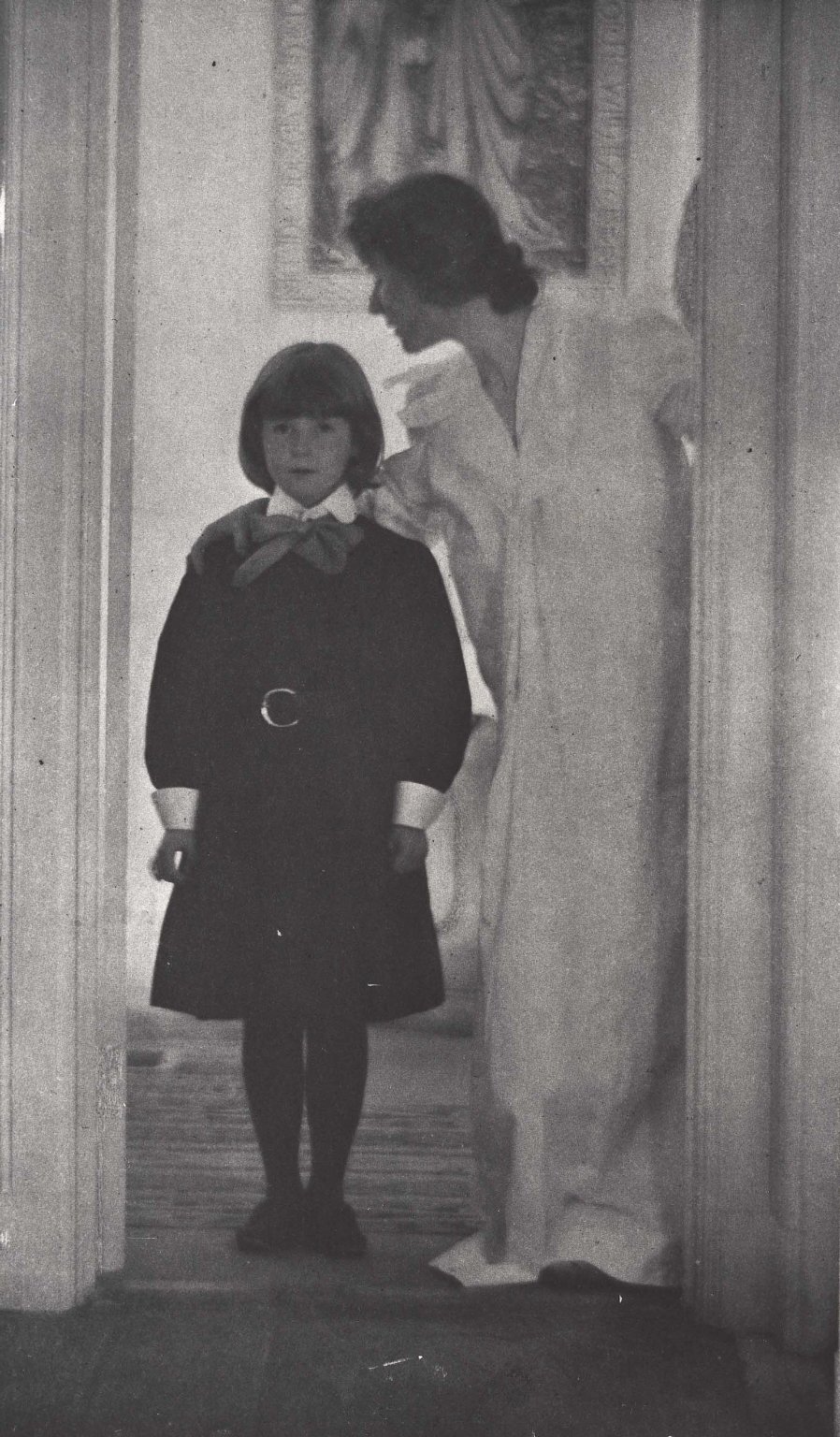
The best place to see that charge is Blessed Art Thou Among Women, made in 1899. The Brooklyn Museum identifies the work as a photogravure showing Agnes Rand Lee and her daughter Peggy, with the child standing at the threshold of a well-appointed home while the mother, dressed in white, leans toward her as if sending her outward.[1] The Metropolitan Museum's print of the same image adds the crucial publication history: Alfred Stieglitz printed it in Camera Notes in July 1900, then again in the first issue of Camera Work in January 1903, an issue devoted to Kasebier's work.[2]
That sequence matters. The picture is not only a sentimental mother-and-child scene. It is a public argument made through a private room. Kasebier takes a subject that Victorian culture had already loaded with moral expectation and turns it into a professional, exhibitable, reproducible art image. The mother does not simply keep the child inside domestic safety. The mother stands at the edge of release.
Image context: this post uses one real archival photographic image, the 1899 photogravure of Blessed Art Thou Among Women from the Brooklyn Museum/Wikimedia file page. It is not a generated visual, chart, or diagram. It belongs here because Kasebier's art is in the photograph's exact staging: the doorway, the softened tones, the biblical reference on the wall, and the child's dark figure facing the world beyond the room.[1][6]
A Late Start That Became Leverage
Kasebier did not enter photography as a young prodigy. The International Center of Photography notes that she married, raised three children, and only then committed herself to art, enrolling at Pratt Institute in 1889 and turning decisively toward photography by 1893.[3] Britannica gives the same broad arc: after family life, she studied at Pratt from 1889 to 1896, then opened her New York studio in 1897.[5]
That timing shaped her authority. Kasebier was not looking at motherhood from the outside as a convenient theme. She was working from inside the social structure that made motherhood both intimate experience and public script. Her domestic photographs matter because they know the script too well to accept it lazily.
In Blessed Art Thou Among Women, the room is carefully coded. The title echoes Marian blessing; the Brooklyn Museum notes that the title and the wall image behind the figures refer to biblical moments of motherhood, including the Annunciation and Visitation.[1] The Met similarly reads the print through Victorian ideals of motherhood and femininity, reinforced by the biblical title and Annunciation image, while also linking the domestic mood to the Arts and Crafts movement.[2] Those references could have produced a closed icon of maternal virtue. Kasebier makes something more unstable.
The child is not nestled in the mother's lap. She stands apart, dressed darker, upright, frontal, and near the door. The mother bends toward her from the side, but she does not absorb her. The photograph's drama sits in that interval. We are seeing relation rather than possession.
Soft Focus Was Not Weak Focus
Kasebier belonged to the pictorialist argument for photography as fine art, but the word "pictorialist" can mislead when it is treated as a synonym for decorative blur. The Met's essay on Pictorialism in America describes a generation of photographers resisting the casual Kodak snapshot by using labor-intensive processes, platinum prints, gum bichromate, and tonal manipulation to demonstrate that photographs could carry craft, intention, and expressive meaning.[4] Kasebier was one of the Photo-Secession members named in that story.[4]
Her softness therefore works as pressure, not evasion. In the Brooklyn Museum's description, the soft-focus technique helps turn domesticity and motherhood into a symbolic image.[1] That is exactly right, but the symbolism does not float away from the room. It deepens the room. The doorway becomes less like architecture and more like a moral hinge. The mother's pale gown becomes almost luminous, but not merely angelic. It marks one side of the threshold, the older language of sanctified motherhood. The daughter's darker dress marks another, more practical and worldly.
The Cleveland Museum of Art's reading makes this future-facing tension explicit: the mother's loose gown evokes domestic history, while the girl's spare clothing and practical hair suggest a path toward maturity and independence in a moment when more women were beginning to work outside the home.[7] That interpretation keeps the photograph from collapsing into a simple Victorian ideal. Kasebier is not only praising the home. She is staging the point where the home prepares someone to leave it.
That staging also clarifies why her art was persuasive in the Photo-Secession context. Stieglitz could use Kasebier's work to argue that photography had tonal beauty, compositional control, and emotional seriousness.[2][4] But Kasebier's image carried an additional claim: the subjects assigned to women were not minor by default. Motherhood, girlhood, domestic interiors, and female relation could bear the full weight of artistic experiment.
Professional Independence Inside a Domestic Image
There is a useful contradiction at the center of Kasebier's career. She became famous for images of women and domestic scenes, but she also built a professional life that complicated the passive domestic ideal those subjects might seem to support. ICP describes her as a highly visible Photo-Secession member whose work appeared in most of its exhibitions between 1903 and 1909, then as someone who resigned in 1912 and continued supporting pictorialism through international exhibitions and the Pictorial Photographers of America.[3] Britannica adds that she helped found the Women's Federation of the Photographers' Association of America in 1910.[5]
The point is not to turn every mother-and-child photograph into autobiography. It is to understand the stakes of representation. Kasebier made pictures that could satisfy viewers looking for tenderness, but her own career was built on training, studio practice, publication, exhibition, organizations, and market value. Britannica notes that her photograph The Manger sold for $100 at the 1899 Philadelphia Photographic Salon, setting a new precedent in the photography art market.[5] That commercial and artistic success is part of the same world as Blessed Art Thou Among Women.
The photograph's threshold, then, can be read doubly. Inside the picture, a daughter stands at the edge of the home. Outside the picture, Kasebier is pushing photography itself across a threshold: from amateur pastime toward fine art, from private female subject matter toward public exhibition, from sentimental content toward professional authorship.
Why The Picture Still Holds
What makes Blessed Art Thou Among Women last is not that it resolves the tensions around motherhood, femininity, art, and independence. It holds them in one small vertical frame. The child faces forward but does not yet depart. The mother leans in but does not close the scene. The biblical reference sanctifies the image, but the doorway secularizes it by making the next step practical. The soft focus warms the room, but the composition keeps the figures separated by a line of passage.[1][2][7]
Kasebier's achievement is to make the domestic interior behave like a decision point. She does not reject pictorialist beauty; she uses it. She does not reject symbolism; she tightens it around a real social transition. She does not abandon motherhood as a subject; she makes it spacious enough to include ambition, instruction, release, and professional art-making.
That is why Kasebier deserves to be remembered as more than a gentle pictorialist. She understood that a photograph of a mother and child could be beautiful and still intellectually sharp. In Blessed Art Thou Among Women, motherhood is not a retreat from modernity. It is the doorway through which modernity enters the room.
Sources
- Brooklyn Museum, Blessed Art Thou Among Women - object page for the 1899 photogravure, including models Agnes Rand Lee and Peggy Lee, soft-focus description, biblical references, medium, dimensions, and accession data.
- The Metropolitan Museum of Art, Blessed Art Thou Among Women - collection record for Kasebier's 1899 platinum print, with notes on F. Holland Day, Agnes and Peggy Lee, Annunciation imagery, Camera Notes, Camera Work, and the 1906 Photo-Secession exhibition.
- International Center of Photography, "Gertrude Kasebier" - artist biography covering Pratt training, studio opening, exhibitions, Photo-Secession visibility, 1912 resignation, and later pictorialist advocacy.
- Lisa Hostetler, "Pictorialism in America," The Metropolitan Museum of Art, Heilbrunn Timeline of Art History - context on pictorialist craft, labor-intensive processes, Photo-Secession, Camera Work, and photography's fine-art claim.
- Encyclopaedia Britannica, "Gertrude Kasebier" - biographical overview covering Kasebier's family life, Pratt study, New York studio, The Manger sale, Camera Work, Photo-Secession, and women's photography organizations.
- Wikimedia Commons, "File:Gertrude Kasebier Blessed Art Thou Among Women 1899.jpg" - source page for the Brooklyn Museum photogravure image used as this article's cover.
- Cleveland Museum of Art, Blessed Art Thou Among Women - collection page emphasizing the contrast between the mother's domestic gown and the girl's practical attire as a sign of maturity, independence, and changing possibilities for women around 1899.