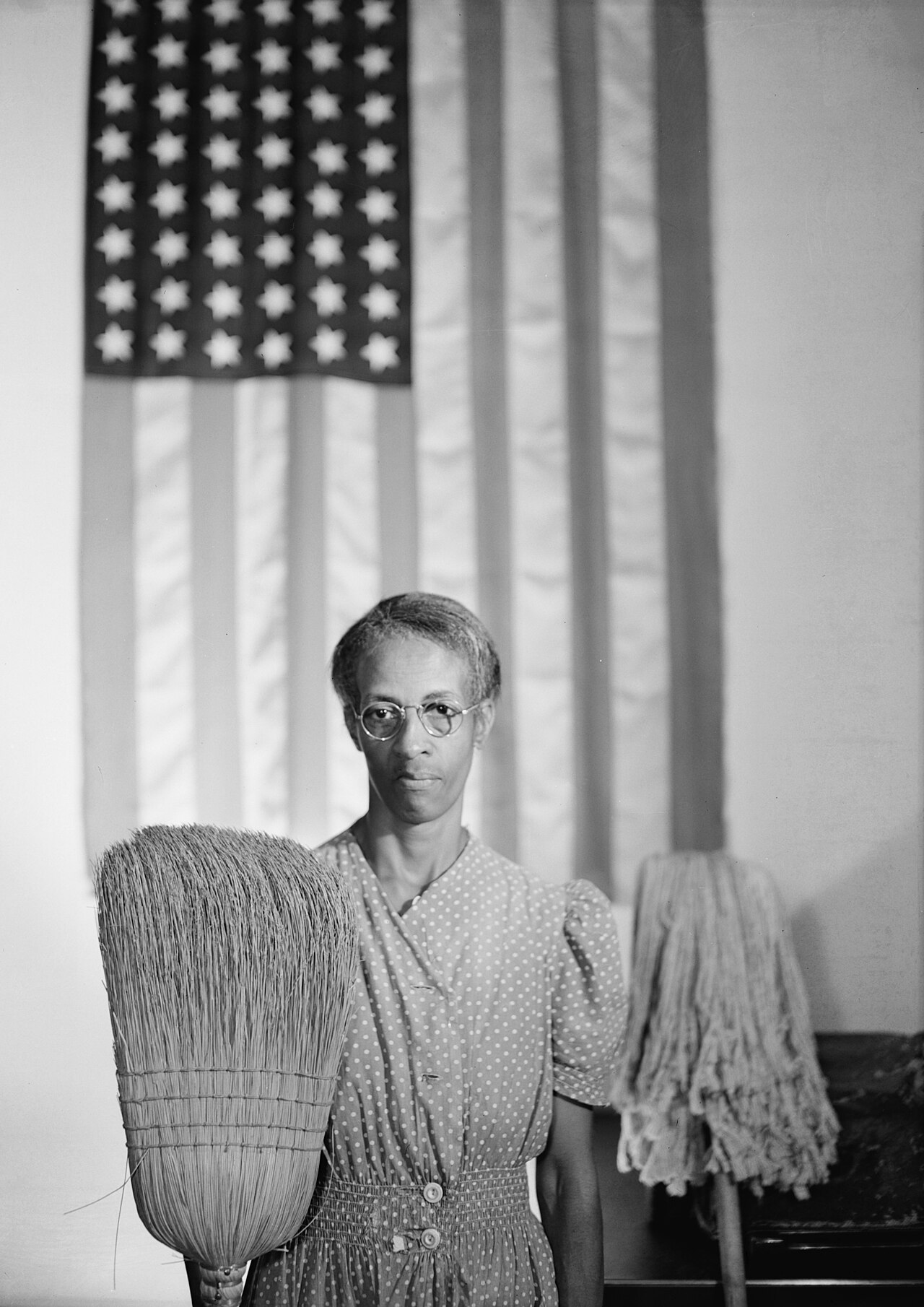
Gordon Parks's 1942 portrait of Ella Watson is often introduced through its famous borrowed title, American Gothic. That title matters, but it can also make the photograph sound like a clever remake before we have really looked at it. The image is sharper than parody. Parks places Watson in front of a large American flag with a broom and mop held upright at either side, then lets the photograph ask a harder question: what does national symbolism mean when the person standing inside it is a Black federal cleaning worker in segregated Washington?[1][2]
The answer is not delivered as a slogan. Watson does not perform anguish for the camera. She stands almost rigidly, glasses catching light, face turned slightly away, mouth closed, hands working the handles of the tools rather than presenting them theatrically. The flag behind her is huge, but not triumphant. Its stripes become a backdrop that cannot absorb the facts in front of it: labor, race, gender, state power, and a body asked to clean the rooms of a government that has not made equality ordinary.[1][3]
Image context: the lead image is a real archival photographic reproduction from the Library of Congress/Farm Security Administration-Office of War Information orbit, not a diagram, chart, or generated visual. It belongs here because Parks's argument is visual before it is verbal: Watson, the flag, the broom, and the mop have to be seen in one frame for the pressure of the work to register.[1][5]
The flag is not background
The flag in Parks's photograph is easy to name and hard to settle. In a patriotic portrait, it might offer authority, belonging, or public honor. Here it does those things only under strain. The Gordon Parks Foundation's publication page places the portrait in relation to Grant Wood's 1930 painting, but the substitution is more than a compositional joke: the white rural couple of Wood's painting gives way to a Black woman whose work is literally maintenance work inside the federal state.[1]
That shift changes the flag's role. It no longer sits behind a figure who can be comfortably absorbed into a myth of national steadiness. It becomes evidence. Watson is not outside America looking in. She is inside a federal workplace, inside the capital city, inside the image's patriotic field. The photograph's force comes from that inclusion. Parks does not need to remove the flag or tear it down. He makes it share space with the inequality it usually tries to cover.
Princeton's object record is useful here because it identifies the pose and props plainly: Watson stands before the American flag with a broom and mop in her hands, echoing Wood's painting while turning the scene toward the realities of race, labor, and fortitude.[3] The photograph's critique depends on that plainness. The flag is recognizable. The cleaning tools are recognizable. Watson's stance is recognizable. The tension comes from putting them together without giving the viewer a comfortable hierarchy among them.
The tools make labor vertical
The broom and mop are not incidental props. They rise like two hard verticals around Watson's body, replacing Wood's pitchfork with tools of cleaning labor. That substitution is visually exact and socially brutal. The pitchfork in Wood's painting has often been read as an emblem of rural work, protection, and stiffness. Parks's broom and mop carry a different social weight. They point to repetitive, low-status labor that keeps institutions presentable while remaining easy for those institutions to ignore.[1][3]
Parks does not sentimentalize the tools. They are not softened into domestic charm, and they are not exaggerated into caricature. Their handles are severe. Their heads sit near Watson's shoulders like blunt facts. The tools nearly frame her as an official emblem, but the emblem refuses to become clean. It carries the abrasion of job title, wage, race, and public invisibility.
That is why the photograph does not work only as a single iconic portrait. It also belongs to a series. The Gordon Parks Foundation describes the wider 1942 Washington, D.C., and Ella Watson group as moving through Watson's family life, home, church, and city surroundings, with the famous flag portrait as the culmination.[2] The series matters because it prevents the icon from flattening Watson into one symbol. Parks followed a life, not merely a pose. The portrait condenses that life into one frame, but the frame points outward toward family responsibility, Black community, faith, and the daily negotiation of segregated space.[2][4]
Watson's expression refuses easy consumption
The photograph would be weaker if Watson's face delivered only one readable emotion. Parks gives us something more guarded. She looks steady, tired, watchful, and self-contained without becoming any one of those things completely. That restraint changes the ethics of the image. Watson is not presented as a passive example of suffering. She meets the frame with composure.
The Gordon Parks Foundation's 2024 exhibition page places Parks several months into a fellowship in Washington, working with the Farm Security Administration's Historical Section, and stresses that the Watson photographs grew from an extensive collaboration rather than a single setup.[4] That context helps explain the portrait's balance. Parks is making a strong public image, but he is not reducing Watson to a poster function. The famous picture gains force because it is linked to a larger act of attention. Parks photographed her world long enough for the flag portrait to feel like a conclusion rather than a stunt.[1][2][4]
Watson's expression also keeps the viewer from escaping into admiration too quickly. It is easy to say that the photograph shows dignity. It does, but dignity alone is too polite a word for what is happening. Dignity can become a way of praising the subject while leaving the conditions around her untouched. Parks makes that evasion difficult. Watson's composure is visible, but so is the system that demands such composure from her.
A federal picture against federal innocence
The historical setting gives the photograph its bite. Parks arrived in Washington in 1942 in connection with the Farm Security Administration, and the Princeton record identifies Watson as working in the building of that New Deal agency.[3] The image is therefore not a detached street observation. It is made inside the visual culture of federal documentary photography, by a photographer learning how the government's own image apparatus could reveal the exclusions of the government itself.[1][4]
That double position is what makes the photograph so durable. A lesser image might simply accuse America from outside its symbols. Parks does something more exacting. He makes the American flag bear witness against a narrower American self-image. The photograph says: here is the promise, here is the worker, here are the tools, here is the capital, here is the contradiction. None can be cropped away without weakening the truth.
The borrowed title also deepens the work rather than exhausting it. Grant Wood's American Gothic had already become a picture of national type and staged rural identity. Parks takes that format and changes its moral temperature. In Wood, the pose can hover between reverence, satire, stiffness, and theatrical regional identity. In Parks, the pose becomes an indictment because the national type has been recast through racialized labor in wartime Washington.[1][3]
Why the image still holds
The photograph lasts because it never settles into a single label: documentary, portrait, protest image, art-historical reply, federal record. It is all of those, but its power comes from keeping them in tension. The composition is clear enough to become iconic, yet the person in the frame resists being simplified by the icon.
Parks's strongest visual decision is not the reference to Wood, though that is the hook. It is the refusal to let any element become innocent. The flag is not innocent. The broom and mop are not neutral. The federal building is not just a workplace. Watson's composure is not decorative resilience. The camera is not merely recording. Each part presses on the others until the image becomes a compact argument about who is asked to maintain a nation and who is allowed to feel represented by it.[1][2][3][4][5]
That is why the portrait still feels alive. Parks did not make Ella Watson stand before the flag so the symbol could rescue the scene. He made her stand there so the flag would have to answer to her.
Sources
- The Gordon Parks Foundation, "American Gothic: Gordon Parks and Ella Watson" - publication page on the 1942 portrait, Parks's Washington fellowship, the flag/broom/mop composition, and the broader Ella Watson project.
- The Gordon Parks Foundation, "Washington, D.C. and Ella Watson, 1942" - archive page on the broader Watson series, including home, church, city, and the culminating flag portrait.
- Princeton University Art Museum, "American Gothic, Washington, D.C." - object record with title, date, medium, dimensions, Watson's FSA workplace context, and description of the flag, broom, and mop composition.
- The Gordon Parks Foundation Gallery, "American Gothic: Gordon Parks and Ella Watson" - 2024 exhibition page on the Watson collaboration, Parks's FSA fellowship, Watson's religious community, and the series as a multidimensional portrait.
- Wikimedia Commons, "File:Gordon Parks - American Gothic.jpg" - source page for the article image, linking the Library of Congress digital ID and identifying the August 1942 photograph of Ella Watson.