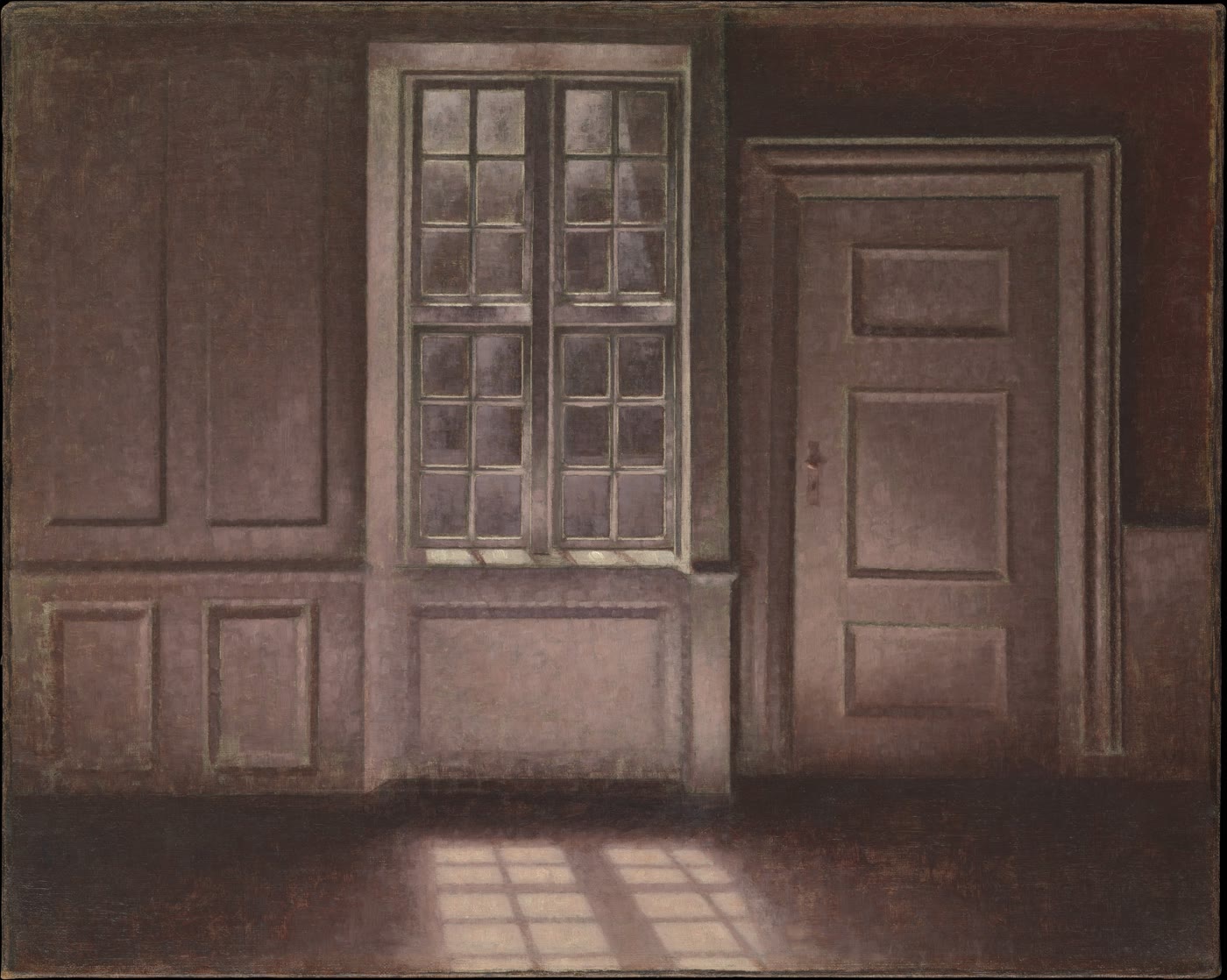
Vilhelm Hammershoi is usually introduced as a painter of silence, and the phrase is accurate as far as it goes. The Met's page for Moonlight, Strandgade 30 notes the reputation directly, describing him as the "Poet of Light - of Quietude - of the Home."[1] But that label can make the work sound softer than it is. Hammershoi is not interesting because he found quiet subjects. He is interesting because he built a pictorial system in which quiet behaves like pressure. Doors open and do not resolve. Windows admit light but hold back event. Figures, when they appear, arrive with their backs turned or absorbed in some minor task, as if narrative had been thinned down to its supporting structure.[1][2][3]
That is why the paintings still feel unnervingly modern. They do not charm the viewer with domestic coziness. They convert ordinary Copenhagen rooms into instruments of delay. The apartment becomes less a setting than a device for controlling distance, access, and timing.[1][2]
Image context: this article uses the painting itself rather than a portrait photograph because the argument depends on Hammershoi's room grammar. The window, the doorway, the pale floor reflection, and the low-contrast wall are the profile's real evidence base.[1]
Quiet is architectural, not atmospheric
Moonlight, Strandgade 30 is the cleanest entry point because almost nothing "happens" in it.[1] Yet the painting does not read as empty. It reads as organized withholding. A window anchors one side, a door or doorway implies a passage beyond, and the floor catches enough light to make the room feel inhabited by an event that has already retreated. The painting's force comes from how little descriptive information Hammershoi needs in order to make the room psychologically active.[1][2]
This is the first correction an artist profile of Hammershoi needs. The subject is not just muted light. The subject is threshold management. He paints rooms that are always partly available and partly withheld. Their geometry stays plain, but their access never becomes simple. Even before a person enters, the space has already become dramatic.
That point becomes clearer when you look across the Strandgade works in the Vilhelm Hammershoi Digital Archive. The repeated title itself matters: Interior. Strandgade 30 is not one isolated mood piece but part of a sustained return to the same apartment, the same wall systems, the same doors, windows, and floor planes.[2] Hammershoi did not need novelty of location. He needed a stable chamber in which tiny shifts of angle, season, and light could produce a different emotional voltage.
The room stays central even when a figure appears
The common shorthand says that Hammershoi painted empty interiors, but that is only half right. He also painted people inside them, especially Ida Hammershoi, and those pictures clarify his priorities. ViHDA's Interior. Ida Hammershoi at a Sewing Table tells you a lot before the description begins.[3] The title names a person, yet the structure still starts with "Interior." Ida is there, but the room remains grammatically first.
That ordering is not trivial. In Hammershoi, a seated woman sewing is rarely there to open up anecdote or character psychology in the usual nineteenth-century way. She stabilizes scale, interrupts emptiness, and gives the room one more measured rhythm. Attention moves between chair, table, wall, doorway, and body without letting any single part claim the entire scene.[3] The figure does not cancel the hush. She makes it legible.
This is one reason the back-turned or task-absorbed figure matters so much in his work. Such a figure does not return the viewer's gaze and therefore does not settle the room into social exchange. Instead, she deepens the sense that looking in these paintings is slightly asymmetrical. We are present in the room's logic, but not admitted to a full encounter.
Hammershoi manufactured quiet through materials
The second correction an artist profile needs is material. The hush in these paintings is not an abstract spiritual atmosphere floating above technique. ViHDA's technical pages show how constructed it is. On Interior. Strandgade 30, the brushstroke direction generally follows the room's main vertical and horizontal lines; the canvas texture remains perceptible throughout; and the picture is unvarnished.[2] Those are not minor conservation notes. They help explain why the room feels dry, matte, and exact rather than lush or absorbingly tactile.
The same archive page on Interior. With the Artist's Easel sharpens the point further. ViHDA identifies an industrial canvas with an even weave, notes that Hammershoi typically worked on white industrially primed canvases, and describes paint handling that proceeds largely from dark to light while leaving the canvas texture visible across the picture.[4] In other words, the famous quiet is not just a poetic aura readers bring to the work. It is a low-gloss surface regime.
This matters because Hammershoi is often misread as a painter of temperamental inwardness alone, as if the rooms simply emitted melancholy by nature. The technical record says otherwise. He engineered that effect through supports, ground, brush direction, and the decision not to saturate the surface with varnish.[2][4] The stillness has craft behind it.
ViHDA itself is useful here for another reason. Its Open Access framing is built around reusable technical metadata as well as finished images, which means Hammershoi's paintings can be read not only as moods but as worked objects.[5] That is unusually valuable for an artist whose reputation has so often drifted toward adjectives like "silent," "mysterious," or "haunted." The archive keeps pulling the discussion back toward decisions.
Why he matters now
Hammershoi's importance in 2026 is not that he offers a soothing antidote to noisy media. That reading makes him decorative. His rooms are stronger than that. They teach that subtraction can intensify attention rather than reduce it. By stripping away anecdote, he forces the viewer to register how much psychological weight can be carried by a doorframe, a patch of reflected light, or the distance between a seated figure and the far wall.[1][2][3]
That is why the paintings hold up under repeated viewing. They are not generic minimalism before the fact. They are highly tuned arrangements of access and refusal. The room keeps offering itself, then stopping one step short of full disclosure.
A practical viewing drill
If you have ninety seconds with a Hammershoi interior, use them in this order:
- Find the threshold first: door, doorway, or window.
- Track where light lands on floor, wall, or paneling.
- Notice whether the figure returns your gaze or remains occupied.
- Move closer and check how matte the surface feels.
By the end of that sequence, the work usually stops looking merely quiet. It starts looking precise. That precision is Hammershoi's signature achievement: he made ordinary rooms behave like instruments of thought.[1][2][4]
Sources
- The Metropolitan Museum of Art, "Moonlight, Strandgade 30" (object page with artist overview and work description).
- SMK, The Vilhelm Hammershoi Digital Archive, "Interior. Strandgade 30" (object and technical examination page).
- SMK, The Vilhelm Hammershoi Digital Archive, "Interior. Ida Hammershoi at a Sewing Table."
- SMK, The Vilhelm Hammershoi Digital Archive, "Interior. With the Artist's Easel" (object and technical examination page).
- SMK, The Vilhelm Hammershoi Digital Archive, "Use this data" (Open Access and technical-metadata policy page).