Élisabeth Vigée Le Brun is often introduced with one flattering shortcut: the favorite portraitist of Marie Antoinette. That is true, but it is too small. Her real achievement was building a portable career architecture in a period when institutions, regimes, and patron networks were all unstable.
Read as an artist profile, her work is not just a sequence of elegant faces. It is a system for converting social risk into visual authority.
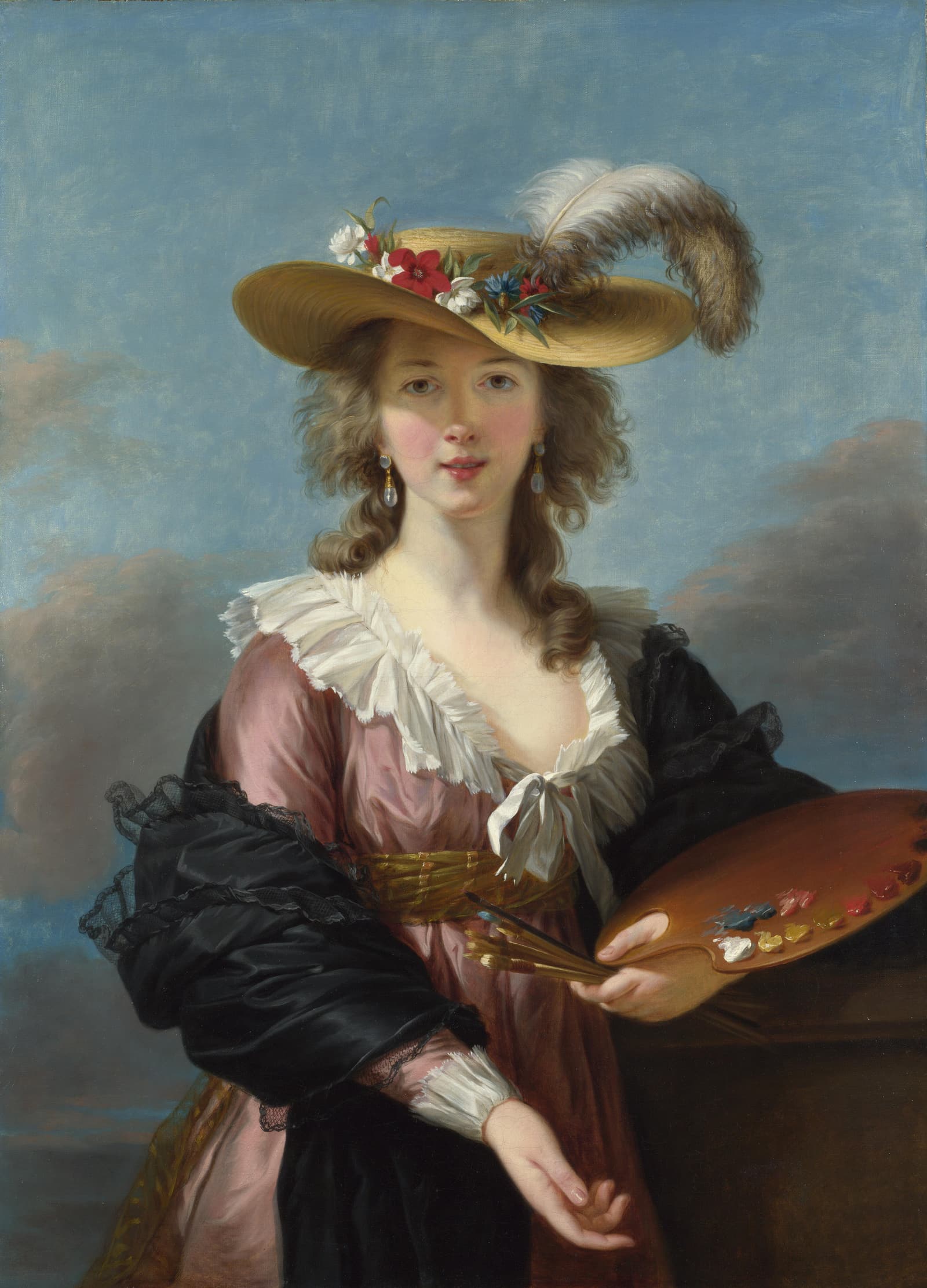
Image context: The cover image, Self-Portrait in a Straw Hat (1782), is core evidence here—palette and brush in view are part of how Vigée Le Brun stages authorship, not decorative detail.
The first engine: technical fluency plus social reading
The biographical scaffolding is familiar: born in Paris in 1755, trained early through her father’s studio environment, then pushed into professional work as a teenager.[1][2][5] What matters is not only precocity. It is that she learned portraiture as a negotiation medium.
In the late Ancien Régime, portraits did political and social labor at once. They had to flatter, rank, reassure, and circulate. Vigée Le Brun became unusually effective at this because she could combine finish with psychological tact. The Met’s framing of her as a painter with exceptional sympathy for sitters is not soft praise; it helps explain why elite clients kept returning.[2][3]
That soft power had hard output. She exhibited heavily at the Salons of the 1780s and reached top-tier visibility before the Revolution disrupted the court system.[2]
Access was won twice: first at court, then inside institutions
Her 1778 summons to Versailles for a state portrait of Marie Antoinette shifted her career from successful Paris portraitist to court-adjacent image specialist.[2][5] But court access alone was not enough. She also needed institutional legitimacy.
In 1783, despite structural barriers tied to gender and to her husband’s role as an art dealer, she entered the Académie Royale de Peinture et de Sculpture, with documented royal intervention behind that admission.[2][3][5] Contemporary museum framing repeatedly notes that she became one of only four women members.[3][4]
That combination—court patronage plus academy status—gave her a rare dual platform:
- symbolic legitimacy (official recognition),
- market reach (elite commissions),
- distribution channels (Salon visibility and copy demand).
Seen this way, her career was never merely “talent discovered.” It was an expertly managed position inside overlapping power systems.
Self-portraiture as brand control, not vanity
Vigée Le Brun’s self-portraits are often read as charming self-presentations. The National Gallery’s account of Self Portrait in a Straw Hat points to a deeper design: she deliberately stages herself in dialogue with Rubens while visibly carrying palette and brushes.[6]
That decision solves two problems at once.
First, it claims lineage: she places herself inside a high-art genealogy rather than outside it as a novelty woman painter. Second, it claims professionalism: tools in hand, eye contact direct, she is not only subject but maker.
So the image performs a double conversion:
- from social femininity to authorial authority,
- from likeness painting to intellectual positioning.
This is why the painting still feels modern. It behaves like a controlled public profile shot for a high-skill operator, but built with 18th-century pictorial grammar.
The revolutionary break did not end the system—it internationalized it
After the October 1789 march on Versailles, Vigée Le Brun left France and entered a long exile period that stretched across major European centers.[2][3][5] The obvious reading is survival. The more useful reading is business-model transfer.
Outside France, she kept converting local aristocratic demand into portrait commissions—Rome, Naples, Vienna, St. Petersburg, Berlin, and beyond in different phases.[2][3][7] NMWA’s profile and Met materials converge on the same point: exile did not collapse her output; it widened her geography.[3][7]
In other words, she proved that her method was not court-specific. It was portable across languages of rank.
That portability is a major reason she remains historically significant. Many court artists were tied to one regime. Vigée Le Brun adapted across regimes without losing visual recognizability.
Why this profile still matters
Her long afterlife can be reduced to “famous queen painter,” but that misses the stronger lesson. Vigée Le Brun shows how artistic authority can be engineered through three linked layers:
- craft credibility (technical control),
- institutional insertion (academy and exhibition systems),
- circulation strategy (patrons, replicas, transnational clientele).
By the time she published her memoirs in the 1830s, she had already done something harder than reputation maintenance: she had built a narrative infrastructure around a body of work that crossed political eras.[1][7]
That is why her portraits still read as more than decorative survivals. They are documents of how images travel through power, crisis, and reinvention.
Sources
- Encyclopaedia Britannica, “Elisabeth Vigee-Lebrun | Biography, Paintings, & Facts”
- The Metropolitan Museum of Art, “Élisabeth Louise Vigée Le Brun (1755–1842)” (Timeline of Art History)
- The Metropolitan Museum of Art, “Vigée Le Brun: Woman Artist in Revolutionary France” (2016 exhibition page)
- The Metropolitan Museum of Art, “Madame Grand (Noël Catherine Vorlée, 1761–1835)” (object record)
- Château de Versailles, “Élisabeth Louise Vigée Le Brun” (history profile)
- National Gallery (London), “Self Portrait in a Straw Hat (NG1653)” (work record)
- National Museum of Women in the Arts, “Élisabeth Louise Vigée-LeBrun | Artist Profile”
- Wikimedia Commons, “Self-portrait in a Straw Hat by Elisabeth-Louise Vigée-Lebrun.jpg” (source metadata for cover image)