Most famous paintings promise endurance. The Last Supper offers the opposite contract: it gives extraordinary psychological control, then spends five centuries trying not to fall apart.
That contradiction is not accidental damage layered onto a stable masterpiece. It starts in Leonardo’s technical choice. In the refectory of Santa Maria delle Grazie, he did not use standard fresco workflow. He chose a dry-wall approach so he could work slowly, revise, and pursue subtler transitions in gesture, expression, and light.[1][2] The gain was expressive freedom. The cost was adhesion failure almost from the beginning.[2][3]
If you read the painting through medium rather than iconography alone, the piece becomes clearer: this is a high-risk engineering decision that produced a high-reward visual system, and the conservation apparatus around it is now inseparable from the artwork’s meaning.
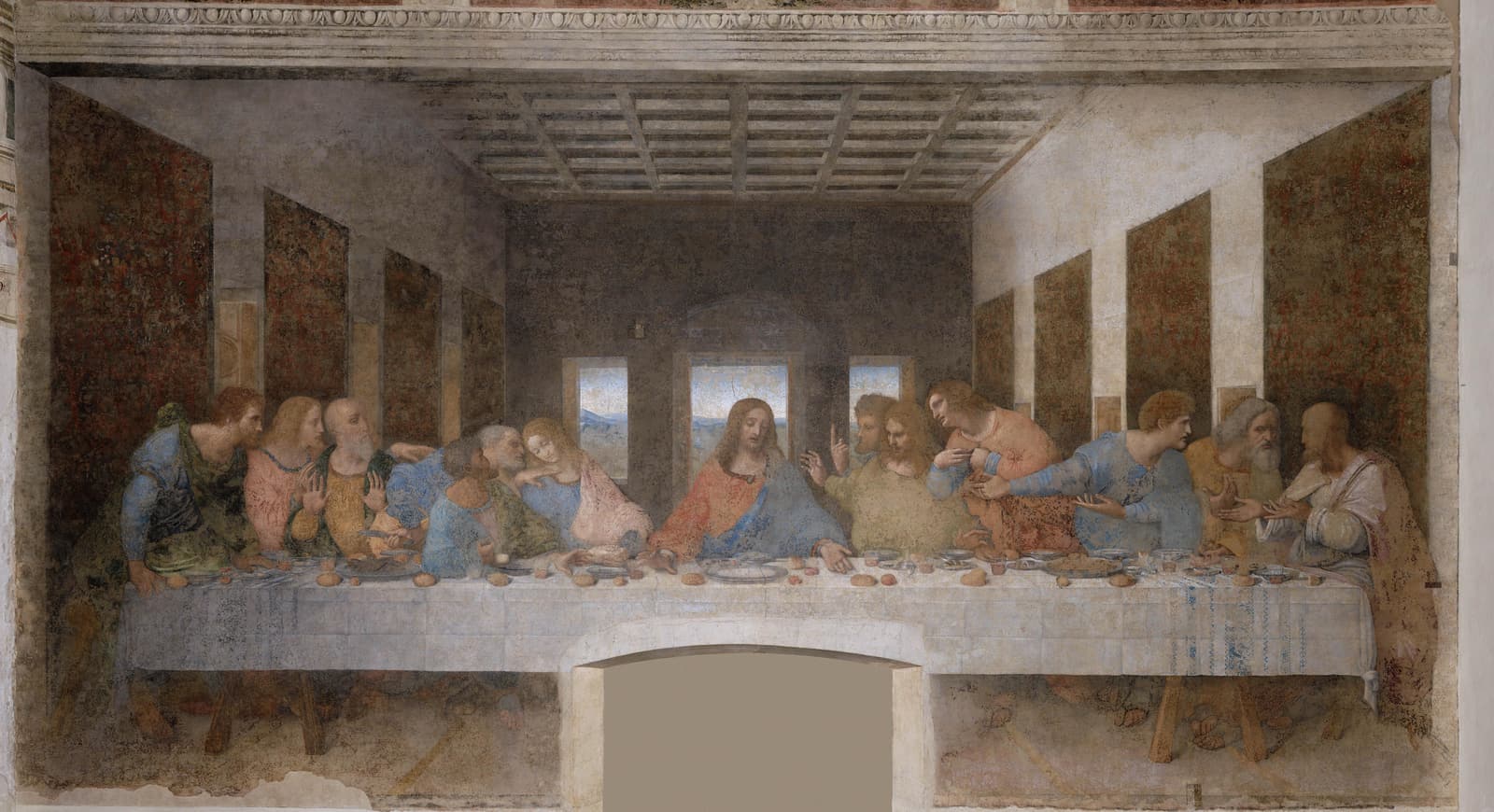
Image context: the cover image is a full-view reproduction of Leonardo’s mural at Santa Maria delle Grazie, included as a visual reference for the wall-scale composition and fragile painted surface discussed below.
The technical gamble: why Leonardo moved off true fresco
True fresco binds pigment into wet plaster and forces fast execution in daily sections. Leonardo wanted the opposite tempo. He needed pause points, revisions, and the ability to model “motions of the soul” across the full wall rather than lock each patch as it dried.[1][3]
The museum’s own technical framing is explicit: he worked on dry preparatory layers, treating the wall more like a painting support than a conventional fresco surface.[2] Britannica similarly summarizes the method as an experimental tempera/oil approach on dry ground rather than stable wet-plaster fresco bonding.[3]
For a work at this scale—about 460 × 880 cm—that choice matters at every level.[1][4]
- It makes subtle facial and hand transitions easier.
- It allows iterative changes in composition and detail.
- It weakens long-term mechanical bond between color layer and wall.
In other words, the visual intelligence viewers admire is structurally linked to the fragility conservators fight.
Precision in perception: what the method buys on the wall
People often read The Last Supper as a perspective miracle or a narrative tableau. Those things are real, but medium clarifies why the room still feels psychologically charged.
The composition organizes apostles in clustered reactions while Christ remains the axial calm point; sources repeatedly note the perspective pull toward Christ and the sequential, not frozen, narrative moment.[3][4] Technical flexibility helps this staging because micro-adjustments in faces, hands, and overlaps are not trapped inside rapid fresco-day boundaries.
This helps explain why the painting feels both structured and volatile:
- Structured in geometric control (long wall, central perspective, grouped bodies).
- Volatile in emotional tempo (interruption, recoil, argument, disbelief).
The medium supports that double condition. Leonardo’s slower, revisable process is part of why each apostolic reaction can sit inside a precise global rhythm rather than read as an assembly of separately solved patches.[1][3]
The failure curve started early
The conservation record is unusually blunt. Degradation was reported within years, not centuries.[2] The museum’s backstage documentation describes pigment loss soon after completion, amplified by environmental stress in the refectory and by later restoration habits that often repainted or overcorrected.[2]
Secondary syntheses repeat the same chain:
- unconventional dry method,
- humidity and pollution stress,
- repeated intervention layers,
- cumulative visual distortion before modern conservation standards.[3][5]
This is not just a story of “old painting gets old.” It is a case where original method set a low tolerance for a difficult site. Britannica’s historical summary adds major shocks—door cutting in the wall in 1652, Napoleonic misuse of the space, flood and mold episodes, and wartime blast damage to the refectory envelope—each one compounding a surface already vulnerable by design.[3]
Why the 1977–1999 restoration changed the viewing contract
The late-20th-century restoration campaign led by Pinin Brambilla Barcilon (completed in 1999) did not “return the original” in a naive sense.[2][5] It reset the terms of legibility: remove many later additions, stabilize what remains attributable to Leonardo, and disclose loss rather than cosmetically hide everything.[3][5]
The result remains debated in tone, but the methodological shift is clear. Earlier eras often treated restoration as re-making missing image zones. Later conservation increasingly prioritized stabilizing surviving material and making intervention boundaries legible.[2][5]
That is why visiting conditions are now part of the artwork’s practical frame:
- timed entry windows (about 15 minutes),
- controlled group size (around 40 people per slot under current museum policy),
- filtered/managed air pathways and environmental monitoring.[1][2]
These are not tourism inconveniences added from outside art history. They are the continuation of the medium problem by institutional means.
Reading the painting after conservation science
A medium-first reading upgrades interpretation in three concrete ways.
1) Fragility is not incidental biography
The conservation crisis is not external bad luck layered onto a stable fresco object. It follows directly from a deliberate technical decision to prioritize expressive control on a dry wall.[2][3]
2) Psychology and material are the same argument
The famous emotional choreography of the apostles is usually discussed as composition and theology. It is also a materials story: the same process that allowed nuanced iteration made permanence harder.[1][3]
3) Preservation protocol is now part of reception
What we see today is mediated by climate control, access limits, and conservation ethics developed after centuries of cumulative damage.[1][2][5] The modern “encounter” with The Last Supper includes those constraints as part of the work’s lived form.
Takeaway
The Last Supper is often presented as a triumph of Renaissance order. Technically, it is closer to a brilliant unstable system: maximum expressive ambition built on a support strategy that could not reliably carry it across centuries without continuous institutional care.
That does not reduce the painting. It explains why it still feels urgent. You are not only seeing Leonardo’s composition; you are seeing a 1490s material experiment still being negotiated in real time.
Sources
- Museo del Cenacolo Vinciano — The Last Supper, Leonardo da Vinci (1452-1519)
- Museo del Cenacolo Vinciano — Backstage (conservation and restoration history)
- Encyclopaedia Britannica — Last Supper | Painting, Milan, History, & Facts
- Museo del Cenacolo Vinciano — History
- Wikipedia — Conservation-restoration of Leonardo da Vinci's The Last Supper
- Wikipedia — The Last Supper (Leonardo)
- Museo del Cenacolo Vinciano — official homepage and visitor policy context
- Wikimedia Commons file record — Leonardo da Vinci - The Last Supper high res.jpg