The triptych survives because it solves an attention problem that never went away.
When art has to hold more than one time-state at once—before/after, promise/fallout, wound/recovery—a single frame often flattens the argument, while a long sequence scatters it. Three panels are a structural middle lane: enough room for tension and change, still compact enough to be read as one thought.
That is why the format keeps resurfacing in very different media worlds. Medieval churches used winged panels to organize ritual time. Modern painters used triptychs to stage psychic collision. Contemporary audiences, trained by swipe sequences and split-screen habits, still read a three-part visual sentence almost immediately.
The original engineering: hinged time, not decorative symmetry
A lot of contemporary writing treats triptychs as a style. Historically, they were closer to interface design.
In late medieval and early modern devotional contexts, hinged multi-panel works were built for controlled reveal: closed state, opened state, feast-day state, ordinary-time state. Meaning depended on sequence and on the relation between outer and inner surfaces, not just on any one panel viewed alone.[1][2]
In that sense, the triptych was never only “three pictures together.” It was a time-based display system before modern exhibition design had that vocabulary.
Why three panels are cognitively sticky
Three panels offer a stable viewing rhythm:
- establish a world,
- destabilize or intensify it,
- force a resolution (or deny one).
That rhythm is visible from Bosch to Bacon, even when the emotional register is completely different.
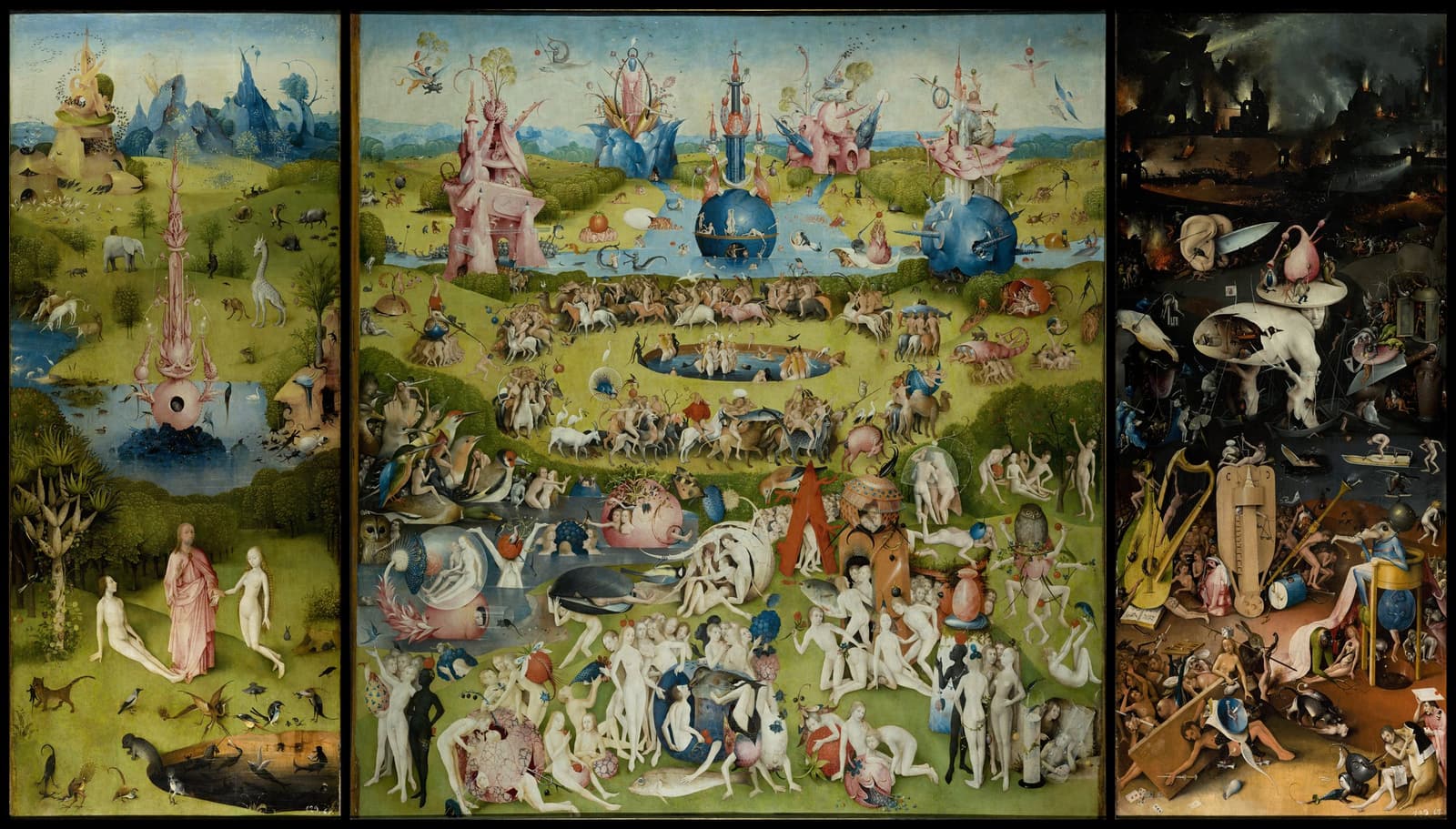
Bosch’s The Garden of Earthly Delights is not memorable because the center panel is crowded; it is memorable because the side panels frame that crowding as a moral and temporal arc.[3][4] The viewer is pulled through an order of reading, not an image dump.
In Francis Bacon’s early triptych format, the effect flips from theological narrative to psychological voltage, but the structural logic still holds: flanking pressure changes how the center image is read, and vice versa.[5][6]
The durable point is not iconography. It is relational reading.
The contemporary return is about sequence pressure
Triptych logic returned strongly in modern and postwar painting because artists needed a way to carry multiple incompatible states without pretending they reconcile smoothly.
A three-panel frame can keep contradiction alive: intimacy beside violence, private memory beside public image, body beside event. Unlike cinematic montage, the panels remain visible at the same time, so comparison is not deferred. The viewer performs the edit in real time.
That simultaneity is exactly why the format maps well onto contemporary visual behavior. We now consume images in lanes—carousels, tiled interfaces, multi-window feeds—yet we still search for a center of gravity. The triptych gives that center while preserving fracture.
Reading triptychs well: four practical cues
If you want to get more from a triptych in a museum, four checks usually outperform label-dependent interpretation:
- Hinge logic: where does the eye move first, and what panel forces the second look?
- Scale asymmetry: is the center dominant, or are side panels stealing narrative authority?
- Color migration: which hues or textures leak across panel borders to imply continuity?
- Narrative temperature: does panel three resolve tension, or harden it?
These cues keep you inside the work’s formal machinery before symbolism takes over.
Why this old form is still current
Triptychs endure because they are efficient containers for complexity. They let artists stage conflict without collapsing into either single-image simplification or endless serial sprawl.
In an era of compressed attention, that efficiency becomes more—not less—valuable. Three panels still do what good interfaces do: they pace the eye, structure comparison, and leave one unresolved charge that follows the viewer out of the room.
Sources
- Wikipedia, “Triptych” (historical form, hinged panel definition, liturgical/altarpiece context)
- The Metropolitan Museum of Art, “The Ghent Altarpiece” (winged altarpiece structure and viewing logic context)
- Wikipedia, “The Garden of Earthly Delights” (triptych structure, sequential reading context, panel framing)
- Wikimedia Commons file page, “The Garden of Earthly Delights by Bosch High Resolution.jpg” (image object history and file provenance)
- Tate collection page, Francis Bacon, Three Studies for Figures at the Base of a Crucifixion (1944)
- Christie’s, “The evolution of Francis Bacon’s triptychs” (format evolution context in Bacon’s practice)
- Christie’s, “What is a triptych?” (cross-period format usage and modern continuity overview)