When people describe the Vienna Secession, they often start with style labels—Art Nouveau curves, gilded surfaces, Klimt ornament. That is not wrong, but it misses what made the movement structurally powerful. Between 1897 and 1905, the Secession did more than produce a recognizable look: it built an operating system for modern art in Vienna, with coordinated infrastructure across exhibition design, publishing, architecture, and applied arts.[1][2][5]
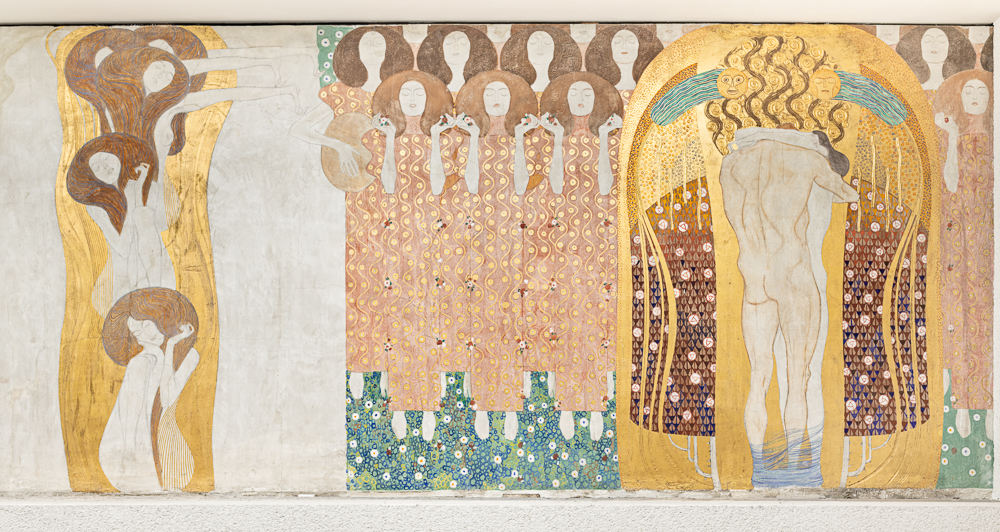
Image note: the lead image shows the right-wall section of Klimt’s Beethoven Frieze (1902), preserved inside the Secession building. It is not decorative filler; it is a record of how the movement treated exhibition space itself as a medium.[3][3]
The core break came in 1897, when Gustav Klimt and other artists left the conservative Künstlerhaus and formed a new association.[2] Their problem was not simply taste. It was institutional. If selection logic, display logic, and public narrative all remained in old hands, “new art” could only appear as occasional exception. The Secession’s answer was to create its own pipeline—from room to page to object.
1) Architecture as program, not backdrop
The Secession Building, completed in 1898 by Joseph Maria Olbrich, is usually read as a famous façade with the gold laurel dome.[1][2] But its strategic value was functional: a dedicated venue for continuously changing exhibitions in which presentation itself could be redesigned show by show.[1][5]
That mattered because modern art was still fighting for viewing conditions, not just for critical approval. A permanent institutional shell gave the group repeatable control over lighting, sequence, wall treatment, and circulation—what we would now call the user experience of interpretation. The famous inscription above the entrance, “To every age its art, to every art its freedom,” was not just rhetoric; it was an operating rule attached to a physical space.[2]
The building also encoded collaboration at the level of detail. Secession sources describe contributions across architecture and ornament (portal sculpture, façade elements, decorative programs), which made the structure itself a manifesto of cross-disciplinary authorship.[1]
2) Exhibition design as a medium
The movement’s second engine was exhibition practice. Secession archival material highlights a rapid sequence of shows in the first years and records that by 1905, 23 exhibitions had already been staged.[5] This pace mattered as much as any single masterpiece: repeated exhibitions created a feedback loop between artists, viewers, and critics.
The XIVth exhibition in 1902 is the clearest case. Organized as a Beethoven homage, it assembled architecture, painting, sculpture, and music discourse into one integrated environment under Josef Hoffmann’s direction, with Max Klinger’s Beethoven statue at the center and Klimt’s Beethoven Frieze installed in relation to that sculptural core.[3] The show drew nearly 60,000 visitors, an extraordinary number for the period.[3]
That attendance figure is not a trivia point. It shows the Secession was solving for scale: modernism was being converted from studio experiment into public event format.
3) Print as distribution infrastructure: Ver Sacrum
Movements survive through circulation, not only through objects. The Secession’s journal Ver Sacrum (1898–1903) functioned as that distribution layer.[6][7] It carried images, criticism, literary contributions, and design experiments in a format that extended the exhibition discourse beyond people physically present in Vienna.
Secession documentation and archive references show how central the journal was: regular publication cadence, substantial design innovation, and editorial work embedded in the movement’s own institutional environment.[6][7] This turned style into reproducible language. Readers could encounter the movement as typography, layout rhythm, and graphic method, not only as wall-bound art.
In other words, Ver Sacrum transformed Secession aesthetics into media literacy.
4) From exhibition experiment to everyday object: the Wiener Werkstätte link
A movement becomes durable when it exits the gallery. In 1903, Josef Hoffmann and Koloman Moser, with Fritz Waerndorfer’s support, co-founded the Wiener Werkstätte, extending Secession principles into furniture, interiors, metalwork, fashion, and daily-use objects.[8] Vienna sources frame this explicitly as a Gesamtkunstwerk ambition: art and craft should reorganize ordinary life, not remain isolated as elite display.[8]
This is why the 1905 rupture inside the Secession should be read as a governance split, not a simple aesthetic quarrel. The central dispute concerned priorities between painting-centered fine art and broader applied-arts integration—an issue already visible in the movement’s institutional experiments.[5] Even after departures, the model had already propagated.
5) Why this movement still feels contemporary
The Vienna Secession still reads as modern because its real innovation resembles today’s cultural platforms:
- Own the venue layer (space and curation rules),
- Own the distribution layer (journal/media channel),
- Own the translation layer (from high art to design objects and daily environments).
Many movements produced a style. Fewer produced a full-stack cultural system. The Secession did both, and that is why it keeps returning as a reference point whenever people ask how aesthetics become institutions.
If you stand in Vienna today—between the Secession building near Karlsplatz and the museum circuits preserving Werkstätte archives—you can still see the same argument in material form: art is strongest when it designs not only images, but also the conditions under which images are encountered, discussed, and lived.[1][2][8]
Sources
- Secession (official), Building
- Vienna Tourist Board (Wien.info), Secession
- Secession (official), Beethoven Frieze
- Vienna Tourist Board (Wien.info), Klimt’s Beethoven Frieze
- Google Arts & Culture / Secession, The Vienna Secession Exhibitions
- Google Arts & Culture / Secession, The Vienna Secession’s Art Journal “Ver Sacrum”
- Heidelberg University Library, Ver sacrum: Mitteilungen der Vereinigung Bildender Künstler Österreichs (1898–1903)
- Vienna Tourist Board (Wien.info), Wiener Werkstätte