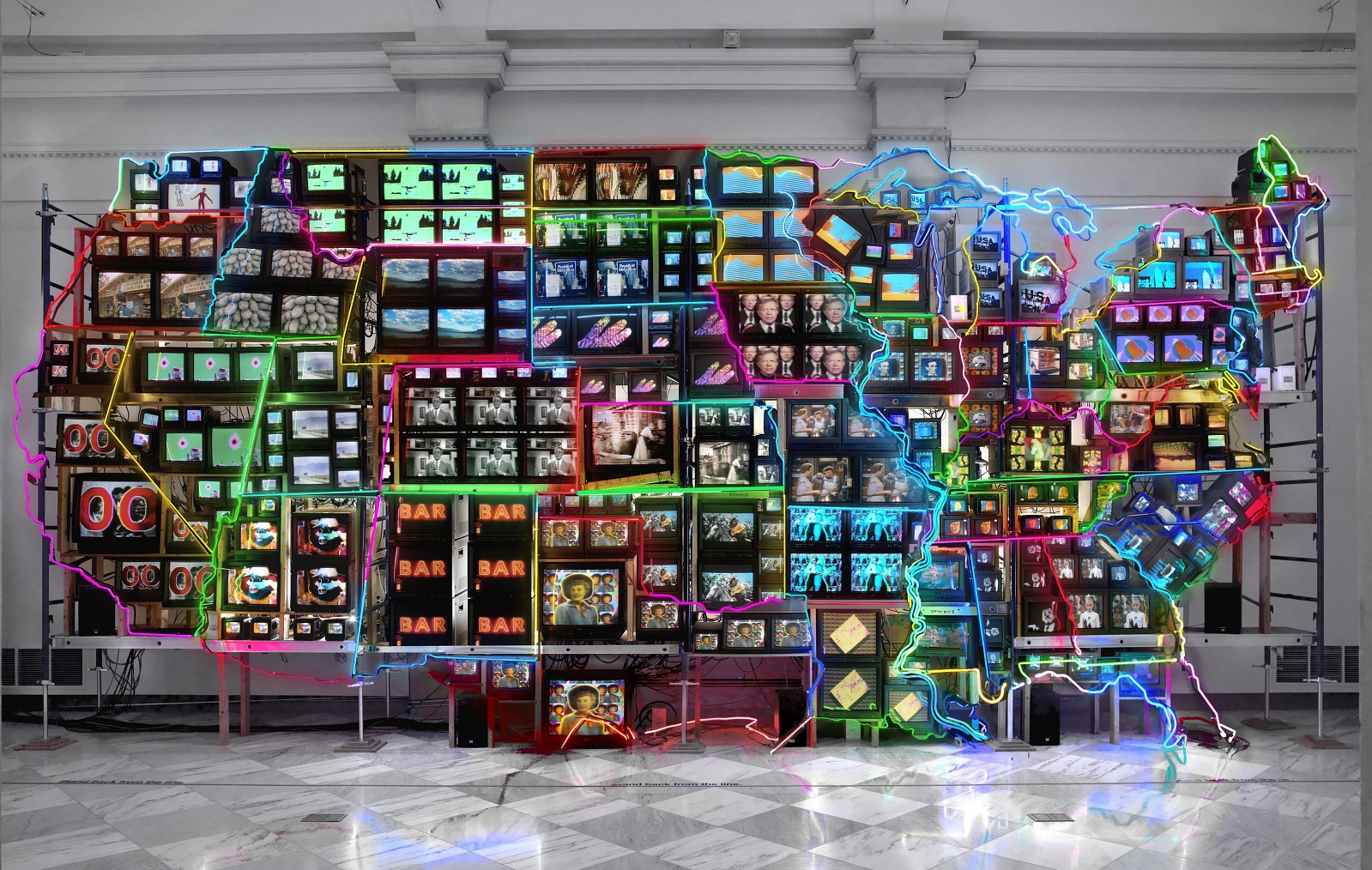
Nam June Paik’s Electronic Superhighway: Continental U.S., Alaska, Hawaii is usually remembered as a dazzling wall of TVs. That description is correct but incomplete. The piece is better understood as an interface model: a national map turned into a channel-routing machine where geography, media memory, and viewer identity are processed in real time.[1][2]
In 1995, that looked visionary. In 2026, it looks diagnostic.
Image note: The header image shows the installation’s neon-outlined U.S. map and monitor-dense surface at the Smithsonian. It is included as a direct visual anchor for the article’s core claim: this work functions less like one image and more like a routed field of competing channels.[1][7]
The work is physically old-school and conceptually network-native
At the Smithsonian American Art Museum, Electronic Superhighway still lands as an object before it lands as an argument: a roughly 40-foot-wide wall map outlined in neon, packed with state-level video channels, with Alaska and Hawaii displaced to the side.[1][2]
The technical specs are not ornamental details. The work’s scale and wiring logic are the point. The installation has been described in museum and scholarship contexts as a multi-channel system with hundreds of monitors, dedicated playback infrastructure, and a closed-circuit camera feed integrated into the map.[1][2][3] You do not "look at one image" here. You negotiate a field of competing signals.
That design decision matters because Paik refuses stable framing. The piece behaves less like a single-screen artwork and more like a civic control room that never fully resolves.
A map of states becomes a map of media stereotypes and collisions
Paik’s state channels are not neutral documentary footage. They are collages of association, memory, cliché, and private signal. Contemporary and archival reporting around the museum installation repeatedly highlights this logic: familiar references for some states, stranger juxtapositions for others, and pacing that often outruns comfortable comprehension.[1][3][4]
The effect is structural, not just playful. A conventional political map promises orientation: clear borders, stable names, manageable overview. Paik keeps the borders, then breaks the promise. Every state boundary lights up, but the content inside each boundary slips between recognition and overload.
That is exactly the sensation of platform-era feeds: legible containers, unstable meaning.
The viewer is not outside the system
One of the work’s sharpest moves is the closed-circuit camera node in Washington, D.C., which lets visitors appear inside the installation.[1][2] The map is no longer only about "America out there." It becomes a live feedback surface that absorbs the spectator.
This is where the piece jumps from media criticism to media architecture. Paik does not simply warn that television shapes perception. He stages a loop where identity is produced inside the signal environment itself.
In contemporary terms, this anticipates the shift from broadcast spectatorship to participatory capture: users are not only audiences but also raw input.
Why the 2006 and 2023 reinstallations matter
The work’s institutional history helps explain why it keeps reading as current. The Smithsonian acquisition and reconstruction process—documented by museum materials and reporting—required significant technical rehabilitation before reinstallation, and the piece has repeatedly re-entered public view through broader gallery redesign cycles.[2][4][5][6]
That repeated reinstallation is not a side story. It is part of the artwork’s meaning in a technology-dependent century.
Unlike static painting conservation, time-based media works must continuously renegotiate obsolete hardware, playback standards, and maintenance labor. Electronic Superhighway therefore operates on two timelines at once:
- The 1995 conceptual timeline (national media-space as infrastructure), and
- The ongoing technical timeline (what must be rebuilt to keep a signal artwork alive).
Put differently: the artwork predicts platform logic, and its own survival demonstrates platform fragility.
Why this still matters in 2026
If you strip away the neon spectacle, Paik gives us four durable propositions.
- Media geography is constructed. Borders do not guarantee coherent narratives.
- Attention is routed, not freely discovered. Multi-channel abundance can narrow understanding as easily as expand it.
- Spectators are part of the circuit. The system reflects and captures its users.
- Infrastructure decides memory. What can be maintained remains visible; what cannot drifts into loss.
This is why the work has aged so well. It does not depend on one historical headline or one obsolete gadget. It models a recurring condition: social meaning assembled from fast, unequal, partially interoperable streams.
In that sense, Electronic Superhighway is not a nostalgic monument to early media art. It is a still-active report on how a country learns to see itself through machines.
Sources
- Smithsonian American Art Museum, Electronic Superhighway: Continental U.S., Alaska, Hawaii (collection record and curatorial text)
- Wikipedia, Electronic Superhighway: Continental U.S., Alaska, Hawaii (work metadata, dimensions, installation history)
- NPR, Exploring the 'Electronic Superhighway' (2006 museum-opening interview transcript)
- Washington City Paper, How the American Art Museum Acquired and Rehabilitated Nam June Paik’s Work (acquisition/reconstruction reporting)
- Washingtonian, The Smithsonian American Art Museum’s Reimagined Modern and Contemporary Galleries Open This Friday (2023 rehang context)
- Smithsonian American Art Museum, Galleries for Modern and Contemporary Art (current gallery framing and collection context)
- Wikimedia Commons, Smithsonian image endpoint used for article visual reference (SAAM object image delivery)