Mary Cassatt is often flattened into a familiar line: “Impressionist painter of mothers and children.” Accurate, but too small. A better profile starts with what she actually built: a new visual grammar for modern looking, where intimacy is not sentimental escape but a site of compositional risk, social observation, and technical invention.
That reframing matters because Cassatt did two difficult things at once. Inside the picture, she made ordinary care work look structurally modern rather than anecdotal. Outside the picture, she helped move French modern art into major U.S. collections through her advising relationships, especially around the Havemeyer circle. If you only keep one fact about Cassatt in view, keep this: she was not just painting a subject; she was designing how an audience learns to see.
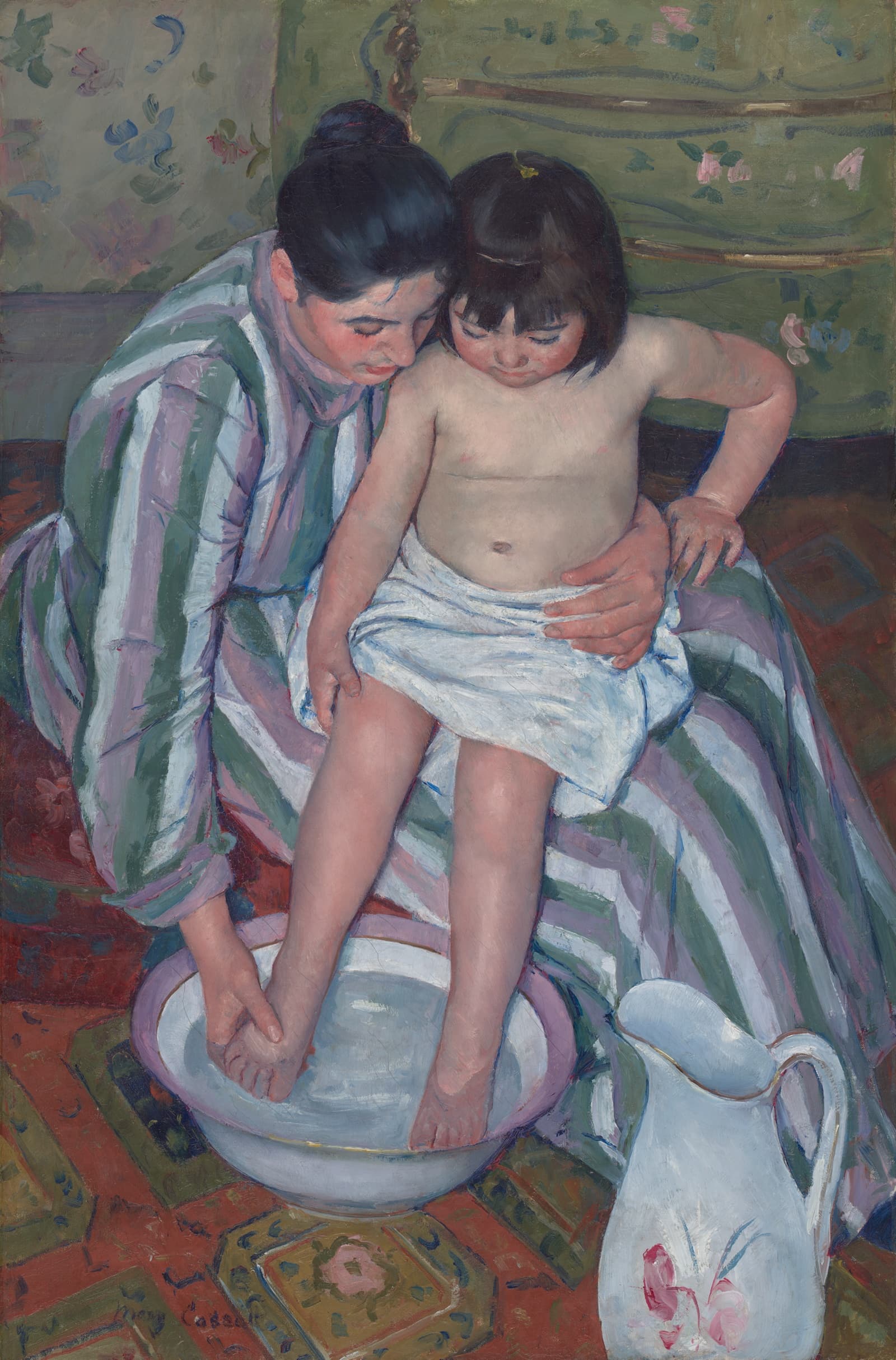
Image context: the cover image reproduces Mary Cassatt’s The Child’s Bath (1893, Art Institute of Chicago), the work discussed in this article as the key formal case study.
Training, relocation, and the price of entry
Cassatt’s career begins with a pragmatic contradiction. She trained at the Pennsylvania Academy of the Fine Arts in the early 1860s, then pushed to continue in Paris because institutional access for women was constrained and studio routes were uneven.[1][5] By the mid-1870s she had settled in Paris, showing at the Salon before entering the Impressionist orbit.
The inflection point is 1877, when Edgar Degas invited her into the independent group that would define Impressionism’s public break with academic norms. Cassatt exhibited with the group in 1879, 1880, 1881, and 1886.[1][5] This is usually told as a biographical milestone, but it also functioned as a method shift: tighter control of cropping, sharper asymmetry, and a more deliberate use of patterned surfaces to organize space.
In other words, Cassatt did not simply adopt Impressionism’s color and brush looseness. She treated the movement as a platform for compositional decisions that made private life legible as modern experience.
Why The Child’s Bath still feels contemporary
If one work concentrates her mature intelligence, it is The Child’s Bath (1893), now at the Art Institute of Chicago.[2][3] The painting is often praised for tenderness, but the deeper achievement is architectural.
- The vantage point drops and tilts, creating an overhead pressure that prevents passive viewing.
- Pattern does structural work: striped dress, floral basin, and carpet motifs interlock into a rhythm rather than decorative background.
- Touch is rendered as choreography: the mother’s grip is protective and practical, while the child’s body twists into the act of being washed.
The result is not a religious Madonna rewrite and not a genre anecdote. It is an image of routine care organized with the same formal seriousness that many contemporaries reserved for public spectacle. That is one reason the work remains a cornerstone in museum teaching collections.[2][3][6]
The print turn after 1890: compression, line, and repeatable modernity
After the major Paris exposure to Japanese prints in 1890, Cassatt developed a sequence of color prints that tightened her handling of line, contour, and flat shape relations.[1][5] This phase is sometimes summarized as “Japonisme influence,” but that shorthand misses the operational change.
In painting, she could model transitions through layered brush handling. In print, she had to commit earlier: edge, interval, and block relationship carry more of the sentence. The shift fed back into her painting logic, making later works more economical and more structurally explicit. Cassatt’s modernity is therefore less about one style label and more about medium-to-medium learning.
Market influence: the artist as collector-bridge
Cassatt’s profile is incomplete without her market role. She advised American collectors on old masters and the French avant-garde, and she was materially important in shaping the Havemeyer collection that later entered the Metropolitan Museum.[1] That influence was not peripheral social activity; it changed what U.S. institutions could show and therefore what U.S. audiences could normalize as serious modern art.
Put plainly: Cassatt did not only produce paintings for history. She also helped build the audience infrastructure that would receive that history.
Why this profile should be updated in 2026
The old reading of Cassatt as “domestic specialist” understates her risk. She repeatedly chose scenes historically dismissed as minor, then rebuilt them through viewpoint stress, pattern logic, and psychological precision until they carried full formal weight. Her best works do not ask for sympathy first; they ask for attention discipline.
That is why she stays current. In a culture saturated with quick image recognition, Cassatt rewards slower visual parsing: where is pressure in the frame, what is doing structural work, how does care become form? Once those questions are active, the paintings stop looking soft and start looking exact.
Sources
- The Metropolitan Museum of Art, “Mary Stevenson Cassatt (1844–1926)”
- Art Institute of Chicago, artwork page, The Child’s Bath (1893)
- Art Institute of Chicago API, artwork record 111442
- The Metropolitan Museum of Art, collection entry, Mother and Child (The Oval Mirror)
- Wikipedia, “Mary Cassatt”
- Wikipedia, “The Child’s Bath”
- The Art Story, “Mary Cassatt Artist Overview and Analysis”
- The Met Collection API, object record 10401