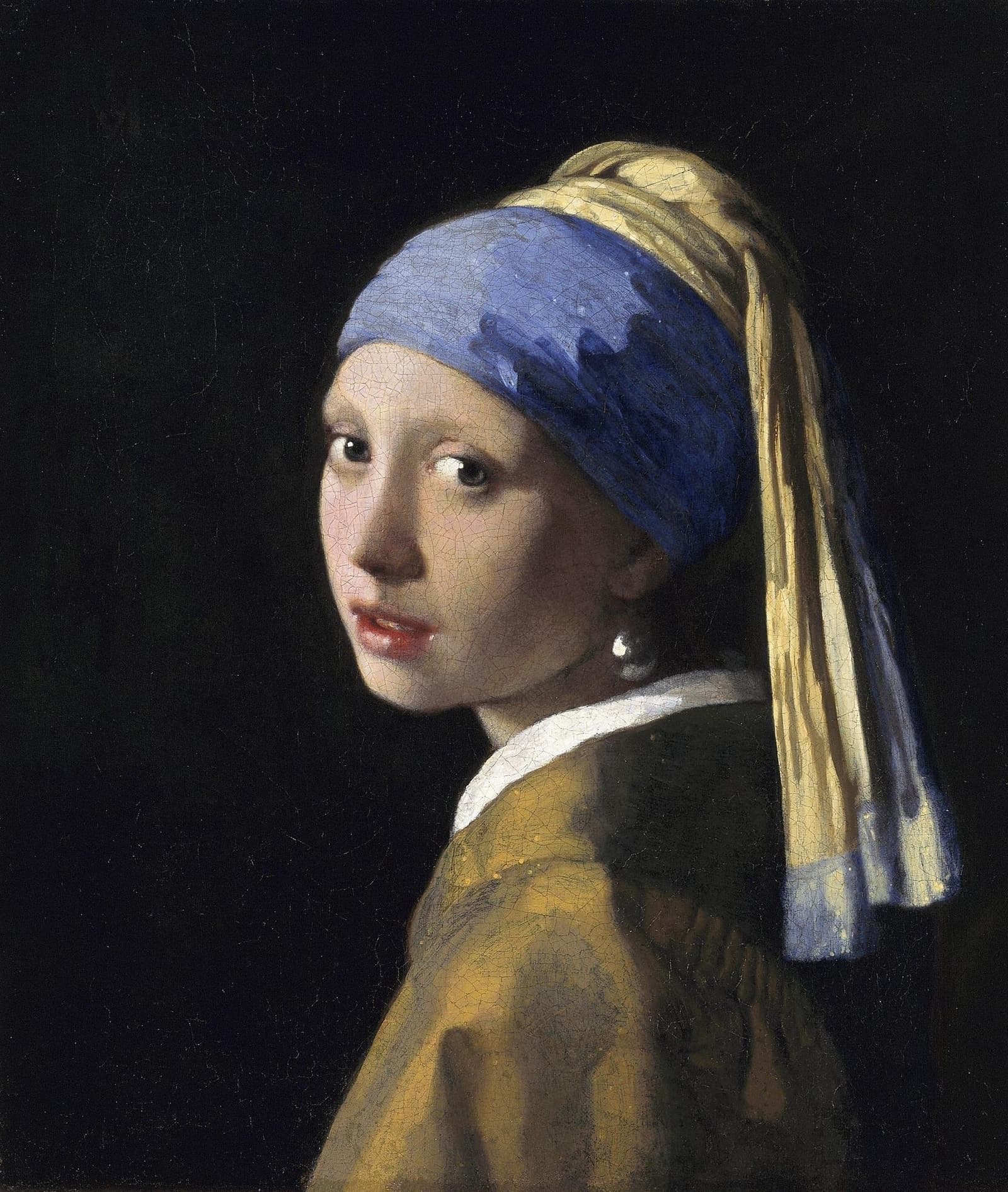
Most viewers remember Girl with a Pearl Earring as expression: the turn of the head, the parted lips, the eye contact. But the 2018 technical re-examination shows that the painting’s emotional force is inseparable from build order and material control.[1][2] Vermeer is not just depicting a face; he is staging when each layer will appear, soften, or flash against the next.
The result is a painting that reads as immediate while being technically slow: prepared in phases, dried between stages, and finished with a few high-risk accents that sit on top like punctuation.[1][3]
The support is simple; the sequence is not
The work (c. 1665, oil on canvas, 44.5 × 39 cm, Mauritshuis) is often discussed as an icon, but the underlying structure is disciplined.[3][4] Cross-section and imaging results indicate a relatively economical stratigraphy in many passages: ground, one or two underlayers, then upper paint.[1][5]
That economy matters. Vermeer did not rely on endlessly reworking thick paint stacks. Instead, he appears to have built a calibrated sequence where underlayers establish light logic early, and upper layers tune surface perception later.[1][5]
Underlayers do the heavy lifting before the "finish"
One of the strongest findings from The Girl in the Spotlight is how much of the modeling work is already solved beneath the visible surface. Multispectral infrared reflectography and microscopy showed dark underlayers and fine preparatory contours; in several zones, these hidden layers establish form and shadow before the final color passages arrive.[5]
In practical terms, this means Vermeer can keep the top layers comparatively economical. Instead of building volume only by piling opaque paint, he lets lower-value structures carry part of the spatial load, then uses upper paint selectively for transitions, skin softness, and focal accents.[1][5][6]
Background strategy: a dark field designed to project the figure forward
Today the background reads as mottled dark grey, but technical studies indicate a different original intention: a black underlayer beneath a translucent dark green glaze, producing a richer and more unified dark space.[7][8] That space was not a passive backdrop. It functioned as a projection surface to push the brightly lit figure toward the viewer.
As glaze chemistry and surface condition changed over time, that dark envelope lost part of its original optical continuity.[7] The painting still works because the compositional contrast remains strong, but the current look should not be mistaken for the exact 17th-century chromatic balance.
Blue and yellow are engineered as an interaction, not isolated color blocks
Technical analysis of the headscarf confirms extensive ultramarine use, plus indigo in mixtures associated with green glazing behavior elsewhere in the work.[3][8] The important point is relational: Vermeer’s blue does not merely "describe fabric." It is positioned to regulate temperature and rhythm against warm flesh and yellow cloth.
This keeps the face from becoming sentimental. The cool blue system and the warm skin/yellow system counterweight each other, so the encounter feels alert rather than sugary. In medium terms, this is less about any single pigment and more about orchestrating adjacent zones with different scattering and transparency behavior.[3][6]
The earring is a tiny masterclass in temporal painting
The earring is often treated as symbolic detail, but the technical description is concrete: a soft counter-reflection and a teardrop highlight applied in thick impasto near the end of the process.[1] In other words, Vermeer saves a high-luminance event for late in the sequence and deposits it on top of already-resolved forms.
That timing is crucial. If everything is resolved with equal intensity from the start, the surface flattens. By delaying these compact highlights, he creates a visual "now" inside a carefully layered "then." The painting’s famous immediacy is produced by chronology.
What this changes in how we read the painting
Three viewing upgrades follow from the technical record:
- Presence is constructed, not mystical. The "alive" effect comes from sequencing decisions—underlayer planning, selective glazing, and final high-contrast marks.[1][5][7]
- Softness is an engineered optical outcome. Flesh transitions depend on layer interactions and scattering behavior, not only hand skill in one visible pass.[6]
- Condition history is part of interpretation. Background and glaze change over time, so present-day tonality includes both Vermeer’s design and material aging.[7][8]
Seen this way, Girl with a Pearl Earring is not just a face that "looks back." It is a tightly managed optical system where preparation, drying time, and last-stage accents are inseparable from meaning.
Sources
- Heritage Science (2020), The Girl in the Spotlight: Vermeer at work, his materials and techniques in Girl with a Pearl Earring
- Link Springer collection intro, The Girl in the Spotlight: A technical re-examination of Vermeer’s Girl with a Pearl Earring
- Heritage Science (2020), Out of the blue: Vermeer’s use of ultramarine in Girl with a Pearl Earring
- Mauritshuis artwork page, Girl with a Pearl Earring
- Heritage Science (2019), Revealing the painterly technique beneath the surface of Vermeer’s Girl with a Pearl Earring using macro- and microscale imaging
- Heritage Science (2019), Beauty is skin deep: the skin tones of Vermeer’s Girl with a Pearl Earring
- Heritage Science (2019), Fading into the background: the dark space surrounding Vermeer’s Girl with a Pearl Earring
- Heritage Science (2019), Mapping the pigment distribution of Vermeer’s Girl with a Pearl Earring
- Wikimedia Commons file record, Girl with a Pearl Earring.jpg
- NICAS project page, The Girl in the Spotlight
Editor’s Pick Review
This piece wins on precision and payoff: it turns conservation science into an unusually readable argument about why the painting still feels alive now. The strongest move is structural—it ties underlayer sequencing, glaze behavior, and late highlight timing into one coherent visual mechanism, then keeps interpretation bounded by technical evidence rather than atmosphere alone.
It also stands out in Chinese translation quality: the prose stays natural and low-jargon, technical English terms are introduced with concise inline glosses where needed, and terminology remains consistent without sliding into translationese. That combination makes the article genuinely bilingual in clarity, not just in coverage.